
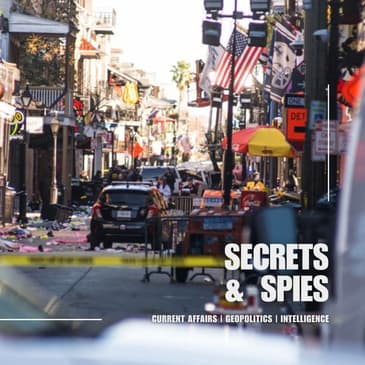
On today’s episode, Matt is joined by another leading counterterrorism researcher, Aaron Zelin. Aaron has spent years studying the global jihadi movement, focusing on the Islamic State and Al-Qaeda. They explore the resurgence of the Islamic State following its territorial defeat in Iraq and Syria in 2017, and the evolving threat the group poses to the United States and other countries—from recent attacks in Iran, Russia, and New Orleans, and the organizational restructuring that’s made them rather resilient. Unpack these critical issues with one of the foremost experts in the field.
Read Aaron’s work for the Washington Institute for Near East Policy: https://www.washingtoninstitute.org/experts/aaron-y-zelin
Read Aaron’s Substack, Jihadology+: https://www.jihadologyplus.com
Read Aaron’s past work for Jihadology: https://jihadology.net
"A Globally Integrated Islamic State" by Aaron Zelin | War on the Rocks
"Remaining, Waiting for Expansion (Again): The Islamic State’s Operations in Iraq and Syria" by Aaron Zelin | The Hudson Institute
Follow Aaron on Twitter/X: https://x.com/azelin
Follow Aaron on Bluesky: https://bsky.app/profile/azelin.bsky.social
Support Secrets and Spies
Become a “Friend of the Podcast” on Patreon for £3/$4: www.patreon.com/SecretsAndSpiesBuy merchandise from our shop: https://www.redbubble.com/shop/ap/60934996
Subscribe to our YouTube page: https://www.youtube.com/channel/UCDVB23lrHr3KFeXq4VU36dg
For more information about the podcast, check out our website: https://secretsandspiespodcast.com
Connect with us on social media
Bluesky: https://bsky.app/profile/secretsandspies.bsky.socialInstagram: https://instagram.com/secretsandspies
Facebook: https://facebook.com/secretsandspies
Spoutible: https://spoutible.com/SecretsAndSpies
Follow Chris and Matt on Bluesky:
https://bsky.app/profile/fultonmatt.bsky.social
https://bsky.app/profile/chriscarrfilm.bsky.social
Secrets and Spies is produced by F & P LTD.
Music by Andrew R. Bird
Secrets and Spies sits at the intersection of intelligence, covert action, real-world espionage, and broader geopolitics in a way that is digestible but serious. Hosted by filmmaker Chris Carr and writer Matt Fulton, each episode unpacks global events through the lens of intelligence and geopolitics, featuring expert insights from former spies, authors, and analysts.
Hosted by Simplecast, an AdsWizz company. See pcm.adswizz.com for information about our collection and use of personal data for advertising.
[00:00:01] Due to the themes of this podcast, listener discretion is advised. Lock your doors, close the blinds, change your passwords. This is Secrets and Spies.
[00:00:26] Secrets and Spies is a podcast that dives into the world of espionage, terrorism, geopolitics, and intrigue. This episode is presented by Matt Fulton and produced by Chris Carr. Hello everyone and welcome back to Secrets and Spies. Today we're joined by another leading counterterrorism researcher, Aaron Zelin. Aaron has spent years studying the global jihadi movement, focusing on the Islamic State and Al Qaeda.
[00:00:51] In this episode, we'll explore the resurgence of the Islamic State following its territorial defeat in Iraq and Syria in 2017, and the evolving threat it poses to the United States and other countries. From recent attacks in Iran, Russia, and New Orleans, and the organizational restructuring that's made them rather resilient, we cover it all. Stay tuned as we unpack these critical issues with one of the foremost experts in the field. Thanks for listening, and I hope you enjoy our conversation.
[00:01:17] The opinions expressed by guests on Secrets and Spies do not necessarily represent those of the producers and sponsors of this podcast. Aaron Zelin, welcome to Secrets and Spies. It's so good to have you on.
[00:01:46] Yeah, thanks for having me. You are a well-known in counterterrorism spaces and have been for years. I'm sure there are plenty of listeners who are well acquainted with you already. For any who aren't, if you could just tell us a bit about you and your work. Yeah, well, thanks again for having me. I'm a senior fellow at the Washington Institute for NERI's policy, also a visiting research scholar at Brandeis University. I founded the website Jihadology.
[00:02:14] And, you know, I focus on the global jihadi movement essentially, anything related to the Islamic State, Al-Qaeda, as well as, you know, groups that maybe aren't global jihad but local jihadis like Taliban in Afghanistan or HTS in Syria. So, just try and cover everything if I can. So, we are here to, yeah, talk about ISIS.
[00:02:35] I wanted to get you on for a while and I said to you when I reached out in my head, it was sort of like, you know, this year, okay, do I want to ask Aaron to talk about HTS in Syria or should we focus on ISIS? And then, of course, recent events of the last week or so sort of kind of made the decision for me. But, yeah, so I wanted to discuss ISIS with you. We've had a range of attacks from them in the last year.
[00:03:04] I just want to go through a few major ones to sort of set the scene and then I'll hand it over to you with a question. Starting in January, a bombing of a memorial service for Qasem Soleimani in Kerman, Iran killed 103 people. In February, twin bombings in Balochistan the day before Pakistan's general elections killed 30. Later that month in Mozambique, ISIS militants murdered at least 26 people and left a note declaring war on Christians in the area.
[00:03:33] In March, an ISIS-linked ambush left 30 Nigerian soldiers dead. The next day, a bank in Kandahar was bombed in Afghanistan, killing another 20 people. Again, the next day after that, four ISIS gunmen from Tajikistan carried out a mass shooting and arson attack at a concert near Moscow, killing 145. Then in June, a church and a synagogue in Russia's Dagestan province were attacked, leaving approximately 30 dead.
[00:04:00] To cap the year off, on New Year's Eve, Shamsuddin Jabbar drove a pickup truck into a crowd on Bourbon Street in New Orleans and killed 14 people before being shot dead by police. Jabbar, a born and raised Texan and army veteran, recorded videos in the hours before his attack, pledging allegiance to ISIS. So those are just a few major ones in the last year.
[00:04:21] And of course, this follows, I think, what was sort of announced to be in sort of a mission accomplished kind of air, you know, following the group's territorial collapse in 2017. They no longer control a so-called caliphate the size of Britain through Iraq and Syria, but they still pose quite a considerable threat.
[00:04:44] So I wanted to discuss that a bit. Following its territorial defeat on the ground, ISIS has undergone significant organizational restructuring. How does this new structure, particularly the role of its general directorate of provinces, which I know you've written a lot about, differ from the more decentralized franchise model of al-Qaeda? And what are the implications of this shift for their operational coherence in global strategy?
[00:05:11] Yeah, it's an important body within the Islamic State to understand, to really get why it's been able to be involved in so many of these external operations in recent years. We saw starting in, you know, with the fall of their territory in Iraq and Syria, that they were reorganizing themselves, where at the time in Iraq and Syria, they had dozens of different provinces internally in those places.
[00:05:36] And they kind of just put them into one Syria province, one Iraq province. And part of that process was that they then created this general director of provinces, which in many ways helped establish more integration amongst its global networks than they had previously. Of course, they announced that they had these external provinces going back to the fall of 2014.
[00:05:59] And they did send operatives to these locations so that they would follow sort of the methodologies of what the Islamic State was doing in Iraq and Syria. And there were some successes, especially in the case of Libya, short-lived though, since they lost the territory there after a year or two.
[00:06:14] But overall, many of these groups more or less still continue to remain remnants of older insurgencies or just didn't have the footing maybe to be able to follow exactly what the Islamic State was trying to do as they had been in Iraq and Syria. And with the general director of provinces, it created this body where you had senior figures from all the provinces now really all connected to one another all the time in constant contact.
[00:06:43] And you also saw movements of recruits and money between the provinces in a way that really hadn't been seen before. And so, you know, one of the key parts of this is that Abdul Qadir Mutman, who's a Somali ISIS leader, became the head of the general director of provinces. In some ways, an important point, because historically, most of the leaders of IS have been Iraqis or Syrians.
[00:07:07] So the fact that somebody in this body, which is essentially a body right under the caliph in the Majlis Al-Shura positions, has the key role of managing the whole network more or less on a day-to-day basis, just because the caliph has to kind of hide. And also is more, you know, symbolic religious leader, political leader, military leader, but not necessarily telling people what to do on a day-to-day basis.
[00:07:31] But because of that, Somalia has become this key node in the broader global IS network in terms of the movement of recruits via Somalia into other parts of Africa or the movement of money because they don't have a ton of fighters within IS in Somalia.
[00:07:49] And so the type of, you know, illicit activity that they're involved with locally, they're able to send that money to other IS provinces, especially the ones in sub-Saharan Africa and Mozambique and in Democratic Republic of Congo.
[00:08:03] And two, beyond just sort of movement of recruits and financial networks, these hubs, especially in Somalia, but also you see in Turkey as well, they're sort of in between the theaters in Africa and Europe, the Caucasus, the Middle East, South Asia.
[00:08:20] And therefore there's these in-between spaces in some regards globally that allows the different spheres of the world to connect to one another in a way that might have been more difficult when you're just considering Iraq and Syria, which are harder to move through in some ways. And that's why Turkey has become this key way station for a lot of these networks as well within the general directorate of provinces.
[00:08:42] I mean, you saw the attacks in Russia. There was also some plots in Germany, as well as some other cases where before people did the attacks or attempted to do a plot that was broken up, they went back to Turkey ahead of time to sort of get final instructions from like a handler. So essentially they have this whole network of people assisting on this front.
[00:09:03] And so while a lot of these plots and attacks that people have talked about in the last year or two being attributed to like the Islamic State's Khurasan province in Afghanistan, ISKP, it's much broader than that when you actually dig down into some of these attacks and plots where you have components of it being funded, say, by IS in Somalia.
[00:09:21] You have recruitment by ISKP online and maybe sending cryptocurrencies online from ISKP folks, but also you have handlers based in Turkey and then informants in other locations as well with fake documentation so people can move through different areas more easily. And a lot of this is being coordinated essentially through this general directorate of provinces. And in many ways, that's why they've been successful in a lot of these attacks as well as just having more plots in general.
[00:09:51] Because you can't just go after one province per se and whack the mole that has happened in the past when we talk about these issues. Like when we saw all those attacks like a decade ago coming from IS in Syria, it was mainly just coming from IS in Syria. Obviously, there are a couple that came from IS in Libya. But for the most part, once they started doing the global campaign against IS in Syria as well as Iraq, once it happened, you stopped really seeing a lot of these plots and attacks.
[00:10:18] Another aspect of this, too, that I think is important and crucial for this is the role of encrypted applications. Obviously, we know governments can break these types of things. But if they don't know who is doing it or who is involved in these types of communications ahead of time, there's no leakage of information. Then it's much more easy for people to communicate in a way that's hidden now than maybe even five to ten years ago as well. Because a decade ago, a lot of, you know, we did see, of course, inspired attacks.
[00:10:47] But a lot of them were also directed from the territories where people would train in the locales of the war zones and then go back home or in a third country to do an attack. Whereas now much of it is continues to be inspired, but also this middle model, the guided model, where they're able to talk to people through encrypted applications and provide instructions, making sure people stick to the plan and things along those lines.
[00:11:12] And that makes it a bit more difficult, too, especially if, you know, law enforcement intelligence isn't aware of the particular, like, you know, people messaging. Because then even if they might be able to crack it, in that case, they wouldn't be able to because they don't know who's involved in it. Who's thought to be their overall leader right now? Um, it's the same guys they announced a few years ago, this Abu Hafs al-Hashimi al-Qurashi. That hasn't changed.
[00:11:35] We still, at least in the public domain, have no idea who that actually is, no idea where he actually is based. I mean, most people assume that he continues to be based in Syria, as the previous IS leaders were the, you know, main other people that were killed in succession to Abu Bakr al-Baghdadi. Um, but they haven't put out any, you know, audio messages from him once, um, which has been interesting as well. And it's now been maybe a couple of years since he took power.
[00:12:03] But yeah, and that's why somebody like Abdul Qadr Muthman has also become so important because people actually know who he is. And he's the one directing a lot of the management. So even if he's not the actual caliph, a lot of power within the organization derives from him because he's managing a lot of these networks. Um, within the broader Islamic State system.
[00:12:24] It's interesting because Baghdadi was such a, in his, in his heyday back, you know, between what, 2014, 2016 was such a kind of, um, public facing figurehead for the organization in this almost sort of, I guess you could say arrogant way. Like, like crowning himself, the caliph in Mosul, the mosque in, in Mosul. Is that, you think, more of a deliberate strategy now to keep their leaders sort of like totally off the front pages, so to speak?
[00:12:53] Um, I mean, I think it's a continuation of what we've seen in the past. It is true that we did see Baghdadi's face and he had the speech at Mosul. But besides that, he only had one other video where he actually was on video. Um, and it was like six months before he was killed, I think in April, 2019, all of the other releases that he did in sort of the nine years he was in charge of the group, you know, was an audio message for him. And, and they weren't that often either. I mean, there may be once or twice a year at most.
[00:13:21] So it's, it's not really different than sort of what we've seen in, in the recent past from the group. Um, similar things happen with a couple of other caliphs that, uh, you know, came into power after Abu Bakr al-Baghdadi was killed. And then before they were killed themselves, of course. Um, and part of it is because they have more of this like legalistic model of leadership where it doesn't really matter who the person is in charge.
[00:13:46] It's really about sort of the ideology and continuing the fight and the path of their worldview and trying to implement it on the ground globally. Um, whereas a, you know, on the other hand, Al Qaeda very much a charismatic model where you'd have all these videos from bin Laden. We'd also have videos from other key ideologues all the time.
[00:14:05] Um, and once many of them were killed, that sort of began the process of them being in terminal decline in many ways, because, you know, Ayman al-Zawahiri never was able to fill that charismatic role that bin Laden had. I mean, he also had other issues too, in terms of strategy and also just people didn't necessarily like his personality. But because of that, you know, for the Islamic State, a lot of it is just about, you know, keeping calm and carrying on for their perspective.
[00:14:33] And it doesn't really matter who the caliph is, so long as there is this caliph figure. People pledge, you know, allegiance and that's that. And they continue to work on their projects. From an organizational standpoint, is that what I think you're describing here, that balance of centralized coordination and regional autonomy, does that expose any vulnerabilities that could be exploited by counterterrorism efforts? Um, I mean, it's a good question. It's, it's, it's hard to say.
[00:14:58] I mean, you know, one of the things people have been curious about over the years is whether because the core or the original core in like Iraq and Syria has gotten weakened, if different groups might try and break away. In the same way, we saw more fractures within Al-Qaeda's networks once Bin Laden was killed, but also the large scale drone campaign against much of the senior leadership in the AFPAC region over the years from like around 2008 to 2012, 2013 time period.
[00:15:25] Um, and so far we really haven't been able to see these cracks in this foundation in the same way. Um, it's important to note though, that even though, you know, there was a split between ISIS and Al-Qaeda now more than a decade ago, uh, most of the OG Al-Qaeda branches remained with Al-Qaeda. So, uh, even if there have been issues within Al-Qaeda, um, and of course you did see the Islamic State as well as HTS break away from them, all of the other main ones have remained with them.
[00:15:52] So it's clear that, you know, there's a lot of discipline, um, and adherence to, um, leadership instructions and messaging by a lot of these groups just because of the way that this worldview is in many respects. So, you know, while there could be a potential for it, there really hasn't been any signs of it at all. ISIS has, uh, strategically expanded into regions like Central Asia, Somalia, Sub-Saharan Africa.
[00:16:18] What makes these regions fertile ground for their operations and how have local dynamics there influenced their strategies? Yeah, I mean, obviously it just, it depends on the particular spaces you're talking about. You know, a lot of the areas say in the Sahara region, like West Africa, they've been able to take advantage of the fact that there have been all these Russian sponsored coups.
[00:16:41] And the Russians mainly have been involved in sort of, you know, protecting the regime, then it really being truly counterterrorism. In the same way we saw in Syria, you know, before the regime fell, where a lot of it was about regime protection than it was against actually going after jihadists. Of course, in this space, you also have Al-Qaeda's main branch there, Jamaat Nusrat al-Islam al-Muslimin or Jainim.
[00:17:05] And both of those groups have been able to take advantage of this because these regimes just do not have the capabilities to take on the jihadists, especially once they're being sponsored with Russia, which is less focused on that aspect of it than, say, when the French and the U.S. were actually providing good intelligence and also not creating massacres that led to more grievances and more people than joining up with either Jainim or ISIS. In Somalia, they've been able to take advantage of primarily being based in one of the autonomous zones in Somalia, in the Puntland regions,
[00:17:35] and therefore farther away from, say, Al-Shabaab, which is Al-Qaeda's branch there in arrival because Al-Shabaab is a much stronger actor. And so they've been able to carve out their own territory and be able to take advantage of that. Interestingly enough, we've seen for the first time that the Puntland regional government's starting to do an offensive against the Islamic State there, which if they were to be successful, obviously a big if, it could severely undermine a lot of ISIS operations,
[00:18:03] not only in Somalia, but also broadly speaking in its global network. Because, as I said, a lot of the power within the general director of provinces is based in Somalia now with Abdul Qadr movement. And the fact that a lot of money moves through it to Turkey, to Afghanistan, as well as on to southern Africa and the DRC and Mozambique regions. And so it'll be interesting to see how that plays out and how that could then not only affect ISIS in Somalia itself,
[00:18:30] but the whole broader network and how they might react to that. But again, that's a big if. And then in terms of, you know, the issue of Central Asians, I mean, a lot of this mobilization isn't really happening within those countries itself. You know, there's this whole thing about like all these Tajiks being involved in a lot of these attacks or plots. It's not really happening within Tajikistan. A lot of this is happening from Tajiks based abroad, whether in Iran, Turkey, Russia, Europe.
[00:18:58] They're, you know, migrant workers. You know, they don't necessarily feel like they're integrated into the societies, but also kind of feel alienated from their home country because of the way that the governments operate there. And therefore, the Islamic State has been able to fill this gap for them and providing this sort of new identity for them and to provide some significance in their life beyond just being like a menial type of worker in some foreign land. And so they've been able to take advantage of that through their recruitment networks,
[00:19:26] especially via the Islamic State's Khorasan province in Afghanistan, by building up this whole network of propaganda in different languages, including in Tajik, in Uzbek, in other, you know, in Russian and other languages to sort of connect these older foreign fighter networks that have been involved in Afghanistan previously, or even remnant ones from Syria that have kind of hung out in Turkey and connecting to these, you know, networks of individuals that have, you know, personal grievances
[00:19:56] and then taking advantage of it. And we've seen the consequences of it now in recent years. It seems like, you know, in the last maybe two or three months of the year, the pace of things started to go down a little bit. I think part of it is that law enforcement intelligence finally started to catch up to this phenomenon that was building over the previous two years or so. But, you know, I think this year in 2025 will really give us an indication of whether that's
[00:20:21] continuing to go down or the last two months of the year or so is just like a blip and it'll remain the same or if it will continue to go up. Yeah, I want to stay with ISIS-K here for a second. So that's their Khorasan province, so Central Asia. They're the group that was responsible for the big Moscow attack in March. U.S. officials have indicated that that's the part of the group that really concerns them, at least for a homeland threat standpoint, I guess.
[00:20:48] Why is that branch so active and seen by officials as a greater threat than the others? I mean, a lot of it has to do with the fact that probably, I don't know, maybe two-thirds or so of the external plots and attacks that we've seen over the last year or two have emanated or been related to ISKP. Though I think it is important to note that we have seen some of these plots have aspects of
[00:21:13] coordination between ISKP and IS in Syria and IS in Turkey and IS in Somalia as well. So even though it's kind of the face of it, they're not the only ones involved in it. And it's interesting because they've actually been degraded within Afghanistan. Like since the U.S. left and the Taliban took over, the amount of attacks in Afghanistan has gone down by 95%. And so it's not necessarily like a day-to-day issue in Afghanistan. And a lot of it goes back to what I said before in terms of them being able to parlay a lot of these
[00:21:41] propaganda communication networks and taking advantage of encrypted applications to recruit people abroad. I mean, you know, we saw last year in 2024 that two of the attack plots that happened that were broken up by, you know, the FBI, local law enforcement, were related to ISKP. And a lot of it has to do with people just being in communication online with these operatives. And that's what makes this more complicated in some ways than in the past, where even if, say, the U.S.,
[00:22:10] for whatever reason, started doing airstrikes in Afghanistan, it wouldn't necessarily stop external operations because you don't necessarily need to be in a particular place to do this type of things now. I mean, somebody could be literally living in, like, Idaho and talking to somebody else somewhere else in the world and tell them to go do an attack and provide them with guidance and instructions, and they can do it. So, like, it makes it that much more complicated in some ways than just if somebody has, like, an address in territorial control.
[00:22:40] Well, it should be caveated that although it is true that many of the IS-related plots and attacks that we saw in the last year were ISKP-related, five other IS provinces were also involved in external operations plots and attacks as well, which is unprecedented. I mean, a decade ago, like I said, it was primarily IS in Syria, a couple things here and there from IS in Libya, but at one time or another, it was usually just one province or so at the time.
[00:23:09] Well, last year, six IS provinces were involved in external operations planning and plotting with IS in Pakistan, IS in Iraq, IS in Syria, Turkey, Somalia, as well as IS in Yemen. If you'll recall, one of the other larger attacks this year was the one in Oman, and that was related – or I should say last year now, 2024 was related to IS in Yemen. And then, of course, there was, like, a small attack at the beginning of 2024 in early January in Turkey as well.
[00:23:38] So while it is crucial definitely to pay attention to ISKP, I also think it's important to identify that it's not just ISKP that's involved in these external operations. And that's why I think understanding the general directorate of provinces is so crucial too because it is this coordination amongst all of them. So while there might be certain faces of provinces for particular plots, there is this coordination amongst them beyond it just being one province in a lot of cases too.
[00:24:03] So the sudden, unexpected fall of Assad's regime in Syria has created a power vacuum, if even temporarily. How likely is it that IS will exploit that vacuum to reestablish a significant foothold? And what would that resurgence look like in – like, what are you expecting, I guess, over the course of the next year or so? Yeah, I mean, thankfully so far, we're almost a month since the fall of the Assad regime.
[00:24:31] We haven't seen the Islamic State being able to take advantage of it. Part of it is due to the fact that the global coalition against ISIS remains based in northeast Syria. And so they've continued to conduct operations against cells in the eastern part of the country as they have been doing the last 10 plus years now.
[00:24:50] But also something that we saw earlier this past fall was that CENTCOM started doing airstrikes in central Syria as well, at the time Assad regime territory, because they were pissed off that the regime and the Russians weren't dealing with ISIS there. Because in many ways, ISIS was stronger in central Syria than they were in eastern Syria.
[00:25:10] But now because the regime is gone, they've been able to unload all the intelligence that they've had in a larger manner and done a bunch of airstrikes, large-scale airstrikes that have killed hundreds of ISIS operatives and broken up training camps. And also one of the forces that the US has been working with has also taken over the central city of Palmyra.
[00:25:30] So they not only have sort of this hub in sort of the northeastern part of the country through the Syrian Democratic Forces, but also through the Syrian Free Army, which was based in the Tanf garrison sort of at the border area between Jordan, Syria and Iraq. Now they've moved into central Syria and Palmyra to try and avert anything from happening. I think that's part of the reason why we really haven't seen anything beyond sort of the trend line that we had been seeing previously with ISIS in Syria.
[00:25:58] And, you know, one of the things that I was looking for was whether we would see spontaneous ISIS attacks during Christmas Eve or on Christmas against minority communities Christians within Syria. We did not see that, thankfully. And then also the potential for attacks on celebrations related to New Year's, New Year's Eve. Unfortunately, we saw something like that in the US, but in Syria we did not. So those are all positive things.
[00:26:20] I still worry that in sort of the few days after the fall of the regime, IS might have moved operatives from central Syria into some cities and set up cells and are waiting to try and do attacks. Thus far, we have not seen this, thankfully. But it is something that I'm looking out for and worrying about potentially. You know, the biggest worry, though, is the fact that there continues to be 9,000 male ISIS prisoners based in northeast Syria run by the SDF.
[00:26:49] And the SDF has been having to fight against the Turkish proxy, the Syrian National Army. And so the worry is if for whatever reason the SDF loses the territory or they have to focus more of their resources on the fight with Turkey's proxies, then there could be greater opportunity that the Islamic State could try and break these people out of prison. We already saw them trying to do this back in two or three years ago now in the Warren prison in Hasakah City. Some people got out.
[00:27:17] Many were found and brought back, but others escaped. And so, you know, when we think about a resurgence for the Islamic State, if it did happen, that's where it would come from. People being released from prison that are hardened individuals that were involved in the creation of sort of that caliphate project 10 years ago. And they would be back out onto the streets, essentially.
[00:27:37] And if people remember, you know, there was the breaking the walls prison break campaign that we saw from the Islamic State back in like 2013-14 time period and lead up to the takeover of Mosul in Iraq. And at most, there was maybe like up to 1,500 people that were let out of prisons then. And we saw the kind of chaos and how ISIS was able to parlay that into victories within Iraq, but then also back into Syria as well.
[00:28:01] We're talking about 9,000 people, and that doesn't even get into all of the women and children that were previously associated with the Islamic State through marriage or through people being born that are based at the IDP camps too. Obviously, they won't necessarily be involved in fighting per se, but it would insist with building back up that sort of state building project too. And so for me, that's still the biggest question mark.
[00:28:26] And I think that, you know, the US and Turkey really need to be careful with this fighting between the two groups that they're both backing because in many ways, it's playing with fire that Turkey continues to back these forces that could totally undermine and destabilize not only Syria, but also Iraq, but also Turkey itself, as well as, you know, global security too. Because we know what emanated from IS in Syria a decade ago.
[00:28:56] These aren't just Iraqis and Syrians in these prisons that were with ISIS either, but also foreigners too, including many people from the West as well. And so I think that, you know, unless there's a long-term solution to this, there's always going to be this, you know, issue in the back of people's mind that could lead to ISIS being able to break these people out.
[00:29:19] And therefore, we're back at square one from, you know, maybe not a decade ago, but from around, you know, 2016, 17 time period, when ISIS was starting to lose its territory. It was more of an insurgency by then. Let's take a quick break and we'll be right back with more.
[00:29:34] We're going to see you next time. We're going to see you next time.
[00:30:09] We're going to see you next time. The platform, the platform we've used before Shopify has used regularly updates, which have sometimes led to that, that the shop didn't work. Ending makes our Nemo Boards shop so that we can also make a good figure on mobile devices. And the illustrations on the boards come now much clearer, what is important to us and what our brand also makes us out.
[00:30:35] Starte dein Testen heute für ein Euro pro Monat auf Shopify.de slash radio. So you've been posting an almost, I think, daily chronicle of HTS, this Islamist confederation of militias that now governs Syria.
[00:30:59] You posted this almost like daily chronicle of their efforts to build a cohesive functioning governance. Really fascinating stuff. I'll post a link to it in the show notes. In the event that, yeah, let's say Turkey intervenes in a more aggressive way or the incoming U.S. administration says, yeah, we're not here for this in Syria anymore. We're packing up and we're going home. Do you think HTS is willing and capable to handle the IS threat there on their own?
[00:31:29] I think they're definitely willing. The question is more whether they have the capacity to do that. When they were only controlling northwest Syria, they took down all the ISIS cells in that region, as well as Al-Qaeda cells for that matter. But again, that was only in a small area of the country. Now they're not only trying to scale everything up related to governance, but also security. And they're also dealing with remnants of the former regime being involved in violence and also trying to undermine the security of the country now.
[00:31:58] And so, you know, one of the questions going forward is what kind of deal can be cut between HTS and SDF so that there's a smooth transition? Because that northeastern part of the country still is outside of the control of HTS. HTS pretty much controls most of the country except for parts of Raqqa, Deirazor, and all of Hasakah region. And so that's one of the biggest questions going forward as well as what that could mean for the global coalition as well. You know, it's hard to say right now.
[00:32:28] There have been discussions between the two of them. But, you know, HTS views itself as the ones that overthrew the regime. They want to have a monopoly on violence in Syria like any government would when they're the ruling entity, essentially. But of course, you know, the SDF, which is majority Kurd, worries about, you know, being able to defend themselves against any threats,
[00:32:50] whether local or outside of Syria, because of the fact that Turkey views the SDF as, you know, a branch of the PKK, which is a foreign terrorist organization by the U.S. government. And it's true that there are elements within the SDF that have been associated with the PKK. But saying the SDF is just a wholly PKK branch is not completely correct. And so there's a lot of complications related to that.
[00:33:16] And while it's true that Turkey has pushed this idea that, you know, they could be the ones in control of fighting ISIS or in control of the prisons and IDP camps or that HTS could do it, it's just very risky proposition since there's no like, you know, history of something along these lines. And I think the U.S. would be uncomfortable in any situation related to that just because it has massive security concerns, not just for Syria, but the global community.
[00:33:43] And putting that on a new government that's trying to consolidate control over so many parts of the country is a tall order. And so, you know, I think that there needs to be some phased transition where that could eventually happen. But in the near term, I think it would be a terrible idea. Obviously, I think we understand that the instincts of Trump and in many ways is to leave Syria, as we saw in his first administration.
[00:34:12] But I think it would be a massive mistake and that there could be monumental security consequences globally for it. And I think it would be regretted at some point, too, if that happened. I think you sort of were touching on this just now. But my next question I wanted to ask, reflecting on the policy decisions of the last three administrations, we'll say, that sort of brought us here.
[00:34:34] Are there any lessons that you think the U.S. and its Western allies should heed to avoid the mistakes that enabled IS's initial rise? I mean, it seems you're very clear that we need to have some sort of presence remaining in Syria for the foreseeable future. Anything else you think big missteps in the past that we should seek to avoid again? You know, I think it's also important to contextualize that, yes, the U.S. is in Syria.
[00:34:57] But we shouldn't be like thinking about this in the context of like the U.S. invading Iraq in 2003 or Afghanistan in 2001. There's only like 900 American troops there and they're not on the front lines fighting. They're providing training assist mostly and ISR more or less. And I think that is important to remember because the way it's sometimes talked about more in the political class as well as those that are like activist types about forever war, quote unquote, type things. Is that everything is the same as the 2003 invasion when there's like this spectrum of military activity.
[00:35:27] If you look at what the U.S. has done in Syria vis-a-vis the campaign against ISIS, it's like the best bang for its buck. In many ways, it's on par with, say, the campaign in the original Gulf War, like when the U.S. saved Kuwait from Iraq, where it was like this is like the pinnacle of the end of the Cold War, essentially. Where this is in many ways the pinnacle of the 9-11 era in many ways. Obviously, I would argue we're in many ways post that era now because of the focus on China, Russia, etc.
[00:35:53] But this is sort of like the perfect example of what probably should have been done after 2001, but it finally happened between 2014 and the present. And therefore, so long as there isn't a stable situation in Syria or there needs to be this transition away from it once HTS and whatever government forms there happens, it's a key to remain there.
[00:36:18] And besides that, I think, you know, continued law enforcement intelligence sharing, I think that that's gotten better and better over the years. It's part of the reason why many of these plots by ISIS have not succeeded recently. Obviously, unfortunately, there was this attack in New Orleans and, you know, there was a stabbing attack in Germany this past summer in Solingen. But overall, within the Western context, at least, ISIS is at a very difficult time actually succeeding in doing attacks.
[00:36:43] They still have been plotting a lot, but they haven't succeeded because of this intelligence sharing and law enforcement coordination amongst many, you know, Western nations. It's important to recall that the U.S. actually warned both Iran and Russia about the attacks that happened last year by ISKP. And if they actually heeded those warnings, it's likely that they wouldn't have actually happened. And I think there might have been a different perception on how we might look at the threat from external operations as well if they didn't occur too.
[00:37:09] So that's an important aspect to think about. And then, you know, special operations too. Like, I think that it's important that, you know, within sort of the government sector that we maintain enough resources in terms of budgets, but also personnel to track these threats because they do take advantage of any seam within any location in society, whether to start a terrorism campaign or an insurgency and then external operations.
[00:37:35] But I think we've kind of figured out, broadly speaking, the best way to manage this issue in terms of alliance building, intelligence, law enforcement, collaboration, sharing, special operations, and then where needed sort of boots on the ground. But boots on the ground in a way that you're not like occupying a country, but more working with local forces to force multiply them in some ways to do this.
[00:37:56] And I think we've gotten overall to a pretty good spot while still trying to also deal with other security threats globally, as I alluded to before with, you know, China, Russia, Iran, North Korea, whatever else. When you ask counterterrorism experts, you know, what leads to someone becoming radicalized, the answer to that is so often just very nebulous and I think subjective to the person that you're talking about.
[00:38:20] So looking at this guy behind the New Orleans attack, born and raised Texan in the military, had a six-figure job working for Deloitte, however, was on his third divorce, I believe, deeply in debt, right?
[00:38:34] So if you look at, I think, on one's road to radicalization, at the point where that radicalization mobilizes itself to violence, the reasons behind that mobilization to violence, I think, often have very little to do with the ideologies that you're claiming to do this for, right?
[00:38:54] Like, if you want to unsubscribe from your life because it's falling apart around you, what better way to, at least in your head, think that there's some sort of greater meaning behind this than to look into your phone on your way to Bourbon Street and pledge allegiance to ISIS? I don't know if you have thoughts on that. Yeah, I mean, there's definitely truth to these statements. He obviously, I think, was looking at Islamic State content and propaganda prior to that, of course, too.
[00:39:20] But, you know, there's this saying from security officials in, like, Belgium, like, back like a decade ago when many people started seeing all this recruitment for ISIS to be foreign fighters, for people to have essentially these lives where they go from, like, zero to a hero. Obviously, this is all in their minds and based off of this worldview of the Islamic State, not necessarily how, obviously, the two of us might look at it.
[00:39:44] But, you know, essentially, it's a way for people to make some level of significance for themselves in their own life and make it seem like they're their own hero in their own story on some level. And you see, like, with this guy in particular, usually a lot of these types of issues happen when there's some problem in somebody's life and they don't necessarily know how to deal with it or pivot. Of course, there's people globally that have problems all the time.
[00:40:13] And that's not why we necessarily see every single person ever getting involved in extremism, radicalism, terrorism, what have you. But, you know, a small subset of people, you know, within psychology, they call this cognitive opening where you're more open to ideas that maybe in a normal situation you wouldn't be. And therefore, they latch on to that to provide this meaning. So you do see this when people, you know, have, like, divorce issues or maybe somebody dies in a family or some level of economic problems.
[00:40:43] Not to say that those are the explanatory reasons why people become jihadists, for example, just because, you know, we see people getting involved from literally all walks of lives. There is no profile for somebody that gets involved with an Islamic State or an Al-Qaeda.
[00:40:59] But when you do have those issues in your life, it could, for some, provide this opening where you're more exposed to or maybe willing to take on ideas that maybe if your life was a bit more stable or you're in a better mental space, you likely wouldn't have potentially taken on. You know, and then there's also sometimes identity issues as well, especially for people that are maybe immigrants in more of like a Western context than say somebody like a Muslim majority context.
[00:41:28] We're just talking about jihadis where, you know, say somebody from like, you know, their parents went from Algeria to France like 30 or 40 years ago. So they grew up in France. They don't necessarily feel completely French because of, you know, the discrimination or maybe potential racism or maybe the way people treat them. But they also don't necessarily feel completely like Algerian anymore either because they didn't grow up in Algeria and therefore are seen a foreigner in their parents' homeland when they might go there as well.
[00:41:56] And therefore, a group like the Islamic State or in the past Al-Qaeda, they're like, well, you don't have to be either of these. You can just be a Muslim. And therefore, you should do this on behalf of God. And that then provides you with this identity where you can strongly latch on to from their perspective that then pursues, you know, the goals and mission of, say, an Islamic State. So there's sort of like that whole aspect of it. And then you add on to that all the ideological reasoning and the ideological reasoning that helps justify and mobilize action in some ways as well.
[00:42:24] So in our current bewildering and often very dumb age of online extremism and deep political polarization, how has the Internet served as both a breeding ground and accelerant for IS-inspired radicalization within the U.S.? Do you think the information environment will make this worse going forward?
[00:42:45] Well, I think that for a time period, it was actually getting better because by 2014, 2015, most technology companies realize that you can't just have unfettered information online because then anybody could be exposed to stuff. And there's also no lines on what's considered legitimate or not or ones that could incite violence or recruit people to violence for that matter.
[00:43:13] However, in the last couple of years, obviously, we've seen that there's sort of been a pushback against this because some people – they don't necessarily view it in the context of like jihadis and terrorism, but more like censorship of more normalized political speech.
[00:43:30] But because of that, there's these consequences then for extremist and terrorist movements where this more libertarian view on things as we've seen since Elon Musk has taken over Twitter slash X and now sort of what we've heard more recently from say Meta slash Facebook and them kind of opening the floodgates again that groups like the Islamic State will be able to take advantage of this even if maybe the reason for why these companies are doing this is their version of a back
[00:44:00] backlash against sort of the woke politics and all of a backlash against sort of the woke politics and all of that type of thing. But you can't like – but just because you're only narrowly focused on that doesn't necessarily mean it's not going to have effects in other parts of the world and other ideologies and other issues. And what we've seen is that Islamic State supporters have once again been able to repopulate platforms, the big platforms like Facebook and X now in a way we really haven't seen since 2015.
[00:44:28] It's not at the same scale as it was a decade ago, so I don't want to like make it a bigger deal than it is. But it's no longer that you don't see them on there and they're not recruiting people or harassing people.
[00:44:42] It's not at the same level, but it's definitely concerning that they're taking advantage of these opening capabilities and there's less of the sort of trust and safety as it's called in the industry within the tech industry related to making sure those types of actors are not able to expose themselves to just random users and therefore potentially lead to more people getting involved in this type of activity.
[00:45:04] Yeah, so we're now a decade out, decade more than that, out from 2014, which is insane to think of. But it feels like it was yesterday.
[00:45:15] Have you seen any signs of like a generation of people who are being exposed to this content online, younger people who perhaps don't have a living memory like we do of the beheadings, the people being set on fire in cages, the Yazidis, you know, being almost driven to extinction? That kind of, you know, don't have that context of like what they're actually getting behind.
[00:45:45] Yeah, I definitely think so. I mean, one of the things that the Islamic State has been able to do in its propaganda is sort of, you know, in the past before that they built this state, a lot of what ISIS and Al Qaeda did was create this, you know, utopian narrative about, you know, the beginnings of Islam and that they needed to go back just to the seventh century. And if they followed that, then everything would be perfect, obviously. But now they don't have to, at least the Islamic State in particular, does it need to rely upon this utopian narrative?
[00:46:14] But now it's just about nostalgia because they can be like, hey, we did this. We restarted the caliphate. We had this thing going. If it wasn't for all these damn apostates and infidels, we'd still be doing this. And they're not going to point to like all this grisly violence, even though, you know, for some people they are into that. And that's part of the reason why they got involved in ISIS, because they're a bit sadistic. But for others, a lot of it, you know, was the state building project in many ways.
[00:46:39] And therefore, they can point to sort of this, you know, aspect of this governance project and to be like, this is what we're doing. Like, we were totally fine. We were living as, quote unquote, Muslims. Muslims and life was good. It wasn't all these outside actors ruining our state, even though, you know, they don't get into the fact that they're literally having a war against everybody in the world, literally. And so you definitely see some of this.
[00:47:05] You know, obviously, I briefly talked about Facebook and Twitter or X in this in some ways more of the U.S. context. But we've also seen them taking advantage of, you know, the algorithm on TikTok, where it's even more viral in some ways because it's like these really short clips and interspersing the, you know, the Anishid, the music in them, and therefore grabbing this even younger audience.
[00:47:28] And that's one of the things that we've actually noticed in the last couple of years, that increasingly people getting arrested for ISIS-related stuff, especially in Western countries. Well, there's definitely people that have gotten involved, you know, that are older. Obviously, this attacker in New Orleans was like 40-something. But on an unprecedented level, we're seeing people from the ages of 12 to 16 getting involved in this type of activity online or potentially trying to plot something, which really wasn't the case a decade ago.
[00:47:54] And that's very worrisome because, you know, these literal kids, they don't know any better. And they also don't even have any context in this. And they probably just, you know, I think it's something that's just fun and silly because they're so young. And, you know, I mean, I'm sure both of us did dumb things when we were kids too. Obviously, it wasn't joining up with ISIS or a jihadist group. I didn't talk to Al-Qaeda in middle school. But for a certain segment of people, this is their dumb mistake.
[00:48:24] Obviously, it sounds absurd saying it. But it is true instead of, you know, like getting involved in, like, you know, drugs or, like, I don't know. You know what I mean? But, like, it's, you know, it's just a reality. And then dealing with that issue from, like, a policy perspective is that much more difficult just because of all the privacy laws related to people under 18. And also, like, what do you do about jailing somebody young?
[00:48:48] And the fact that, you know, while it is true that there's been all these discussions about, you know, having, you know, off ramps and more social services and, like, healthcare workers or, like, you know, mental health professionals involved in type of this stuff. So it doesn't get to a certain level because some of it, so much of it is securitized. But, like, where then, you know, it just gets really complicated when you start talking about, like, a 12, 13, 14-year-old kid getting involved in these types of things.
[00:49:15] It's really, you know, it's definitely a difficult challenge for sure. Just as we wrap up here, as the U.S. juggles multiple global threats, what specific counterterrorism strategies should the military and intelligence community refine or adopt to effectively address IS in its current form? So is it, I mean, yeah, we've talked about the continued footprint in Syria. Is it more of a over-the-horizon JSOC strikes into Central Asia?
[00:49:44] Like, how do we strike a balance between not allowing IS to fester while still being able to address these other more existential geopolitical rivals like Russia and China? I think in many ways, for the most part, there has been some level of rightsizing over the last four or five years or so where it is primarily focused on intelligence sharing and law enforcement locally. It is, you know, drone strikes when necessary.
[00:50:11] You do still have some boots on the ground here and there in places like Syria, but also, you know, in Somalia and some other locations, I imagine, that maybe aren't disclosed publicly. But we also have to understand that there's some limitations and risks to it as well, just because the U.S. can't do this all everywhere necessarily, especially when we're in this era of power competition.
[00:50:33] So, for example, like I was alluding to before with the Russians more or less taking over the quote-unquote counterterrorism space in the Sahel region, West Africa, like the U.S. isn't going to start a war with Russia over counterterrorism in that area. And so, like, even if the U.S. would want to do more in Mali, in Niger, in Burkina Faso, whatever, there's a limitation on what they can actually do. And you have to kind of live with that reality just because the Russians are taking advantage of some of those types of things.
[00:51:03] And then in the case of, say, Afghanistan, like, obviously, you know, people in the U.S. are skeptical of the Taliban, which, you know, makes total sense. But they do get more diplomatic cover by the Chinas of the world. And therefore, if the U.S. wanted to do something like they did right after the Taliban took over with the drone strike against Ayman al-Zawafri and Al-Qaeda, the more time goes on, it's probably likely more difficult to do something along those lines just because China is so invested in Afghanistan now.
[00:51:32] And so, you know, I think a lot of it is making sure the core areas where the U.S. maintains a lot of these presences and fighting capabilities, they don't just seed it in the way that could happen if the U.S. left Syria, for example, but also working at the edges to try and make sure it doesn't spread.
[00:51:52] And it's part of the reason why the U.S. has developed more relations with countries surrounding sort of the Sahara region, more in the Gulf of Guinea, like the Ivory Coast, Benin, Togo, Ghana, Senegal, et cetera, you know, to try and make sure it doesn't continue to spread. Obviously, easier said than done when Russia is making the situation way worse in the way that it's conducting itself in these countries, as well as, you know, the way that the local governments are conducting it, too.
[00:52:19] But overall, you know, if the U.S. can continue to do this and then hopefully maybe showcase down the line that, look, you know, the Russians aren't really actually helping with this. This has actually gotten worse. I mean, the level of violence in the Sahara has gotten four times worse. Maybe the U.S. and France can go back in to help out. And obviously, it would be a lot more difficult now because the jihadi groups are spread out.
[00:52:41] But I think overall, we're in a relatively good space considering the fact that there's also these big elephants in the room of, you know, Russia and China. Anything else you'd like to add or cover that we haven't yet today? I mean, I think the main thing is that although a group like the Islamic State or jihadis in general may be not the top news story anymore, like they were post 9-11 or post ISIS takeover of Iraq and Syria.
[00:53:10] When we have events like what happened in New Orleans, it's not as if these types of actions just come out of nowhere. The group has continued to operate. People saying that they're, quote unquote, defeated is just incorrect. The threat just looks different now than it did 5, 6, 10 years ago.
[00:53:26] And it manifests differently, but they still do have insurgencies in eastern Syria, central Syria, smaller terrorism campaign in Iraq, as well as all of the growing insurgent activity in Africa and then the external operations coming from Afghanistan. And so even if it's not touching people's lives in terms of what they're seeing every day, the Islamic State is still working towards its goals.
[00:53:50] So, you know, if something happens, it's all because this continues to happen globally, even if it's maybe not affecting daily life in the same way that it had been maybe 20 years ago or 10 years ago, for that matter. I guess just to that point, what we were talking about here a second ago, I think in the context of the New Orleans attack, I think the trend of tech companies now very quickly running in the opposite direction on content moderation.
[00:54:19] It's good to keep in mind there are second and third order consequences of those decisions that they, I don't think, intended when they made those decisions. I think that's definitely something to keep an eye on in the next few years. Yeah, especially as things become more encrypted and harder to potentially track.
[00:54:36] So we might see sort of, you know, a tale of this maybe in two to five years where while the insurgencies and things abroad might stay the same or maybe even the Islamic State does worse.
[00:54:50] But in terms of being able to inspire or guide attacks abroad, those could remain higher than what has been, you know, sort of the average previously just because people are able to get access to propaganda or recruiters in a way that maybe was impossible between 2015 to maybe in the last year or so. Aaron, where can listeners find more about you and your work?
[00:55:14] You can follow me on Twitter slash X at a Zellen or on Blue Sky, same username. Of course, I've got both my regular jihadology.net website, which is mainly just propaganda and then jihadology plus, which is more a sub stack. I just want to say you're posting jihadi propaganda on there for to review academically your stuff. You're not saying is propaganda. Yes, exactly. Exactly. Sorry.
[00:55:43] And you also need to like register on jihadology too. It's not like I'm just letting this open to the world. And then, of course, you know, I write with or work for the Washington Institute for Near East Policy. So all my writings are there and, you know, always open for people to contact me. So look forward to seeing people online. Yeah. Well, thank you so much for that and everything today. I would love to have you back on in the near future. If you're down and forth to talk about HTS in Syria, there's a lot to cover there. Yeah, it's a whole nother discussion.
[00:56:12] It's very interesting and complicated. But for somebody that's focused on the group for many of years, it's very interesting, you know, from a research perspective. Yeah. I was talking to Philip Smythe, who we're both friends with, and he was saying to be alive and writing and studying the Middle East right now is really just incredible. Yeah. I mean, you know, what's happening now in many ways is like something that happens, you know, every like two generations or so. It's like a once in 60 year type of thing.
[00:56:41] So it's like the 70s again. So I'm hoping for the best though. So we'll see. Inshallah. Yes. Yes. Inshallah. All right. Well, thank you so much, sir. It's good to have you on. Yeah, definitely. Thanks for having me again.
[00:57:19] Thanks for listening. This is Secrets and Spies.
[00:58:10] Wir sind Teresa und Nemo. Und deshalb sind wir zu Shopify gewechselt. Die Plattform, die wir vor Shopify verwendet haben, hat regelmäßig Updates gebraucht, die teilweise dazu geführt haben, dass der Shop nicht funktioniert hat. Endlich macht unser Nemo Boards Shop dadurch auch auf den Mobilgeräten eine gute Figur. Und die Illustrationen auf den Boards kommen jetzt viel, viel klarer rüber, was uns ja auch wichtig ist und was unsere Marke auch ausmacht. Starte deinen Test noch heute für 1 Euro pro Monat auf shopify.de slash radio.
[00:58:41] Wir sind Teresa und Nemo. Und deshalb sind wir zu Shopify gewechselt. Die Plattform, die wir vor Shopify verwendet haben, hat regelmäßig Updates gebraucht, die teilweise dazu geführt haben, dass der Shop nicht funktioniert hat. Endlich macht unser Nemo Boards Shop dadurch auch auf den Mobilgeräten eine gute Figur. Und die Illustrationen auf den Boards kommen jetzt viel, viel klarer rüber, was uns ja auch wichtig ist und was unsere Marke auch ausmacht. Starte deinen Test noch heute für 1 Euro pro Monat auf shopify.de slash radio.
[00:59:12] Wir sind Teresa und Nemo. Und deshalb sind wir zu Shopify gewechselt. Die Plattform, die wir vor Shopify verwendet haben, hat regelmäßig Updates gebraucht, die teilweise dazu geführt haben, dass der Shop nicht funktioniert hat. Endlich macht unser Nemo Boards Shop dadurch auch auf den Mobilgeräten eine gute Figur. Und die Illustrationen auf den Boards kommen jetzt viel, viel klarer rüber, was uns ja auch wichtig ist und was unsere Marke auch ausmacht. Starte dein Test noch heute für 1 Euro pro Monat auf shopify.de slash radio.