
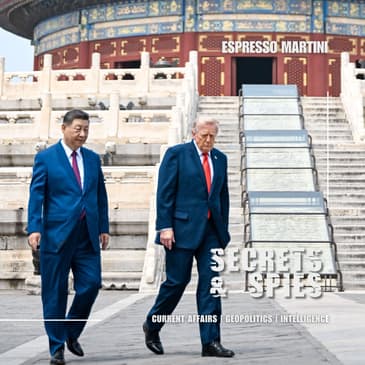
Chris and Matt break down a packed few weeks in intelligence and geopolitics, opening with the resignation of Tulsi Gabbard as Director of National Intelligence — a departure framed officially around her husband's illness but widely read as an exit under pressure. Drawing on a Bulwark piece by former CIA officer John Sipher, they examine whether the ODNI was ever structurally sound enough to survive a politicized occupant, and what Gabbard's tenure — from her reversal on the IC's Iran nuclear assessment to her exclusion from senior meetings — reveals about what this administration actually wants from intelligence. From there, the episode turns to the Trump-Xi summit in Beijing, where the photo-op framing papered over a sharper story: divergent definitions of "constructive strategic stability," a $14 billion arms package for Taiwan left unsigned, and a delegation of American CEOs carrying hat-in-hand business pitches to Washington's principal strategic adversary. They also examine a New York Times investigation into Chinese intelligence's recruitment attempt of a House committee staffer — a case that doubled as a window into Beijing's priorities in the weeks before the summit. Finally, an investigation into Russia's covert cyber warfare training program at a university near Moscow, and a Telegraph profile of Oleg Gordievsky's quiet final years in rural Surrey — including a regular table at a restaurant Chris knows all too well.
Subscribe and share to stay ahead in the world of intelligence, global issues, and current affairs.
Please share this episode using these links
Audio: https://pod.fo/e/422c3b
YouTube: https://youtu.be/DP0ha6QQ394
Support Secrets & Spies
Become a “Friend of the Podcast” on Patreon for £3/$4: https://www.patreon.com/SecretsAndSpies
Buy merchandise from our Redbubble shop: https://www.redbubble.com/shop/ap/60934996
Buy us a coffee: https://buymeacoffee.com/secretsandspies
Subscribe to our YouTube page: https://www.youtube.com/channel/UCDVB23lrHr3KFeXq4VU36dg
For more information about the podcast, check out our website: https://secretsandspiespodcast.com
Articles discussed in today's episode
"Tulsi Gabbard’s Office Shouldn’t Exist" by John Sipher | The Bulwark: https://www.thebulwark.com/p/tulsi-gabbard-office-shouldnt-exist-director-national-intelligence-9-11
"Tulsi Gabbard’s resistance to foreign wars amid Trump’s aggression was her undoing" by Mohamad Bazzi | The Guardian: https://www.theguardian.com/commentisfree/2026/may/24/tulsi-gabbard-foreign-wars-trump
"Tulsi Gabbard is showing why her job shouldn’t exist" by David Ignatius | The Washington Post: https://www.washingtonpost.com/opinions/2026/02/05/tulsi-gabbard-trump-dni-intelligence-agency/
"China and the U.S. Agreed to ‘Strategic Stability’ in Beijing. They Don’t Define It the Same Way." by Zongyuan Zoe Liu | Council on Foreign Relations: https://www.cfr.org/articles/china-and-the-u-s-agreed-to-strategic-stability-in-beijing-they-dont-define-it-the-same-way
"What did Trump and Xi accomplish?" | Atlantic Council: https://www.atlanticcouncil.org/content-series/fastthinking/what-did-trump-and-xi-accomplish/
"He Offered a Lawmaker’s Aide Quick Cash. Was He Spying for China?" by Dustin Volz | The New York Times: https://www.nytimes.com/2026/05/09/us/politics/china-us-spy-congressional-aide.html
"Russia’s top secret spy school teaching hacking and election meddling" by Pjotr Sauer & Shaun Walker | The Guardian: https://www.theguardian.com/world/2026/may/07/revealed-russia-top-secret-spy-school-hacking-western-electoral-interference
"Revealed: The secret suburban life of Britain’s greatest Cold War spy" by Samuel Montgomery | The Telegraph: https://www.telegraph.co.uk/news/2026/05/26/revealed-the-secret-suburban-life-of-britains-greatest-cold/
Connect with us on social media
Bluesky: https://bsky.app/profile/secretsandspies.bsky.social
Instagram: https://instagram.com/secretsandspies
Facebook: https://facebook.com/secretsandspies
Spoutible: https://spoutible.com/SecretsAndSpies
Follow Chris and Matt on Bluesky:
https://bsky.app/profile/chriscarrfilm.bsky.social
https://bsky.app/profile/mattfulton.net
Secrets and Spies is produced by Films & Podcasts LTD: https://filmsandpodcasts.co.uk/
Music by Andrew R. Bird
Photos by Kenny Holston/NYT, Heather Diehl/Getty
Secrets and Spies sits at the intersection of intelligence, covert action, real-world espionage, and broader geopolitics in a way that is digestible but serious. Hosted by filmmaker Chris Carr and writer Matt Fulton, each episode examines the very topics that real intelligence officers and analysts consider on a daily basis through the lens of global events and geopolitics, featuring expert insights from former spies, authors, and journalists.
Hosted by Simplecast, an AdsWizz company. See pcm.adswizz.com for information about our collection and use of personal data for advertising.
[00:00:04] Secrets and Spies presents Espresso Martini with Chris Carr and Matt Fulton.
[00:00:25] Hello everybody and welcome back to Espresso Martini. Now in the UK it is scorching at the moment. It's 28 degrees as we speak. All my windows are closed so I can be in a relatively quiet space and I'm really hot and I have my lights on as well so I thought I'd just put my sunglasses on for a minute just to kind of try and pretend I'm in summer but Matt how are you doing? You're right. I'll just say 28 degrees for you guys goes a lot farther than 28 degrees does for us. Yes, yes.
[00:00:54] But you know we've traded weather for the past week or so it seems. We have. Yeah, you had some, well New York had some bad storms. I don't know what you, what do you have? Do you have some rain and things or? We get the same weather as New York generally. Yeah, it's been, it's been, it's been pretty much raining and cold for like a week straight. Cold for this time of year anyway. But yeah.
[00:01:18] Okay, okay, cool. We're due to have rain I think on Saturday or Sunday and at the moment I'm looking forward to that rain. I think some people are too. But interestingly the government issued a report just about a week ago before this heat wave that they've concluded by 2050 Britain needs to embrace air conditioning. Finally is no one saying it. Yeah, in this house we embrace air conditioning before 2050 but we will see.
[00:01:47] Yeah, just do it. You will be so happy. You will never look back. No one says I really hate that we got air conditioning. I loved it before we had air conditioning. No one says that. No, indeed. So yes, that debate will continue on in my house but there we go. So weather aside, we have an interesting episode today. So we've got Tulsi Gabbard resigns, some information about the China summit, Chinese intelligence trying to recruit political staffers.
[00:02:13] We've also got some details about Russia's secret spy school and a little bit about Oleg Gordievsky and his life in my hometown of Godalming in Surrey. So yeah, that's an interesting little piece there from the Telegraph. So first of all, we're going to kick off with Tulsi Gabbard.
[00:02:31] So yeah, so one of the biggest pieces of news this week in US national security circles was the resignation of Tulsi Gabbard as director of National Intelligence or DNI, which also apparently sounds like we'll do not invite, but we'll get into that later.
[00:02:45] Now, Gabbard was a controversial pick due to her lack of experience at anti-war positioning that often led her towards sort of Kremlin talking points and the political journey that saw her move from the Democratic Party into becoming a prominent figure within Trump's MAGA coalition during his successful 2024 re-election campaign. But there was always an underlying tension in that political alliance.
[00:03:09] Gabbard built much of her public identity around opposition to regime change wars, military intervention, and the Washington foreign policy establishment. While Trump's movement, despite his anti-establishment rhetoric, increasingly relied on nationalistic confrontation, displays of military strength, and loyalty to political power over ideological consistency.
[00:03:32] In many ways, her outsider politics and distrust of the national security system were never naturally compatible with the demands of serving inside such a highly centralized and politically driven administration.
[00:03:43] Former CIA officer and frequent guest of this podcast, John Seifer, wrote an excellent piece in The Bulwark questioning whether the Office of Director of National Intelligence or the ODNI has ultimately become another layer of bureaucracy rather than a solution to America's post-9-11 intelligence coordination problems. The ODNI was created after 9-11 to improve cooperation between America's intelligence agencies following the failures that preceded the attacks.
[00:04:13] But John argues that instead of addressing the deeper cultural and institutional problems inside the intelligence community, Washington effectively added another management structure on top of an already complicated system. One of the key arguments in the piece is that the creation of the DNI weakened the authority of the CIA director without truly replacing it with a clearer or more effective command structure. And according to critics, complicated rather than streamlined the chain of authority.
[00:04:40] John also appears skeptical of Washington's tendency to respond to crises by creating new bureaucracies instead of reforming existing institutions. In this view, the post-9-11 reforms expanded oversight and management structures without fully resolving deeper issues such as inter-agency rivalry, poor information sharing and institutional mistrusts.
[00:05:02] The piece also raises concerns that senior intelligence leaders now spend increasing amounts of time navigating Congress, media scrutiny and White House politics, potentially pulling focus away from intelligence priorities themselves. That concern becomes even sharper when the role of the DNI itself becomes politically controversial, as has happened during Gabbard's tenure. So, yeah, it's quite a very interesting piece and definitely worth a read in light of Tulsi Gabbard's sort of time as DNI.
[00:05:31] And I think, unfortunately, she kind of reflected all the things that were potentially sort of wrong with the office in John's argument. So, Matt, what are your thoughts on all of this? Yeah, well, I think the potential for what could go wrong with her office or having the sort of wrong person in charge of it, you know, his sort of argument, it's a personnel problem and it's also a structural problem that I think he's making.
[00:06:00] But it's, you know, that he says, you know, the ODNI has being only being 20, what, 25 years old now at this point, roughly. So he has no operational culture. Therefore, there's no kind of institutional immune system against the politicization that we've seen more of at times in the past few years, especially in, you know, larger, more established organizations like CIA, NSA, DIA, right? They all have missions.
[00:06:29] ODNI just has a role that's really not that old to begin with, right? I think his best line in his piece in The Bulwark, I think it also offers a sort of a really sharp lesson about the last decade of American politics.
[00:06:50] Overall, he writes that institutions must be designed for the people who may someday occupy them, not only for the people we wish would occupy them. And I think you definitely see that here, you know? Indeed. Yeah, I mean, I remember when we were together when she was announced as DNI and I remember you were not happy. I was back in an Uber. I was not. And many people were not happy and it led to a lot of pieces.
[00:07:19] And I mean, she's been on such a bizarre journey. I mean, so she was in the military herself and she kind of came out of that. Because has she served in Iraq as a, was she a reservist or was she National Guard? I've lost track of what she actually did in the service. I believe she was a reservist. Yeah, yeah. It was one of the two for sure. She was an active duty. Not that, you know, that's a check against you or anything, but it was one of the two. Yeah, yeah.
[00:07:45] She grew quite, you know, against these forever wars as we kind of call them now, which is the war on terror. And I can kind of understand a little bit about where she was coming from initially. But it's sort of she went on this very bizarre kind of political journey. So she ended up becoming a Democrat in Hawaii, didn't she? And she was the, was she, what was her title in Hawaii? She was just a member of Congress. Member of Congress in Hawaii. In Hawaii, yeah. She was the, she was one of the vice chairs of the DNC for a while too.
[00:08:14] Yeah, yeah. That was sort of before she got really controversial and started, you know, pissing inside the tent rather than out. Well, yeah. And I'm trying to work out kind of whether kind of this sort of line between conviction and political opportunism. Because what sort of happened is she sort of started, yeah, spouting off more and more kind of Kremlin talking pieces and things over time.
[00:08:41] So it was during the kind of the end of the Obama years. Like Syrian civil war, like peak Syrian civil war, chemical weapons attacks and everything. That was when she really started to lose it. Yeah, and then she had that 2017 trip to Syria where she met with Assad without the State Department. And, you know, she even cast doubt on evidence that Assad had been using chemical weapons against civilians, which, you know, had been conclusively proven. And then she eventually kind of ends up joining the Trump MAGA train.
[00:09:11] And sort of, again, like Trump sort of attracts a weird set of bedfellows. And she sort of, yeah, just attached herself to him. And I'm trying to work out whether she genuinely actually thought that Trump was the anti-war candidate. And I think that would be really naive and stupid if she genuinely did. Or whether this is all about opportunism and about what she's going to do next.
[00:09:35] Because is she now going to, in time, because her resignation wasn't one where she's turned around and said, oh, I think Trump's terrible, as far as I've seen. She hasn't sort of criticized Trump openly. No, she was at a cabinet meeting yesterday. And Trump gave her a little bit of very, very light, very light compliments in it. She announced that her husband has bone cancer. And that was sort of the official reason. Yeah. Right.
[00:10:05] That's sort of the official reason of why she was leaving to deal with that. And, of course, you know, as this is who these people are, there are a bunch of Trump people that right away came out of the woodwork and being like, yeah, no, she was going to get forced out. And that's, you know, I'm not saying it's an excuse. I don't think you make that kind of an excuse to get out of anything, even her. But, you know, that, yeah, they tried to stick the knife in her back on the way out saying, yeah, no, we were going to fire you. You were sort of forced out.
[00:10:34] But, yeah, because she's been on thin ice for a while because she released that video last year about the Hiroshima bombings kind of outputting it through. It's her personal YouTube. That's it. Yeah. And it just kind of came out of nowhere. And I think it took everybody by surprise. And then it didn't really reflect well on her within the Trump administration. And then famously during the Signal Gate scandal, it came out that she was known as the Do Not Invite. So she was not being included in a lot of important meetings.
[00:11:01] And obviously when the Venezuela raids happened earlier this year in January, you know, she was still, I think, in Hawaii at the time. And it all happened. And it didn't look like she was even in the loop of what was going on. Yeah. So, yeah, it seems like, yeah, so she just seemed a very strange character. And, you know, then she was involved in that weird election stuff just before she did leave, didn't she? Do you remember the strange election count controversy that she sort of reignited?
[00:11:30] Well, let's take a step back there. And I think her whole lifetime of her involvement with the Trump administration, you know, the second Trump administration and the MAGA movement more generally, I think she was always, whether she saw this and saw a good role for her in it or saw it and didn't care or didn't, I don't know. I don't know what's in her head and in her heart. I don't want to, frankly. She was a casting choice.
[00:11:58] You know, she gave the Trump campaign a former Democrat anti-war crusader, I'll say in air quotes, you know, this gloss that was useful for about six weeks of messaging to podcast bros and undecided voters and made a convention speech that, you know, gets headlines at the campaign once.
[00:12:22] And, you know, once that function was served, she was always going to be a bad fit inside an administration that spent its first year bombing seven countries. You know, even without that, I think it would have been a very difficult fit for her. Just culturally, temperamentally, policy-wise aside, you know, it's a weird, it's a weird fit.
[00:12:46] I mean, the words that were coming out of my mouth in the back of that Uber when I saw her name come across my phone that day were, it was along the lines of like, what, what, who, why? Like, like, like, why? The problem is these are not serious people and they're in serious positions. That's the problem.
[00:13:03] And you take a wrecking ball to American institutions since Trump's come back in that I'm deeply concerned at some point sooner rather than later, there's going to be a horrific terrorist attack because people are not communicating properly again. So, in a weird way, we're in a kind of almost a semi-more dysfunctional situation than you were pre-9-11 is what it looks like from the outside. Now, it could be dead wrong there, but it sort of appears that way.
[00:13:30] And it appears at the moment as sort of luck and maybe just the fact that there are still good people in certain roles that's prevented this from happening. Oh, there are. Sure. No doubt. You know, those people are strained. They're stressed. They're getting pulled into a bunch of different cases and threats and environments and stuff, you know, that they're not, they're not specialists to. You know, we went to war with Iran after firing all of the FBI's Hezbollah specialists.
[00:14:01] Good move, wasn't it? Yeah. Yeah. Questionable wisdom there. Yeah. Honestly. I don't know. You know, as far as Iran is concerned with her, you know, she famously had merch that said, no war with Iran, you know, which has been a joke repeatedly in the last, what, three months or so, you know? But, I mean, so last, this was March 2025, right?
[00:14:29] So, over a year ago, it was sort of in the run-up to Midnight Hammer, the first wave of bombing strikes against the Iranian nuclear facilities last summer. Almost a year removed from that now. Time flies.
[00:14:42] But, you know, she held the honest assessment of the intelligence community on Iran's nuclear program that they axed the program back in the early 2000s and they are pursuing a lot of dual-use technologies and they want the option to have a nuclear weapon. But the Supreme Leader at that time had not made the order to go ahead and build one, right? They wanted to walk right up to the line, you know, play footsie with that line, but not cross it.
[00:15:11] They wanted the capability to do so. That was the assessment of the IC and she repeated it accurately to Congress and then she reversed under pressure once she heard it wasn't what her boss wanted. And that, to me, makes her look worse. It does. She knew what the honest assessment was, set it on the record, and then chose to abandon it. And to that point, you asked about, like, the Atlanta stuff.
[00:15:37] Like, how else should we see these sort of, like, domestic side quests, the Atlanta elections raid, the Obama treasonous conspiracy threats, is anything but desperate efforts from someone who knows they're losing the principal's confidence and is throwing anything at the wall.
[00:15:55] I mean, you and I had, our job descriptions gave us as much of a right to oversee an FBI raid on the Fulton County Elections Office as hers. Yeah, that's crazy. That's crazy. Yeah, I think that Iran story with her is also telling for, it shows what this administration actually wants from intelligence. Yeah.
[00:16:21] And I think it's also sort of informs then, okay, what do you do with the ODNI, with her office in that position as a whole? You know, it's not just yes men that they're looking for. It's yes men who will validate, or yes women, I should say, who will validate the fantasies and the grievances, who will, you know, look at this butt-ass naked emperor, look him up and down, and then say without a hint of shame, like,
[00:16:47] aren't you hot wearing all this today, you know, we're in the middle of a heat wave. When you have political loyalty go up against institutional loyalty that institution lost. And I think in her case, that's a loss felt by the entire intelligence community. But I'm shocked that it didn't work out for her. Just so shocked. Well, I'm surprised she lost as long as she did. But there we go.
[00:17:16] It's, yeah, it's because I think in comparison to Trump's first term, I think people are holding on a bit longer. And I've noticed that people leaving, they're making an effort to either basically not get into a personal spat with Trump. And I don't know whether that's by them just not wanting his anger, or whether it's the Trump administration have kind of got some sort of new policy in place to try and minimalize bad press or something.
[00:17:46] I don't know what it is. I think a lot of the figures in the first term who left, they had lives and careers, you know, before him, right? This, these, a lot of these guys are like, this is it, you know? Like, what else is Pete Hegsath or Kash Patel going to do when they're not Secretary of Defense or FBI Director, you know? I don't know. There's also, there's a good, there's a, there's a good discussion here about the future of the DNI and what that looks like.
[00:18:16] Yeah. I mean, what do you think might happen with it all? I mean, under Trump, I think it's probably going to stay as is, isn't it? Or do you think he would exit? Yeah. I don't, I don't think anything, I don't think anything meaningfully is going to change there. You know, I mean, John makes the argument in, in, in his piece in the bulwark, you know, sort of small coordinating office to manage, you know, the budget analytical standards and everything.
[00:18:42] Anything would, would sort of prevent the top of the IC there from being politicized. There's a counter argument that I can see, okay, well, wouldn't sort of a small IC coordination office inside like the National Security Council or the White House or whatever, you know, face the same sort of risk? And, and yes, but in that case, I think the blast radius would be a lot smaller than like
[00:19:08] a DNI, you know, like a politicized NSC directorate screwing with budget coordination is bad. A politicized DNI speaking with authoritatively on behalf of the entire intelligence community is just a different category of a problem. You know, um, the DNI's unique danger is in like laundered politicization of intelligence.
[00:19:32] Like when she speaks, her office carries the weight of, of all 18 intelligence agencies. I think something will, will change with, with the DNI's office. Um, what that is, I don't know, you know, um, John also said there, you know, his, his sort of prescription was abolish the office, but preserve the functions that matter. So, okay. So I think that's the right one.
[00:19:57] I think that's what a lot of people in the community have sort of been wishing for, hoping for, for a while as especially like the centers under the DNI, like Nick Dick, the National Counterterrorism Center and everything just really ballooned way beyond their, uh, uh, the size they were supposed to perform. Yeah. Well, there's been an ongoing argument for years that you guys have too many agencies because is it, you have about 17 different agencies now, um, from 18, 18. So that's a lot.
[00:20:27] Um, and to both be functionally secret and at the same time share information that's pertinent and important. That must be quite a challenge. Yeah. Well, you know, okay. So like what, what role would there be for some sort of an IC coordinating body, right? That isn't controlled by like the, the CIA director as it was before 9-11. So, you know, I can think of a few things like budgetary oversight and, and, and analytic standards. Sure.
[00:20:55] Um, IC wide crisis management, continuity of operations, readiness planning. There's a little known component of ODNI that's responsible for this now. Um, counter proliferation and intelligence too. Uh, both are tasked across a wide collection of IC components in federal law enforcement, right? And that are all also stretched doing other things, right? So those threats get sort of left by the wayside.
[00:21:24] Um, ODNI was supposed to help, help coordinate that and it's never really had the teeth and, and the resources to, to, to make a difference there. Um, I think there's also, you know, I think the IC should some facet of the IC, I think should be doing more with economic security and private sector and academic outreach.
[00:21:50] Um, you know, like there's a massive, there's sort of all massive foreign intelligence targets and the IC so far has largely failed to communicate that in a, in ways that, you know, private sector and academia can actually hear and act on. So there's, there's, there's room to do something different that is effectual and doesn't have,
[00:22:15] you know, the risk of someone like her being the nominal head of the community. Well, yeah, I mean, there needs to be, I mean, isn't this supposed to be what Congress are ensuring and they're not, it's, it should be a role filled by a proper veteran who knows the intelligence community and has some proper background and it shouldn't be allowed to be filled with political, uh, people. It should be a bit like, well, I say it should be like the FBI director, but that's not really worked out well either, has it?
[00:22:44] But what it was like prior to Cash Patel. In the before times, the FBI director was appointed to a 10 year fixed term and would stay on third administrations and would be a career law enforcement official. Some are good, some are bad, but you know, they were all professional people who were beat, who were there, not really, you know, political. Yeah. I think the IC could benefit from something like that a lot. Yeah. And the other thought I had was whether, but I think when I was thinking, I also had a counter
[00:23:14] thought that it probably isn't functional, but you know how you have the gang of eight who kind of oversee important matters as well. Congress. Yeah. Whether you have something similar in that kind of setup, so it's not revolving around one person, but I could see functionally that could become a problem, but I don't know. There at least was that. I'm not sure how like constituted it is much anymore or how much it actually does.
[00:23:39] There's this body called the ICXCOM or the IC, uh, uh, uh, uh, executive committee is basically, you know, the, the directors of all the agencies and stuff, but I don't, I, I, it wasn't, that's not like an operational coordinating body. It's sort of a, yeah. Yeah. Indeed. Well, um, so yeah. So I think, uh, I think we were saying online that the Vienna Inn was probably quite busy last week. Sure was. After this, uh, news. Yeah.
[00:24:09] Yeah. Um, shame I couldn't be there. Yeah. And, and unfortunately I don't think, you know, I don't think she's going to be missed sadly for her anyway, but, um, but I don't think it's the end of Tulsi Gabbard. I'm sure she will reappear in the, uh, the American political scene in some way in the near future. I'm sure. So, uh, She can have a constituency. There's, there's definitely a lane that is sympathetic for, you know, the kind of stuff she's into. Yeah. Yeah. Yeah. Indeed.
[00:24:39] Indeed. So yeah. So has she, I don't know if she's slightly ruined her credibility by attaching herself to Trump or not. And also then, as you were saying, backtracking on certain things that were important that she should have stuck by, but we will see. We will see. Right. So yeah. Well, let's take a break and be right back with more.
[00:25:12] Right. So Matt, you've got, um, you've got some pieces on the U S the recent U S China summit, which is probably the other significant piece in sort of the U S national security circles in the last week. So I'll let you talk to us a bit about that. That's right. So yeah. So first up, we're going to talk about the big, uh, Trump, she summit. So yeah. Uh, two weeks ago, uh, Donald Trump became the first American president to visit Beijing since 2017, uh, during his previous visit, uh, in his first term, he flew home claiming
[00:25:42] he and Xi Jinping had settled quote, a lot of different problems, but the readout suggests otherwise Washington framed the meeting as a package of practical wins, uh, Chinese commitments to buy American agricultural products and Boeing aircraft, new bilateral trade and investment boards, and a joint agreement to describe the relationship as one of quote, constructive strategic stability. Beijing used exactly that phrase too, but it doesn't, but doesn't mean the same thing
[00:26:11] by it for the white house. Stability means managing competition well enough to deliver economic windfalls ahead of the midterms for Beijing is a doctrine rooted in deference to China's core interests and the expectation that the U S will keep competition within limits. Beijing finds acceptable. One side walked away advertising deals. The other walked away advertising a geopolitical framework. They hope will govern the relationship for the foreseeable future.
[00:26:40] Meanwhile, the harder questions on semiconductors, AI export controls, military technology in Taiwan were left entirely outside the room, which brings us to where the consequences get real. U S policy on Taiwan has long been that Washington does not support say in quotes, independence. So careful, limited language that preserves American flexibility and strategic ambiguity.
[00:27:05] Uh, after the summit, China's foreign minister claimed the U S quote, does not support or accept independence except being an addition that really matters there. That's the word to pay attention to. Uh, the administration has not pushed back on it since the Chinese foreign minister said that, uh, Trump also said publicly in an interview that arms sales to Taiwan, are in his words, a very good negotiating chip.
[00:27:31] And that Taiwan should quote, cool it while the $14 billion arms package for the island remains unsigned. Uh, the U S intelligence community's own assessment earlier this year concluded that Beijing currently prefers coercion over military force to achieve its goals on Taiwan. So what the summit may have done is make that coercion a little cheaper to attempt because the credibility of American deterrence just got measurably flimsier.
[00:28:01] So Chris, what'd you think? The six assurances just popped out of my head as you were speaking there. And obviously one of those of the six, well, should I read out the six assurances? Yeah, please. So yeah, let's take a moment to look at what the six assurances are. So the six assurances are kind of like the anchor of U S Taiwan policy since the Reagan administration. And the six assurances we read out here from 1982 and they've been used since.
[00:28:27] So the first one is the United States has not agreed to set a date for ending arms sales to Taiwan. The second one is the United States has not agreed to consult with the PRC, which is the People's Republic of China on arms sales to Taiwan, which is the very point that Trump's now just violated. Then the United States will not play a mediation role between Taipei and Beijing.
[00:28:53] The next point is the United States has not agreed to revise the Taiwan Relations Act. And the next point is the United States has not altered its position regarding sovereignty over Taiwan. And then the final point is the United States will not exert pressure on Taiwan to enter into negotiations with the PRC. So those are the six assurances. So these have been kind of the staples of all the anchor of U S Taiwan policy since Reagan
[00:29:21] and Trump has already walked over the second point. And he sort of, as he claims, he's sort of using the arms sales to Taiwan as a bargaining chip. And it kind of starts to make me ask, well, how does Ukraine feel? Because it's all transactional. Yeah. It's suddenly, you know, we're seeing another pattern here. Everything's transactional.
[00:29:44] And what worries me a bit here, because so despite the summit claiming better top level communication between the United States and China, I think there is still a real risk of the China Taiwan situation flaring up during Trump's time in office. I don't know how likely it is, but it does concern me. And what obviously keeps China currently in check is concerns over a potential U S and NATO response to an invasion Taiwan.
[00:30:12] But the more that Trump makes it less likely the United States will defend Taiwan or even help Taiwan in defending itself, then the greater the risk becomes China may conclude that it has less to lose if it invades Taiwan. And it might conclude that now is the best time to do it rather than maybe Trump's replacement. So time will tell on that one. But I do worry we might see Ukraine-esque situation unfold in the next few years.
[00:30:39] And Trump may be very wish-washy on Taiwan as he's been very wish-washy on Ukraine. And then on Air Force One, again, Trump says some off the cuff comment that completely contradicts what other officials in the administration are saying. And so, again, people like to bring up this madman theory that Trump is sort of trying to deliberately push out this idea. He never know where he's coming from.
[00:31:07] But I'm starting to wonder if even he knows where he's coming from anymore. But we shall see. But the thing with this madman theory, while I don't subscribe to Trump, it just off he Trump often appears uninterested in a deeper historical and strategic detail behind issues. And that sometimes can produce kind of broad unconventional thinking. And sometimes it has. You like with the Abrahamic Accords in his first term and things like that.
[00:31:34] But the problem is occasional innovative positions don't always... They sometimes tend to create new problems to existing issues. And this is what I think Trump does well, is actually create new problems of existing issues. I don't think he resolves existing issues very well. And I don't think we're currently seeing Iran being resolved very well. We're not seeing Ukraine being resolved very well.
[00:31:58] And certainly the Greenland fiasco, which came at a huge cost to American credibility, just to renegotiate an existing agreement. Well, that's also potentially what we're going to get in Iran. Sorry, in Iran. That's potentially what we're going to get in Iran. Oh, yeah, yeah. I think that's exactly where you're heading with Iran. I think what you're going to end up with is, or all of us will end up with, is some sort of deal a bit like what Obama came up with,
[00:32:27] but possibly not even as good as the Obama deal, but at a greater cost. At a much greater cost. Because Obama managed to do this without the drama because he used the office in a way, in a more conventional way, because that conventional wisdom comes from years of experience. Not necessarily on Obama's part, but he respected the office and respected the advice and counsel of more experienced people around him.
[00:32:55] And that's why he didn't kind of constantly, what's the word, see-saw around to different positions. And I just think this whole madman theory is currently being used to excuse just bad behavior on the Trump administration's part and causing more problems than it's worth. And I think that this summit ultimately looks like diplomatic softball,
[00:33:20] because they didn't even really talk about Taiwan or long-term military deterrence in the Indo-Pacific, China's military buildup, cyber warfare, and also US-China rivalry, where that's going. So, yeah, what really did this summit achieve other than a photo op and some sales of planes?
[00:34:08] Yeah. In recent times. However, I think the chances of a Normandy-slash-Ukraine-style invasion of Taiwan by the PLA between now and 2030, I think actually went down since this summit. I hope so. I hope so. Well, I think it went down. That doesn't mean it's going to stay that way. I mean, who knows? I think it went down.
[00:34:38] I think the chances of a very aggressive, sort of coercive gray zone campaign by the Chinese to bring Taiwan back into the fold by means left of launch, whether that's engineering some sort of a political crisis or cyber energy or what have you. I think that went up.
[00:35:00] And I think that's clearly what they would, that's the option that China would certainly prefer rather than having to, you know, fight over inch after inch after inch of this mountainous island that has been fortifying itself for many years. I think she also doesn't have the military that he wants right now to do that.
[00:35:24] I think that also extends to just, you know, the kit, the carriers, the aircraft, the electronic warfare capabilities. I mean, they're getting there quickly. I also think he doesn't have the leadership that he would want to do that. Well, there's been a big turnover, hasn't there, in leadership in the military recently in China? Yeah, there's a lot of, there's a lot of his, his folks that got purged. Sad.
[00:35:49] I mean, so there's, there's a couple of things that could be true here at once, you know, was, is it, I think it's just materially true that we are not able, we would not be able to defend Taiwan and Ireland 5,000 some odd miles away right now, just logistically. And with the drawdown on stockpiles after Iran, we won't be for a good, a good ways still to come. So that's true. Right.
[00:36:17] I think it's also true that this administration would not be keen to, you know, rush into potentially World War Three over that. I think that's true. I think it's also true that China wouldn't be able to pull it off in the window that he's still going to be on the, on the stage, you know? I don't know. There was a lot of, there was a lot of gross.
[00:36:47] I don't know. It's just the whole, the whole, the whole optics of it was, was very, you know, gross. I mean, what sort of, when has a democratic government brought its, its corporate leaders with, you know, hats in their hand to a state visit with its main strategic adversary and call that leverage rather than, you know, thirst, exposure, desperation, you know?
[00:37:10] So in that delegation, we had Elon Musk from Tesla and SpaceX, obviously, Tim Cook from Apple, Larry Fink from BlackRock, Kelly Ortberg from Boeing, Stephen Schwartzman from Blackstone, Brian Sykes from Cargill, Jane Frazier from Citigroup, and Jensen Huang of Nvidia.
[00:37:31] And he's been, he's been trying to sell their most advanced H-200 chips to China for a long time, you know? It's about putting their sort of, their quarterly earnings and their bottom line over U.S. national security, the national security of our allies in, in, in East Asia, in the Indo-Pacific, over American interests. I mean, see, even the whole thing with like, yeah.
[00:38:01] I, I don't know. It's, it's, it's deeply sort of ironic and sad to me to see these CEOs going over there and trying to get all these business deals and stuff with, with people who don't, who don't want a productive relationship, you know? I mean, we'll take Jensen Huang and Nvidia and all the AI chips, for example, okay?
[00:38:28] Like, Chinese policymakers view dependence on U.S. chips or U.S. products as a long-term vulnerability, right? Beijing doesn't want to depend on U.S. chips long-term. They don't want to depend on spare parts from Boeing long-term either. Their strategy is to absorb whatever sort of, you know, capability transfer those sales produces and then build cheaper domestic alternatives for their own markets and to export. Tesla. Right. Exactly.
[00:38:56] And to export to other markets abroad and fuck over our markets, right? That's exactly what they do. So, you know, yeah, it's, it's sort of, I don't know. It's like, it's this, it's this whole thing. It's like, we must do all the joint ventures with these guys. However, any personal electronic devices that you bring into their borders must immediately be shot into the sun because you can never trust it again.
[00:39:25] And these are our super awesome business partners who aren't going to loot our shit immediately. Yeah. You know, it's sort of, I don't know. Is short-term gain over long-term sort of consequences? I think all those people in that room will make money out of it. Yeah. There's always been this sort of like adversary partner, you know, weird frenemy kind of like relationship that we've had. And this, this is sort of in the same kind of vein like that.
[00:39:53] It's, I don't know, it's, it's far more transactional and just like a dollar signs, like right in front of you this time. Right. Like every administration since Nixon has, has had this issue, you know, like Biden ran hundreds of billions in trade with China calling while also calling China sort of like the defining strategic competition of our era.
[00:40:15] Um, I think what's specific to Trump here is, and what is, is that prior administrations at least maintained the pretense of having some sort of, you know, like principle around this relationship rather than just like, let's just make a whole bunch of money here. You know, like a dollar makes us holler. What do you got? Yeah. Yeah. It feels like sadly, yeah. Principles have kind of gone out the window a long time ago.
[00:40:45] I'm not quite sure exactly what year it happened, but, um, the more I reflect on things, like the more we're entering this world where, you know, like human rights and stuff will never be spoken of. Um, you know, the whole Uyghur camps and stuff like that. Um, the cheap labor, the problem, you know, China, everybody, all the businesses and Trump see it as a big market. Um, Hollywood's seen it as a big market.
[00:41:08] Um, there is money to be made there, but as you were saying is what they will do is they will buy those products for a short time and then it'll come out with the exact same product, but cheaper. And then flood your market back. So then there will, so by the end of Trump's term, yes, your economy might suddenly go, Ooh, because suddenly we stole all this stuff to China, but in maybe two, three years, you're going to have a reverse again. It's going to get worse. Uh, because now you've kind of shown China everything. Yeah. There's nothing left. Right.
[00:41:37] And Elon Musk, who I loathe intensely. Um, I remember your interview you did just a few months ago where it was revealed that Elon Musk had been warned by the FBI before a visit. He went, um, on to China and because he ignored that warning because he's a complete, you can fill in the blank there. Um, he, he cost Tesla a lot of money.
[00:41:59] Was that it was that it was a source code for Tesla's autopilot software that got, um, jacked by was the BYD, the, uh, Chinese electric car manufacturer. Because he's a tech bro who thinks he's above everything and, and ignores the FBI. Right. I mean, that's, yeah, I was, I was just going to say that you get into the stratosphere where these guys are and like any sense of kind of like nationality, you know, like, like it's just like the, the name that's printed on your passport. Right. Yeah.
[00:42:30] Yeah. So it's, it's, I don't know. It does. It's such a, yeah. Such a strange time that we're in right now. Um, so. And my, my, my critique here isn't that. Disrelationship shouldn't or couldn't be managed. Right. Or that trade and, and dialogue and communication and exchange, what have you, isn't, isn't necessary.
[00:42:55] Of course they are talking about the two most powerful countries in the world that will probably remain that way for the rest of our lifetimes. Right. So like find a way to deal with it because the alternative is really, really bad. The question to me is whether we're managing it with clear eyes and, and what the other side does with.
[00:43:18] The, all of these concessions and just the short sighted greed, you know, whether the dollar signs are sitting where the strategic security concerns should be. And I think this summit answered that question pretty clearly and I don't think it's good. No, no, indeed. And I think like the human rights questions that always come up are not being addressed. They haven't been addressed for quite some time. There was an inconvenience for most conversations. Yeah. They like, they don't even like discuss it anymore. They're like, yeah, no, fuck you.
[00:43:48] We're not going to talk about it. Go away. Yeah. Yeah. And, and stuff. So it is an interesting time because like, um, there was a time where we used to, I don't know, I don't feel people feel this way that much anymore, but like we used to think that the West was a pretty good place that we had the rule of law, et cetera.
[00:44:07] Um, and yeah, and we don't even sort of export our principles anymore if we ever had them, some may argue, but you know, I like to believe at least the time I grew up in that we principles were still semi-important that rule of law, et cetera. And, um, a fair play, et cetera, was sort of important things. Yeah. Um, and I know Anne Applebaum argues that and talks about how, um, you know, also Terrence don't like democracy and try and make democracies doubt themselves, et cetera.
[00:44:37] But it's, we just got to this point where greed is the currency and, um, yeah, and we are not exporting any, you know, we're not making the world a better place anymore. We just seem to be trying to make money all the time. Um, so it's, yeah, I don't know really what to say. Perhaps it will be on that. So it's like, um, yeah, I, it's, I feel very cynical about it all right now, but, uh, try not to be, but I do feel that way. So yeah. Um, so yeah, but there we go.
[00:45:05] Well, uh, is there anything else you want to add on the summit or? No, we can move on to the next one. No. Well, we have a fun case of, um, espionage coming up or an attempt to espionage. So, um, Chinese intelligence has been trying to recruit political staffers, uh, in the U S, um, and obviously in the UK too, a bit of story focuses on the U S, but tell us a bit about that. Yeah. So, uh, so this, this story we got here, it's, it's, uh, it's another side of the relationship
[00:45:32] and sort of shows what that competition looks like at a much quieter level and how it informs the kind of relationship that you see at the top. Right. So, um, you know, not, not, you know, that, that, that big ceremony dinner flashy stuff in the great hall of the people, um, but in the, in the inbox of a, uh, congressional staffer.
[00:45:58] So of course we're talking about a front page, New York times story came out a couple of weeks ago now, um, about how I'll, I'll, I'll tell it to you. So in December and aid on the house select committee on the Chinese communist party, the panel whose job is investigating threats from Beijing, um, all manner of threats, uh, from, from them, um, got an email. The center called himself Chris Chen, a Singapore based consultant pitching what sounded like
[00:46:26] easy money, $10,000, maybe more for a few phone calls every other week. Sounds good. Not bad, especially for a congressional staffer. And we can, we can get into that, um, in a bit for sure. And I think there's also connections to the, to the house of commons there too. If you want to talk about that some, yeah, $10,000 for a few phone calls every other week. Um, just share some thoughts on the committee's work and us policy towards China, 2000 upfront to get things moving.
[00:46:54] Um, Chen framed it as a three month trial period, which as it happens is exactly how you'd hook someone you intend to keep paying for a very long time. Um, so the aid didn't take the money. Instead, he took it to his bosses on the committee who quickly concluded that Chris Chen was almost certainly not the business consultant he claimed to be, but a Chinese intelligence officer or a contractor for Chinese intelligence fishing for a new recruit.
[00:47:24] So here's where stuff gets interesting. Rather than cut him off, the committee's staff kept Chen on the hook for months, recording the calls to learn what he wanted and how he worked and what he wanted has its own tell. So days after U.S. forces captured Nicholas Maduro, beginning of January, Chen started pressing this staffer on Venezuela, the oil supply chain, because they were afraid they were going to lose it. Yeah.
[00:47:51] Rare earth minerals, manufacturing, shipping to Vietnam and Mexico away from Chinese markets. At one point he asked point blank whether Washington has a quote plan B if Beijing tightens its grip on rare earth. So like the guy's reading out a, a collection requirements list on the phone. Like, do you know about this? Do you know about that? What about this? You know, just going down a shopping list pretty much. Yeah.
[00:48:18] But Chen's cover story fell apart on giving a little bit of scrutiny. Chen's firm, Nimbus Strategic Consulting, has a website still padded with Latin filler text like the lorem ipsum stuff. It sounds familiar. Yeah. I, I, yeah, I was, I've been, I've been thinking that too. I've been thinking that too. Story, yeah. Has an off-air discussion. Uh-huh.
[00:48:42] Um, and, uh, no trace of an office at its listed Hong Kong address. His WhatsApp avatar is a Winnie the Pooh doll, uh, the censored meme used by Hong Kong dissidents to mock President Xi. And in February, OpenAI reported that users matching this same Nimbus hub firm had been using chat GPT to draft exactly these kinds of flattering, urgent recruitment emails prompting
[00:49:10] in mainland Chinese characters, which is also a bit of interesting tradecraft because he, uh, Mr. Chen claimed to be from Hong Kong and they speak Cantonese in Hong Kong, not Mandarin. Um, so recruiting one committee staffer was never going to be Beijing's crown jewel, of course. And in this case, uh, and in this case, the aid cut it off before any money changed hands. Um, but the potential for access there was real.
[00:49:37] I think this is just one case that we know about, and there's a lot more of it going on that we, that we don't, um, that the method used here, uh, even though it's sort of, it's sloppy, it's cheap, it's repeatable at a massive scale. And a lot of people are not going to do that level of due diligence. They're just going to see 10 grand and go, oh, okay, cool. Um, and, uh, it's, it's overall, it's, uh, it's a story that we sort of never really get
[00:50:04] to see this whole approach unfold, um, from start to finish and that it surfaced in the times the week before Trump sat down with Xi, um, is not an accident. Hmm. So Chris, what'd you think? Yeah. Fascinating story. Um, many thoughts on this. I'll just quickly just write off what something you were saying. So, I mean, in MI5 in the UK warned that Chinese espionage was at an industrial scale and especially
[00:50:31] on LinkedIn, um, you know, the Chinese intelligence services have been targeting MPs and their aides. We've had a very famous spy trial that collapsed. So the two people accused, uh, you know, allegedly may have been involved with China, but we don't know for sure because their day in court never happened because the spy trial collapsed. So we will not know for sure. But, um, that was not the only case. MI5 have been monitoring this for some time. Um, and they've been entered into talks with LinkedIn just last year on how LinkedIn can kind
[00:51:01] of clamp down on prolific Chinese espionage activity. And I'll be honest, it's amazing on LinkedIn how many, um, because again, I suppose naturally. LinkedIn's wild, man. It is. I love it, but it's. You do. It's in a weird, in a way, in a way I love it in the sense of I love it because it can get, I can get, from our podcast point of view, it's great to get access to certain people. Yeah, that's good for that. There's some weird stuff you see on there.
[00:51:29] Well, yeah, the thing I hate about LinkedIn, sorry, let's go to LinkedIn chat now. But, um, the thing I hate about LinkedIn is how always the sort of generic LinkedIn story, as I call it, where somebody has some personal experience, which somehow relates to their business. And by the end that they're available for this, that, and the other, and it's sort of become painful. Um, but that aside, so, you know, um, when you do electronic espionage and industrial scale, smaller details, like the language details, like Chris was spelt with a C in one email
[00:51:56] and K with another, the Cantonese, Mandarin. Do you do that? I don't. I don't. No, no. But, um, but I do know there is another Chris Carr out there who spells it K R I S, but it's not me. So, you know, they're out there somewhere, you know? Um, yeah. So it's, I try not to, yeah, sort of shift language and spelling of my name, um, during emails, but I suppose if one's drunk, that might happen, but. I may have to a couple of drinks. I may. Yeah. You never know.
[00:52:26] Um, but back to the kind of the, with this case, I mean, targeting AIDS and other junior, um, and low paid employees with access sensitive material is not new. And in many ways it is makes for good trade craft. So I'll give the Chinese that, you know, they, um, targeted well. Um, the next level of espionage target in most governments is then the middle-aged individual who's either in debt or has been passed up for promotion and is disgruntled. So that's in the tier of people with access to data.
[00:52:56] That's kind of where it goes. Also, you get young people who ideologically be a people like, uh, Chelsea Manning, um, et cetera, people like that who, who, um, ideologically will, um, give up information even though he wasn't spying for another government, but he gave out information to WikiLeaks for ideological reasons. And there are still questions over whether WikiLeaks was connected to, um, Russian intelligence or, or somebody else. Again, allegations, we don't know for sure.
[00:53:22] But there's a lot of suspicion about WikiLeaks and WikiLeaks seems to have disappeared now unless I just don't pay attention to it. I mean, none of it's still around. I think it was part of his, part of, uh, Assange's deal. I don't want to get too off track. I think it was part of Assange's deal with, uh, with the U.S. that he would go back to Australia and, and, and, and shut his mouth. And he has done that to his credit. Yeah, indeed. So, uh, yeah. So I think as a general PSA, if somebody from another country, uh, or anybody, a stranger is offering you cash and saying you'll barely have to lift, lift a finger.
[00:53:53] And you work, you know, and you work in proximity to your country's secrets. Um, then I would be highly suspicious. Um, you know, we've had it famously of honey traps in the past. This is kind of the new version of a honey trap in a way. It's offering money for very little work. Um, so, you know, be careful out there for that. Um, LinkedIn is very easy to connect with people. And, um, and in fact, I've been going through a process recently of going through my connections and actually saying hello and, and finding most of them don't care.
[00:54:21] So it's like, so I seem to have a lot of connections who don't really care. I care. Yeah. I'm connected with you on LinkedIn and I care. Yeah. I think you actually joined it out of my suggestion. I'll be your friend. I did. I did. You were, you, you, you were on my ass and I did. Yeah. So it is quite, I don't know. It has its advantages. It's kind of, to me, LinkedIn is kind of a little bit similar to what Twitter used to be in the, in a slightly good way, but, um, the access to people and stuff, but there we are.
[00:54:48] Chinese intelligence has been, has been sending these pitches through LinkedIn is massive sort of dragnet at just, you know, shotgun blast of messages out, um, a, a crazy high, um, like a shockingly high. Like, I think I want to say like, like, like 11,000 an hour or something I want to say. And LLMs make that possible of course. And wow. And with AR, you can do that even more now. It's insanity, isn't it? Yeah. Yeah.
[00:55:17] If you, if you, you know, get a 3% return on that in a month, you know, chances are there going to be something good here. I, I don't know, given the committee placement, I think maybe this is more targeted, but even if not, you know, it could just be if Mr. Chen was a, was a contractor rather than MSS proper, which a sloppy tradecraft might suggest. I don't know that for sure. Um, we don't, we don't know.
[00:55:44] Um, but you know, I think it's a case of, in this case, he sent a message and picked the wrong one, you know, and it gave a lot of insight into then, uh, um, techniques and stuff. You mentioned earlier about the questions and in espionage, the questions are just as important as the answers, because the questions tell you where focus is, what is of interest, maybe where knowledge gaps are, et cetera.
[00:56:10] Um, and also those questions can reveal depending on if it's quite specific, it could even reveal that somebody somewhere else in, in your government has given up some information. Yes. Um, so yeah, it's, that's the questions are great. Yeah. You look for networks behind these people, um, and then, and then try to learn from that as well. There's also be sure to consider the timing here. You mentioned, you know, the questions and how you can learn a lot about what they're interested in or concerned about based on their questioning.
[00:56:38] It also gives you an opportunity to feed a bunch of bullshit back to them. Yeah. So consider also the time this is post the Maduro, um, capture. We're heading up quickly towards, uh, the summit, um, in, in, in Beijing. And folks may remember the summit was actually rescheduled. The Iran war pushed it back a little bit. So in this timeframe was going to happen a lot sooner.
[00:57:01] And, um, you know, if you have that opportunity, uh, you have the whole Chinese government, you know, trying to brief up to their, to their leadership. Here's how you prep. Here's what we think us policies are. This is what they're willing to do. This is what they're not willing to do. This is what contingencies they have. This is what they don't have. And you use that information to shape the, a, a negotiating posture that is to China's
[00:57:30] maximum advantage. Right. And you can screw that up pretty royally. If all the information or a good chunk of the information, I'm going to say all a good, a decent chunk of that information that they're working off of is all wrong. Yeah, indeed. Yeah. And, um, one other thing that kind of comes up, which is more of a general thing. Um, you know, you take espionage aside for a moment. It's actually quite hard to verify who people are online.
[00:58:00] Um, so it might not be just a foreign spy who might be trying to get ahold of you. It could literally be a dedicated fraudster. And I had a friend recently who, um, luckily didn't get defrauded, but he was very close to it and had a conversation on a phone with somebody who he thought was the real person, but it just turned out that they were using, I don't know, I'm assuming they're using AI technology to fake being this person on the phone. Um, and it, and, and especially when people are abroad and your relationships, it's very hard to verify who people are.
[00:58:30] So like you were talking about earlier about how this website, you know, under scrutiny, um, had a lot of obvious errors on it, but there are some that don't, but then, you know, they had an office address that didn't actually connect to an office, but how many people are going to be able to tell that, you know, if I connect to somebody who's based in Hong Kong, um, yeah, you can do a Google street view, et cetera. Um, but it becomes quite much harder to suddenly verify that person. Right. If, if, if, if you're the New York times, you have a bureau in, in Hong Kong, you can send
[00:58:58] a reporter, which is what happened here up the street to check the building. Who has that? Exactly. Very, very few, very few people have the research to do that. Yeah. Yeah. I mean, that's what we need. A bureau. Yeah, we do. Well, we're covering America, Britain at the moment, but there we go. But yeah. So no, very, very interesting story. And, you know, thank you for bringing that up. Is there anything else you want to add? I think legislative branches in general, we'll say Congress and also, you know, parliament
[00:59:26] too, are soft targets for foreign intelligence. You have staffers who are young, who are naive, who do not come from a national security background or even a background in national politics. Right. If you consider, you know, staffers in a Congress member's office, the quality and caliber of those people are almost entirely chosen by the member or like the members TIFA staff or something.
[00:59:56] Right. You know, very little controls on that. And of course, you know, you can, yeah, if you're, I've been this person, a 22 year old, you know, in DC, 10 grand, even two grand, it's a lot, you know? Yeah. Because how much are these people getting paid? Because living in DC, you're pointing out, is a very expensive place. That it, it varies depending on where you are, but it's, it's, it's not a lot. I mean, it's, yeah, it's, it's tough in, in DC to, to live on that, on that salary.
[01:00:26] Um, you know, it's, um, yeah. Okay. So yeah, these people don't have clearances. Like if you are a staffer in one of the committees, like the one, one of the intelligence committees or armed services or something, yeah, you, you, you have a clearance and everything and you're working out of a skiff underground in the Capitol visitor center or whatever. But if you're just a legislative assistant or whatever, whose member is on the intelligence committee or something, you know, you can still hear, even without a clearance, you can still hear a lot and learn a lot, you know?
[01:00:55] Like when I was, I, I knew a guy who was shacking up in a hotel with like air force colonels and, you know, was of me knowing what would be interesting to ask that person with presented with such a situation, you know, you, you learn a lot and I'm just walking around with that information in my head, you know, or you recruit them when they're young and naive and don't have a clearance. And then you follow them through their career until they actually are someone who matters, who has a clearance.
[01:01:24] You've already developed that relationship. Like the Cambridge five. Yeah. Maybe it's not the case now, but certainly in my twenties, you know, I think again, cause we're in that period where the cold war was over a lot of people for quite some time, I think even up until the war in Ukraine, actually a lot of people just didn't take espionage threats that seriously anymore. A lot of people thought that the, you know, the it's not, espionage is not such a big thing anymore. I've had that many people ask me that over the years when I've talked about this podcast
[01:01:53] and various situations, people go, do people still spy? And I'm like, wreck it out. To me, that's a ridiculous question. But yeah. To ordinary people out there, I guess there's a perfectly valid question. Um, in many respects, I mean, espionage activity is probably through the roof and bigger because some ways technology makes it easier. Yes. Um, and you know, Russia and China have these sort of, um, teams of people who they could, they could throw kind of person power out of that, put it that way.
[01:02:21] Um, and there's, you know, yeah, it's, it's kind of through the roof at the moment. So I hope people do take it seriously, especially when, and I mean, you know, I believe that the FBI do give warning talks to staffers, don't they? Certainly MI5 and someone like that give, give similar talks in the UK, but. You're asking like in, like for members of Congress and stuff? About security and how to be careful. Or for their, for their staff? Yeah. Uh, I didn't, this was a while ago.
[01:02:50] I didn't get any of that. I mean, I think again, if you're, if you're working in a job in Congress where you're dealing with covered information and all that stuff, I mean, yeah, you're gonna, you're gonna go through that. But, but no, um, I never got any of that stuff. I had sort of, I went through mags going through one of the office buildings. And then, cause I had a staff badge, I had full range of the Capitol for the most part. I couldn't get on the committee on the, on the chamber floors, but I had full range of the Capitol.
[01:03:17] Brought a date up into the dome of the Capitol once, you know, like you sort of have, there was more when I was in the house of commons for the summer, I had more sort of like security training and awareness doing that than I did in the house of representatives. Wow. Oh dear. Well, I hope, I hope that's changed, but it probably hasn't. Um, yeah. Is there anything else you want to add to that? Are you happy? No. Great story. Very cool story. Let's take a break and be right back with more.
[01:04:02] Okay. So our next story is kind of, um, you could link it with your China thing. It's all about Russia's top secret spy school that teaches hacking and election meddling. Um, and it's in the Guardian. It's a really interesting piece. And it was, um, you know, basically they did an investigation into what, um, is described as a highly secretive Russian spy school that's allegedly linked to cyber warfare, hacking operations and election interference campaigns, targeting the West.
[01:04:31] Um, and the report centers on the Bauman Moscow State Technical University, which is one of Russia's most prestigious engineering institutions. And it has in particular a covert division reportedly known internally as special training or department four. Um, I quite like it when they call it department four. It's quite an interesting name there. Um, kind of feels like a 1970s TV series department four. It does. It does.
[01:05:00] This week on department four. So according to, uh, leaked documents, uh, reviewed by the Guardian, the program that's run at department four appears deeply intertwined with Russian's military intelligence service, the GRU. And it acts as a recruitment and training pipeline for future cyber operatives. The investigation suggests students were selected through a highly secretive process and trained
[01:05:25] in areas including cyber intrusion, network exploitation, cryptography, information warfare, and operational secrecy. One of the more striking claims is that students were allegedly taught how Western political systems, media ecosystems, and democratic institutions function. Not simply to understand them academically, but to identify vulnerabilities that could be exploited through cyber operations and influence campaigns.
[01:05:53] So just to repeat that, they're training these people to understand how our political systems work, our media ecosystems work, our democratic institutions work, just so they can work out where there are weaknesses so then they can basically enhance their cyber operations and influence campaigns. So please, people, bear that in mind because that's a very interesting point there. Um, the article also links to this broader ecosystem to previous Russian interference operations
[01:06:21] targeting elections and political institutions in Europe and the United States. So rather than treating, rather than treating hacking and disinformation as separate disciplines, the report suggests Russia increasingly sees cyber intrusion, information operations, and psychological influence as part of the same strategic toolkit. So, yeah, very interesting place. A kind of Hogwarts for spies and hackers. Um, you know, yeah, fascinating piece. It smells weird in there.
[01:06:49] Yeah, yeah, it might do. I mean, I don't know if they had the, uh, I suppose Russian equivalent of Dr. Pepper and Cheetos, which apparently is what cyber people live off in the, uh, in the West. But Matt, any thoughts on that? You know, I think if you think about like Russia's cognitive and cyber warfare, their disinformation campaigns and everything has, um, long been its greatest asymmetric asset against the West. You know, um, it's done well.
[01:07:17] I say that objectively, not cheerleading it. Done well. It's done relentlessly and done at a scale that, you know, NATO countries just sort of structurally and culturally are restrained from matching. You know? And I think this sort of shows how they are taking that, this thing that is sort of uniquely theirs, their shtick, they're really good at and trying to institutionalize it across generations. You know? Yeah.
[01:07:47] Yeah. And, and one other thing that came out in the piece actually, um, was about like the ideology behind it all. And, and sort of what I call Putinism, this idea that, that Russia and the West can never get on. Um, yeah. That's the other thing, this sort of that hyper militant nationalism, even like pseudo religious at this point with the Russian Orthodox church being sort of co-opted by Putinism.
[01:08:11] All this stuff that we've seen since 2022, since Ukraine, you're seeing that now like being grafted in, grafted in is like a core component of the curriculum. You know? And I think that just goes to show like, I don't know, Putin could choke to death on a, on his honey cake tomorrow. And like this, that's not going to go away. No, no, no. This is the legacy of Putin basically.
[01:08:37] Um, and, um, so whoever, as you said, whoever replaces Putin will carry on with this because why give it up? Um, unless somehow, you know, uh, Russian American or Russian Western relations change in such a way where, I don't know, we, we, you know, Trump comes up with a deal where if you get rid of that school, we'll give you this. You know? Um, I don't see that happening. But, um, yeah. Yeah. Yeah. I mean, it is fascinating.
[01:09:03] Obviously, this is run by the GIU and the GIU have been connected to, you know, because they do talk about other things too in this article about how, um, it's also kind of connected to assassination training and things like that. So, you know, the GIU, which is Russia's military intelligence division. So it's been connected to assassinations abroad, obviously hacking and disinformation efforts, sabotage. So the GIU is a pretty formidable, um, organization, I think.
[01:09:30] And, um, it's largely when it comes to foreign intelligence, I see the GIU, you know, maybe I'm controversial. This is probably being a little bit more important than the SBR these days. I could be wrong, but it kind of feels like the GIU seem to be at the moment wearing the big boy pants in the Russian intelligence, foreign intelligence sort of, uh, circles, but we will see. Maybe the SBR will call us in next week and, uh, and say, no, that's wrong. Um, yeah. I think we should get, we should, we should get to the Vienna Inn.
[01:09:57] We should, you should invite to the Vienna Inn, um, uh, John Cipher and Sean Westwester and play Fuck, Marry, Kill, GRU, FSB, SVR, go. That'd be a very interesting, uh, conversation. Oh, dear. Yeah. Yeah. So there we go. Yeah. So talk about Russian spies.
[01:10:19] We're now going to talk about just briefly about, you know, one of Britain's most effective spies who was deep in the, uh, in the KGB, Oleg Gordievsky, who famously, um, was smuggled out of Russia in 1985. Um, and, uh, so he turned against his KGB masters in the 60s because he was basically disgusted with the Soviet system.
[01:10:43] Um, and, um, and he ended up, uh, after leaving Russia in such a dramatic fashion, he ended up being moved into my hometown of Godalming in Surrey, um, of all places, which seems the most unlikely place to have a Russian spy. But there we go. Um, and Oleg, uh, so he lived in Godoming from probably the late 80s onwards. I don't know exactly when he ended up in Godoming, but, um, this piece in the telegraph just talks, paints a picture of his life, um, in, in Godoming.
[01:11:11] And it talks a bit about his relationship with his neighbors and how he started out as quite an open and lively man in the 90s and the early 2000s, but then sadly became more withdrawn after the Salisbury poisoning. And then later, as he got a bit older, he ended up living with quote, quote, carers who were more likely to be bodyguards, um, in rather than being carers by at least the way they're described in the article. Um, some of them with Geordie accents and, uh, broken noses apparently.
[01:11:39] Um, and what was interesting to me in this piece was how many places I recognized in my own life, um, are places that were of importance to Oleg in his later life. Um, and if I understand correctly, he celebrated his last birthday at a restaurant I know quite well called the Refractory, um, the Refractory Restaurant in Milford, which is adjacent to Godoming. And I've been there many times over the years on various family occasions.
[01:12:07] Um, and honestly, I found it kind of a little bit sort of touching to hear that that particular place ended up being so important to him. Um, and how he had a particular favorite table, which I believe was table B4. And he enjoyed quiche, which I couldn't find on their menu, by the way. I was looking the other day because I'm that nerdy, but couldn't find it on the menu. So they should bring the quiche back, God damn it. Um, and he had a... Gordievsky quiche. Yeah, the Gordievsky quiche. They should call it that because, um, he was living under an assumed name.
[01:12:36] He was known as Anton Kelsen. Um, that was his assumed name. I even, I had no idea that was his assumed name. I, I, I never found that out. I only knew him as Oleg from the TV, uh, and my brief two chats with him. Um, so yeah, so it was, it was great to, to read about him, you know, loving that restaurant and, um, you know, enjoying quiche with a glass of whiskey. So yeah. And it's sort of both moving and slightly sad to hear that he's celebrated his last birthday there.
[01:13:04] Um, so yeah, so great little piece there. Just gives you an idea of what life is like after being arguably one of the world's most important spies from possibly helping prevent World War III and then ending up in, in small town Surrey. Um, fascinating piece. So yeah. Yeah. It must be a very, it must be a very, uh, jarring change of pace to go from that sort of life and then, you know, defecting, being extracted out.
[01:13:31] And then, you know, you're, you're living in, in rural Surrey. Not a bad place to be, but. No, no. No, no, it's just a, just a weird shifting of gears. You know, it's like, uh, Ray Liotta says at the end of Goodfellas, uh, I, I ordered some spaghetti with marinara sauce and I got egg noodles with ketchup, you know, where it goes into WITSEC. So. This is it. Yeah. You know, you go from, you know, having meetings with the president and the prime minister and
[01:13:58] so on and, you know, meeting chiefs of intelligence one year to then, you know, um, slowly over time becoming, you know, it's cruel to say it, but a little bit, his knowledge became out of date, you know? Um, and so he could only give so much insight. Um, I, I believe he would give training to young, um, MI6 officers from time to time, um, you know, about how the Russian intelligence services historically worked, et cetera.
[01:14:24] But, uh, yeah, I, I, I don't know kind of what a former defector does after a while. It must be, um, he did write some books and things and would write articles and so on. And I think he, I believe he even had a friendship with Alexander Litvinenko from what I've read. I, I don't know much about that, but, um, yeah, it's, yeah, I'm sure he kept his finger on the pulse best way he could. I know Sergei Skrippel before he was poisoned, I believe was in, um, I believe he went to,
[01:14:54] um, brief the Spanish intelligence services about the GIU and the Russian mafia. I think that might be what it was that got him on the list to be poisoned. But, um, yeah, yeah. But, uh, that was something I read a while back now, but, um, yeah. So there it says, who knows, but I don't, um, yeah, I don't know how high up on the list though, like was, but I guess symbolically he was probably Russia's equivalent of Kim
[01:15:20] Philby, I suppose, but yeah, maybe, you know, I think, I think they don't really make a distinction if you, or if they see you as a trader, you're on their list and you're not getting off. Yeah. Yeah. Indeed. So, uh, yeah. So, um, I think that is it. So I think at some point in the next few weeks, I'll be making a visit to the refractory and ask them why they're no longer serving quiche, ordering a glass of whiskey, seeing if I can get table B4 and have a toast to Oleg.
[01:15:50] Yeah. Yeah. Anyway, well, everybody have a wonderful weekend. Um, hopefully it's not too hot for you, um, and, uh, doesn't get too rainy depending on where you are, but, uh, have a lovely weekend and, um, we will catch you on the next episode. Take care for now. Bye.
[01:16:20] Thanks for listening. This is Secrets and Spies.