
The U.S. Constitution gives Congress the power to declare war. Congress hasn't formally done so since 1942. Brian Finucane, a former State Department lawyer and current senior adviser at the International Crisis Group, joins Matt to make sense of how that happened — and what it means now that the United States is at war with Iran. Brian has spent years arguing, across administrations of both parties, that executive branch war-making has drifted dangerously far from its constitutional moorings. Operation Epic Fury, he contends, is the most consequential test of that argument yet.
Subscribe and share to stay ahead in the world of intelligence, global issues, and current affairs.
Follow Brian on Bluesky: https://bsky.app/profile/bcfinucane.bsky.social
Connect with Brian on LinkedIn: https://www.linkedin.com/in/brian-finucane-15a5652b
Please share this episode using these links
Audio: https://pod.fo/e/41d13c YouTube: https://youtu.be/TUYI1DqO-CAFurther reading
"What the Iran War Reveals About the War Powers Resolution and How Congress Can Act" by Tess Bridgeman & Brian Finucane | Just Security: https://www.justsecurity.org/137977/iran-hostilities-war-powers-restart-clock/ "On the State Department Memorandum 'Operation Epic Fury and International Law’" by Brian Finucane | Just Security: https://www.justsecurity.org/137097/state-department-epic-fury-international-law/ "An Unserious Justification for an Unnecessary War: Assessing the U.S. 'Article 51’ Letter to U.N. on Iran War" by Brian Finucane | Just Security: https://www.justsecurity.org/134290/us-article-51-letter-united-nations/ "Senate Votes to Take Up Measure to Force Trump to End Iran War" by Megan Mineiro | The New York Times: https://www.nytimes.com/2026/05/19/us/politics/senate-iran-war-authorization.html "Bending the Guardrails: U.S. War Powers after 7 October" by Brian Finucane | International Crisis Group: https://www.crisisgroup.org/rpt/united-states/009-bending-guardrails-us-war-powers-after-7-octoberSupport Secrets and Spies
Become a “Friend of the Podcast” on Patreon for £3/$4: https://www.patreon.com/SecretsAndSpies Buy merchandise from our shop: https://www.redbubble.com/shop/ap/60934996 Buy us a coffee: https://buymeacoffee.com/secretsandspies Subscribe to our YouTube page: https://www.youtube.com/channel/UCDVB23lrHr3KFeXq4VU36dg For more information about the podcast, check out our website: https://secretsandspiespodcast.comConnect with us on social media
Bluesky: https://bsky.app/profile/secretsandspies.bsky.social Instagram: https://instagram.com/secretsandspies Facebook: https://facebook.com/secretsandspies Spoutible: https://spoutible.com/SecretsAndSpiesFollow Chris and Matt on Bluesky:
https://bsky.app/profile/chriscarrfilm.bsky.social
https://bsky.app/profile/mattfulton.net
Secrets and Spies is produced by Films & Podcasts LTD: https://filmsandpodcasts.co.uk/
Music by Andrew R. Bird
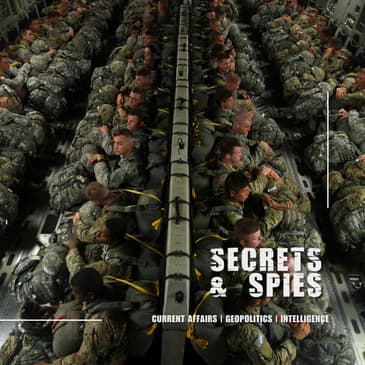
USAF photo by Staff Sgt. Sandra Welch
#IranWar #USWarPowers #NationalSecurity
Hosted by Simplecast, an AdsWizz company. See pcm.adswizz.com for information about our collection and use of personal data for advertising.
[00:00:01] Due to the themes of this podcast, listener discretion is advised. Lock your doors, close the blinds, change your passwords. This is Secrets and Spies.
[00:00:26] Secrets and Spies is a podcast that dives into the world of espionage, terrorism, geopolitics, and intrigue. This episode is presented by Matt Fulton and produced by Chris Carr. Hello everyone and welcome back to Secrets and Spies. This week, I'm joined by Brian Finucane, Senior Advisor at the International Crisis Group. Before joining Crisis Group in 2021, Brian spent over a decade in the Office of the Legal Advisor at the State Department.
[00:00:52] That's the office that develops and defends the U.S. government's positions on war powers, the use of military force, and the law of war. Brian's argument, drawn from his years inside government and the critiques he's published in Sleaving is this. Across administrations of both parties, the executive branch has quietly built a body of legal doctrine, never endorsed by Congress or the courts, that allows the president to use military force more or less on his own say-so.
[00:01:18] The war President Trump launched against Iran on February 28th is the most dramatic example to date, but it didn't come from nowhere. It's the culmination of a 50-year pattern of congressional abdication and executive overreach that runs straight through Republican and Democratic administrations alike. We talk about what it's actually like inside the office where these arguments get made.
[00:01:39] We trace the long bipartisan drift from the Bush administration's 2001 authorization for force against Al-Qaeda to Libya in 2011 to the boat strikes in the Caribbean to the war we're in now with Iran. We get into the specific legal dodges the White House is using to justify continuing the war past the 60-day deadline, and we talk about what realistic accountability looks like from here, including what this week's action in the Senate actually signals. Thanks for listening. Thanks for watching. Take care.
[00:02:09] The opinions expressed by guests on Secrets and Spies do not necessarily represent those of the producers and sponsors of this podcast. Brian Finucane, welcome to Secrets and Spies. Really great to have you on finally. Good to join you.
[00:02:37] Yeah. So I've been following your commentary and expertise on Blue Sky for a while. So when the idea came up, you know, we should tackle war powers and do it like the right way. You were, you know, the first person that came to mind. So really glad to have you here now. Before we get into that issue of war powers, Iran and where we are today, I wanted to start with your background.
[00:03:00] So you previously spent over a decade in the Office of the Legal Advisor at the State Department. It's a body that helps shape and defend the legal positions you now spend a fair amount of time critiquing. Take us inside that office at State. What did your work actually look like on a day-to-day basis, particularly when it came to questions about the use of military force? So the Office of Legal Advisor is the General Counsel's Office of the U.S. Department of State.
[00:03:27] And it provides legal advice on all the sorts of operations that the Department of State undertakes, ranging from issuing passports and visas to acquiring, you know, property overseas for embassies and consulates, to advising diplomatic law and consular affairs in the United States. But also things like arms sales, decisions to use military force. And for much of the decade or so that I was at the State Department,
[00:03:56] I worked in an office that advised the State Department and the executive branch more generally, including the White House, on issues relating to the use of military force under both international and U.S. domestic law, the law of war and counterterrorism operations. There was no, you know, typical day. Depending on what sort of operations were going on in the world,
[00:04:20] it could be a fairly intensive and high-tempo work schedule, long hours. I found it immensely satisfying and learned a lot in the process and had brilliant colleagues. But, yes, it provided the background and the grounding for the work that I do now,
[00:04:45] outside where I'm now at International Crisis Group, having joined that organization going back in the summer of 2021. Yeah. How often in that job did you find yourself having to tell policymakers no versus weighing when to sort of find the legal architecture that would let them do what they'd already decided to do? You know, it's a continuous tension within the executive branch, lawyering.
[00:05:10] You know, one of the challenges, I think, is that lawyers are not always brought in at the front end. And the question is, for lawyers, you know, to what extent you're going to try to make yourself a place at the table so you can advise before decisions are made rather than trying to lawyer after the fact. You know, it should be in the interest of an administration if it wants to comply with the U.S. Constitution, comply with U.S. laws, comply with its treaty obligations to ensure that it's getting the best legal advice possible at the front end,
[00:05:39] rather than simply relying on lawyers at the back end to put legal lipstick on the use of force pig. And so you left state in about 2021, as you said, and you've since been, you know, arguing that the executive branch's legal doctrine on war powers has become extremely permissive. Was there a particular moment or set of moments when you started to feel that the legal framework you've been operating inside had drifted too far from where it should be?
[00:06:04] Well, you know, I think if you look at the text of the Constitution, if you look at the debates over the Constitution, if you look at the early case law from the U.S. Supreme Court, and then you compare that to the executive branch legal doctrine that's been sketched out, particularly since World War II, there's a real disconnect between the two. Obviously, the text of the Constitution gives to Congress the power to declare war and related to war authorities.
[00:06:33] And Article II of the Constitution makes the president the commander-in-chief, but does not give him the power to initiate war. It was understood by the framers of the Constitution and later affirmed by the Supreme Court that the president would have the power to repel a sudden attack upon the country, but he would not have the authority to launch offensive military operations. But despite that sort of original constitutional understanding, the executive branch has written a series of legal opinions that constitute permission slips for the president to undertake military adventures overseas.
[00:07:03] without first getting authorization from Congress. Yeah. Thomas Jefferson called Congress's war power one effectual check to the dog of war. What was the actual fear behind that? Well, you know, the framers of the Constitution, that generation, were looking back to the recent experience in England, right, where the king declared war, right?
[00:07:29] And the constitutional design was a very explicit reaction to that. And so the idea was that if you vest this power in Congress, and it's dependent upon the collective decision-making of the people's elected representatives, subject to public debate and deliberation, that will impede the impulse or impede the ability of the country to go to war.
[00:07:55] We require input and deliberation, rather than leaving it to the whims of one man, which would make going to war more likely. And the framers of the Constitution viewed this being one of the most consequential decisions a country could make, expending its blood and treasure. This is a decision that had to be made by the people's elected representatives and required this collective decision-making. So where would you say is the line between the president being commander-in-chief on Article II,
[00:08:24] commanding the military Congress has authorized, and, you know, unilaterally deciding when to fight? How do you make that distinction? So there's a body of, you know, originalist constitutional scholarship that makes a pretty compelling argument that is originally understood. The commander-in-chief was simply the top general or top naval officer in the case of the U.S. military, right?
[00:08:54] You know, there were commanders-in-chiefs. If you look back at, you know, English practice, there were commanders-in-chief up and down through the military ranks. But I think this is Alexander Hamilton has said as much that in the U.S. constitutional scheme, the president as commander-in-chief would be, you know, effectively the top general of the army, and as commander-in-chief of the Navy would be, you know, the top admiral of the Navy.
[00:09:20] So once Congress had authorized his force through a declaration of war or other mechanism, then the president would command those, command U.S. forces in that congressional-authorized conflict. So fast-forwarding us a lot now to 1973, Congress had watched Vietnam happen. They passed the War Powers resolution over Nixon's veto with two-thirds majorities in both chambers,
[00:09:43] quite a feat even for back then, and tried to put the genie back in the bottle. Congress did with War Powers. What was Congress actually trying to do with that statute, and where did the hostilities question come from? So Congress was reacting to, you know, decades of post-World War II military actions undertaken by the president that Congress felt did not have either authorization at the front end or adequate authorization,
[00:10:12] or even were undertaken without Congress being aware of the military operations. And that's particularly true for military operations in Cambodia under the Nixon administration. And in 1973, there was still an ongoing bombing campaign of Cambodia, despite the fact that Congress had previously repealed the Gulf of Tolkien resolution. So this bombing campaign had no congressional authorization. And, you know, the military action in Cambodia had been initiated with many members of Congress claiming they were being kept in the dark.
[00:10:42] And there was a big parallel fight in Congress to stop the bombing campaign in Cambodia. They almost shut down the U.S. government because Congress was trying to use funding cutoffs to force the end of this unauthorized bombing campaign in Cambodia. So the immediate backdrop to the War Powers resolution was Congress trying to stop the Nixon administration from doing a bomb Cambodia without congressional authorization.
[00:11:08] And so that informs, in part, the interpretation of the War Powers resolution itself. Okay. You referred to this term hostilities. That is a key term in the War Powers resolution. The War Powers resolution tries to do a few things. It imposes a notification scheme for certain military operations that haven't been previously authorized by Congress. So when U.S. combat-equipped troops are deployed overseas or the numbers are substantial at large, you know, Congress has to be notified within 48 hours.
[00:11:37] But also, more importantly, when U.S. armed forces are introduced into, quote, hostilities, Congress needs to be notified within 48 hours. And that notification within 48 hours also triggers a 60-day clot for removing those U.S. armed forces from hostilities unless Congress has authorized that military action through declaration of war or an AUMF, an authorization of use of military force. And so this term hostilities is pretty key to the War Powers resolution.
[00:12:07] Unfortunately, it's not defined in the text of that law. But the legislative history makes it very clear that Congress intended for it to be interpreted broadly, more broadly than armed conflict and to encompass even states of confrontation where there hadn't actually been shots fired between the U.S. and hostile forces. And again, the backdrop of this was that Congress was trying to shut down the bombing of Cambodia. So, you know, obviously, it understood airstrikes to be encompassed within the meaning of the term hostilities.
[00:12:37] Yeah. Seems that also since then the executive branch has found itself with a different definition of hostilities. That means that U.S. troops are like actively being shot at. Right. So in 1975, the U.S. State Department took the position that hostilities meant, you know, exchanges of fire between hostile forces. So a more narrow understanding than what Congress had endorsed in the legislative history.
[00:13:04] And subsequently, administrations of both parties have adopted even more narrow understandings of what constitutes hostilities or what constitutes introduction of U.S. armed forces into hostilities. The Obama administration relied on a new interpretation of the term hostilities to continue bombing Libya in 2011 beyond the 60-day deadline established by the law.
[00:13:29] And the Trump administration recently has relied on a narrow understanding of what constitutes hostilities to continue the boat strikes in the Caribbean and the Pacific well beyond the 60-day mark, where I think we're approaching, you know, eight months of boat strikes at this point. So, you know, both administrations of both parties have relied on narrow definitions or narrow constructions of hostilities to continue unauthorized military action. You mentioned Libya a second ago. We're going to go there.
[00:13:57] Now, a lot of folks may think of the 2001 AUMF against al-Qaeda and its affiliates, wherever they may be, as the moment where concerns about presidential war-making really crystallized, at least in the public consciousness, maybe. But I think, tell me if you disagree, the more consequential inflection point for the legal architecture might have come a few years later with, you know, of course, Obama and the intervention into Libya's civil war.
[00:14:24] Walk us through, if you can, what the Obama administration did in 2011, why it mattered, and why it still casts such a long shadow today. So, well, I just want to say that, Alistair, I think both of those were consequential. And in some ways, I actually do think the 2001 AUMF was far more consequential because it served as an open-ended permission slip, you know, a blank check of administrations of both parties to conduct military operations, first in Afghanistan.
[00:14:54] But, you know, even today, the Trump administration is relying upon that war authorization for bombing in Somalia and Nigeria just over the weekend. I think Venezuela, too, was also one of the 2001. No, they relied solely on the Constitution for that one. Okay. But the Trump administration continues to rely on the 2001 AMF. So that still is, I think, an extremely consequential move in terms of war powers and a, frankly, delegation, a broad delegation by Congress to the executive of this power.
[00:15:24] Now, with respect to Libya, the backdrop of this was the Arab Spring and uprisings and protests in eastern Libya, which then Libyan leader Muammar Gaddafi threatened to put down with great violence, leading to concern in the United States and in European capitals that there wasn't going to be an impending massacre in eastern Libya.
[00:15:47] The U.S. worked with European partners, the British and the French, to get the U.N. Security Council to authorize a military intervention into Libya to protect the civilian population. And so the U.S., famously leading from behind, as it were, but supporting European military partners and allies, launched a military intervention and air campaign in Libya against Gaddafi's forces.
[00:16:14] It turned out that European allies were far less capable of conducting this air campaign than I think the Obama administration had initially understood. And U.S. military support turned out to be quite critical to maintaining and continuing that bombing campaign in Libya. And that remained true even up to the 60-day mark because the Obama administration had not obtained prior congressional authorization for the military intervention.
[00:16:43] So they were relying solely on the president's supposed authority under Article II of the Constitution. And so when they reached the 60-day mark, there was, according to New York Times journalist Charlie Savage, as you recounted in his book Power Wars, a debate within the Obama administration as to whether or not they would have to curtail certain forms of U.S. military support to European allies in the bombing campaign.
[00:17:10] According to Charlie, in his book, the Defense Department and possibly the Department of Justice as well took the view that, you know, that ongoing U.S. military operations constitute hostilities, including the bombing of Libya. And to comply with the law, they would have to dial that back, including by halting U.S. airstrikes in Libya.
[00:17:34] But ultimately, the administration took a different interpretation of hostilities, a narrower interpretation that allowed it to continue bombing, notwithstanding the 60-day mark of the War Powers Resolution. How did that definition and maybe the experience the Obama administration had with Libya influence President Obama's decision not to intervene in Syria in 2013, was it? His red line with the chemical weapons usage.
[00:18:01] Well, I think, you know, my sense is it made President Obama more wary of military interventions without prior congressional authorization. I think the specific backdrop of 2013 in Syria is more significant, though, than Libya, which is that the U.S. was in, reportedly, I was not yet in government. We're not yet working in this file, so that my knowledge is limited to what's in the press.
[00:18:30] But, reportedly, the U.S. was in conversations with the United Kingdom about intervening in Syria in the summer slash fall of 2013, after Assad had used the sarin gas to commit a massacre of civilians in that country's civil war. The U.K. government, I believe David Cameron at the time, prime minister, put it to the British Parliament and gave the vote to the Parliament who voted it down.
[00:19:00] Okay. Vote against it. Which put President Obama, I think, in something of a tight spot where he also felt, you know, the need to potentially put it to a vote in the U.S. Congress. Ultimately, the U.S., working with Russia, reached an arrangement with the Assad regime to remove the bulk of serious chemical weapons, which, frankly, is a result that would not have been accomplished if the U.S. had intervened militarily.
[00:19:30] I will note that President Trump did launch a couple rounds of retaliatory airstrikes in 2017 and 2018 against Assad for other uses of chemical weapons. But I think that, you know, one of the takeaways for me from the 2013 Syria episode was that diplomacy was a far better tool to address the scourge of serious chemical weapons
[00:19:57] than any sort of military intervention would have been, particularly a military intervention that I think the Obama administration might have been able to tolerate. Mm-hmm. I mean, before Obama made that decision to go the diplomatic route, the elective launch option, he asked Congress to authorize use of military force, and they kind of refused to take a position either way.
[00:20:22] Just see a sort of an interesting moment in this whole kind of gradual decline we find ourselves in here. Yeah. I mean, I think one of the enduring lessons from, frankly, the Iraq War and then President Obama's own winning of the Democratic nomination in 2008 is that if you're in Congress, it's best to avoid hard votes on issues relating to war and peace, right?
[00:20:50] And you'll let the executive branch act unilaterally. And if things go well, you can cheer. And if they don't, you'll throw stones, right? And I think that, unfortunately, is a lesson a lot of members of Congress drew from the Iraq War. I think it's starting to change to some degree, but by no means. You know, have all members of Congress discovered that they need to reclaim their institution's constitutional prerogatives in this space?
[00:21:18] But certainly, it remains an enduring feature that some members will try to avoid taking these hard votes. It was true then, and it remains true now. I think it's true, you know, just to fast forward, we may get to this later on in the conversation. I think it counts in part for some of the votes you see in the War Powers resolutions that are being put forward on an almost weekly basis now with respect to Iran. Yeah, we're going to talk about, as we're recording yesterday's vote in the Senate a little bit later.
[00:21:47] Is it fair to say that sort of that kind of congressional inaction, just, you know, the framers not sort of picturing Congress willing to use the tools it has at its disposal that they've been given? Is that sort of like the heart of the issue that we're at now? Yeah.
[00:22:08] I mean, I think it's a part of the broader dynamic of the framers' conception of a separation of powers being supplanted by a separation of parties.
[00:22:53] And I think it's a part of the way that we're going to be able to use the power of the Trump 1.0, when there were more Republican senators willing to vote against the president on these War Powers resolutions, including after the 2020 Soleimani strike. Mm-hmm. I want to put a term in front of listeners that you've used in your writing and your analysis on this, and I think it's going to be useful for the conversation, that salami slicing.
[00:23:21] What does that mean in this context? Where did it come from, and why is it the executive branch's favorite trick for getting around that 60-day clock? Right. So, you know, as we mentioned before, the War Powers resolution imposes a 60-day time limit on hostilities from the time they've been notified to Congress within 48 hours of their initiation. So 60 days after that, they have to terminate. You know, the president has to remove U.S. armed forces from hostilities unless authorized by Congress.
[00:23:49] Now, the executive branch across administrations of both parties has a variety of ploys to get around that 60-day limit. One is construing hostilities narrowly. The other is starting and stopping the clock, starting and restarting the clock, I should say. And that's why we refer to it as salami slicing, where you have an ongoing military campaign, ongoing armed conflict, but you treat it as if it's a series of discrete incidents, each with its own, you know, clock.
[00:24:17] And so that was really a technique that was pioneered by the Reagan administration with respect to the 1987 through 88 tanker war in the Persian Gulf, where there was a series of military engagements with the Iranians using both air and naval assets at the time.
[00:24:37] Also used early on in the counter-ISIS campaign when the Obama administration in summer or fall of 2014 filed multiple reports for various military engagements against the Islamic State in northern Iraq and Syria.
[00:24:55] Also an approach taken by the Biden administration with respect to military engagements with Iran-backed militias in Syria and Iraq following the October 7th, when the U.S. returned to fighting those groups in the aftermath of Hamas' attack on Israel.
[00:25:12] Do you ever, or could you, I guess, picture a version of this maneuver, a context in which it's used that's defensible, or is it always, you know, a cop-out of the Constitution, scurting the letter of the law? So I think that perhaps the Obama administration's approach is the most defensible in the sense that early on, it was far from clear whether the administration would be engaged in an ongoing military campaign. You know, there's a one-off.
[00:25:42] Obviously, the initial U.S. military interventions were fairly discreet, you know, so to relieve the siege of Mount Sinjar and what the Obama administration expected to be a genocide against the Yazidis on Mount Sinjar by the Islamic State, to protect diplomatic and consular facilities in the country, to protect certain dams that were under threat.
[00:26:07] But as that progressed, it became clear that this was going to be, you know, have to be an extended military campaign and it wasn't going to become plausible or viable to continue filing individual reports and suggesting that these were discrete incidents.
[00:26:22] And so ultimately, the Obama administration, not without controversy, decided that actually, you know, they didn't have to rely solely on the president's supposed Article II authority for these operations because the Islamic State was somehow covered by the 2001 authorization used in military force. Therefore, the administration had statutory authority and could continue this operation indefinitely. Let's take a break and we'll be right back.
[00:27:05] I'm sure some listeners are hearing this all and thinking at this point, you know, this is the United States. We have separation of powers, really, as we're supposed to. We have a Supreme Court, a judicial system. Why isn't anyone forcing the issue legally, like taking these questions about war powers to court? Why have courts essentially refused to step in on war powers questions? And is there anything that could change that?
[00:27:27] So there are a variety of moves that the courts use relating to just judicability to avoid weighing in on the merits of these use of force decisions by the White House. Standing is a major one. Mootness, ripeness, political question doctrine. That explains why the courts generally have not weighed in on these operations.
[00:27:52] One of the few contexts which courts have, however, is with respect to detention. If people are being held in military detention under the purported authority, under sort of as law of war detainees, they can challenge that detention potentially through a habeas corpus proceeding. So that's what we've seen at Gitmo, or so what we see if law of war detainees were brought to the United States. They would challenge it and say, you know, the government does not have legal authority to hold me.
[00:28:22] And that, of course, would have to, you know, address the question, well, what is the legal authority for this? The Supreme Court held that there was authority in the 2001 AMF to hold, you know, Al-Qaeda and Taliban prisoners at Guantanamo. But there has never been any sort of similar ruling with respect to ISIS detainees. So the courts have never ruled it, never opined on whether the 2001 AMF would authorize detention of ISIS prisoners,
[00:28:50] and by extension, whether the 2001 AMF would authorize use of military force more generally against ISIS. So that's one of the rare contexts in which you could actually see this play out. And I would note this has contemporary relevance because I think this is one of the reasons that the Trump administration has not tried to hold any of the survivors from the boat strikes at Gitmo. This played out last October when they picked up a couple of survivors from one of the early strikes,
[00:29:19] and then were, you know, trying to hand them off and eventually did hand them off back to their countries of origins because they couldn't take the Gitmo because they feared that they would challenge the military operation as a whole if they ever saw the inside of a courtroom. Right. Correct me if I'm wrong here. It's my understanding that sort of Congress is in a unique position to have standing to bring suits over war powers issues because let's say in the case of the Iran war this year, right, President Trump decides good war.
[00:29:48] He harms Congress. We'll describe it this way. He harms Congress by not allowing them their prerogative to make that decision, right? So they would be the one that would have to file that. Is that a correct way of describing it? Yeah. Even challenges by members of Congress, by themselves or with others, those have faced similar challenges, similar difficulties, similar hurdles to being heard in the courts on the merits.
[00:30:17] So, you know, going back to the 80s and 90s, there were a series of actions brought by members of Congress seeking to enforce the war powers resolution. And they never reached the merits, again, reasonably into standing, whether the question was ripe or political question, or the political question doctrine. So that is a problem with the current, you know, war powers arrangements as something that, you know,
[00:30:43] some of the reform proposals for updating, revising, overhauling the 1973 war powers resolution have proposed. So if the courts won't enforce the war powers resolution, Congress won't enforce it, in what meaningful sense is it still a law then? Well, there are a variety of laws on the books, both U.S. domestic, you know, statutes including criminal statutes,
[00:31:07] U.S. Constitution, international treaties, which the U.S. is a party, which rely on the executive branch to enforce them, right? And the president has a constitutional duty under Article 2 to take care of the laws to be faithfully executed, and that those laws include the war powers resolution and, you know, the Constitution and treaties. The problem arises when the executive branch acts lawlessly, and the president does not discharge that constitutional obligation.
[00:31:31] But I think this also points to the need for an overhaul of the 1973 war powers resolution to give this law sharper teeth, close loopholes, and tighten up some of the deadlines. There have been, you know, versions of these proposals put forward going back into 2021, and both the House and the Senate that had bipartisan support. And I think we're coming up on another opportunity, another time to be thinking about these,
[00:31:59] going into the next Congress and potentially the next administration, of how do we fix this law? How do we enact, you know, better guardrails to prevent the sort of, you know, executive branch military adventurism we've seen, not just Iran, but, you know, in Venezuela with the boat strikes in Nigeria, Somalia, you know, possibly Ecuador, you know, maybe in Mexico or in Cuba in coming months. Yeah, I want to, we're going to get back to that question of, you know, what do we do about it before we wrap?
[00:32:28] But, you know, we mentioned the Caribbean, the Venezuela issue, the boat strikes in the Caribbean and the Pacific. I want to sort of touch on that before getting into Iran in earnest, because I think it really gives a critical context. And your argument that you've been making here is pretty striking. You said that, but for the perceived tactical success of Operation Absolute Resolve in Venezuela, I don't think the U.S. would be at war with Iran.
[00:32:58] I agree. I think you can trace Venezuela to a whole bunch of issues this past year. I don't think you'd get the Greenland catastrophe without the success, success, military success of Absolute Resolve. Can you walk us through that more, what happened in Venezuela, and what's the through line you see to Operation Epic Fury? So the background and context for the military intervention, January military intervention in Venezuela was that, you know, the Secretary of State, Marco Rubio, also dual head as a security advisor,
[00:33:27] had been orchestrating a pressure campaign for many months last year to convince Nicolas Maduro, the former leader of Venezuela, to step aside, to step down. And the boat strikes, one of their functions was as a saber-rattling, part of that pressure campaign. Ultimately, the administration did not succeed in convincing Maduro to step down. And Rubio succeeded in talking President Trump into launching this decapitation raid,
[00:33:56] which, as far as President Trump was concerned, was a spectacular success. You know, with his press conference, you could tell how excited he was about the operation that the Special Operations Forces raid into Caracas, the seizure of Maduro and his wife, and the spirit of them back to the United States, you know, listening off alongside his other, you know, great military accomplishments, you know, the killing of Soleimani, the killing of Baghdadi,
[00:34:23] the, you know, Operation Midnight Hammer, you know, the strikes on Iran's nuclear facilities, you know, last summer. And so, after the, you know, this decapitation raid, President Trump seemed extremely emboldened. He was talking about military action, especially in Cuba, you know, especially in Mexico. He was, as you mentioned, Greenland again. He returned to his Greenland fixation. And, of course, he renewed saber-rattling towards Iran. You know, this administration bombed Iran last summer.
[00:34:52] And the intervention in Venezuela coincided with protests in Iran, mass protests that listeners may recall, which the Iranian government then proceeded to put down quite brutally. And in the midst of that, President Trump put out a social media post, sort of drawing a red line threatening the Iranian government if it were to suppress the protest. Now, there's public reporting from the New York Times and others that
[00:35:20] President Trump was quite close, actually, in mid-January to authorizing a military attack, a military intervention against Iran after having drawn that red line via social media. But there was pushback from U.S. Central Command and Israel because they, frankly, were not ready for any such war. They wanted to better prepare to defend themselves, defend U.S. forces in the region. But Israel felt it needed to bolster its own air defenses,
[00:35:51] including with U.S. assets, before the U.S. attacked Iran. And so, you know, Trump was riding this high after the Maduro operation. And, you know, I think but for that, the U.S. would not have gone into Iran. You mentioned here, at the heart of these discussions, you know, Marco Rubio, who's right now dual-headed, has been for a while, dual-headed as both Secretary of State and National Security Advisor to the President. The only real past precedent for that is Henry Kissinger,
[00:36:20] of course, the architect behind a lot of the spillover from the Vietnam War into Laos and Cambodia that sort of fed into these issues that Congress was addressing with the WPR. How does having one man in both of those positions at the same time, does it dilute or warp the policy process where these decisions and discussions are made? What I hear from talking to the administration, this is the theme, that there is no policy process, okay? Oh, right. Yeah.
[00:36:47] So I think it's, even though both Kissinger and Rubio, you know, they were dual-headed of these positions, I don't think you can really compare the two administrations, in that respect at least. You know, Rubio's remit, where he really cares about is Latin America, right? Mm-hmm. And what is notable is that, so the Iran file was being handled by others. You know, Steve Whitcoff and Jared Kushner were the ones who were,
[00:37:12] you know, negotiating with the Iranians prior to the latest war, okay? They were also handling Gaza, also handling Russia-Ukraine, right? And so what you see, and, you know, this administration functions much more as a royal court in the way it approaches, you know, lots of decisions, including foreign policy. The circle is often very small.
[00:37:39] Decisions will be made by the president based on the last person he spoke with or the last phone call he fielded or what he saw on television. And it may involve people who are, you know, are not, hold no official position in the U.S. government. You know, Jared Kushner is, best I can tell, not a U.S. government employee. There's many conflicts of interest, too. That is a question. I mean, there is a question, you know, whether and to what extent individuals are pursuing the national interest in their operations or their personal interests. Mm-hmm. For sure.
[00:38:08] Well, thank you for that. So getting to Iran then, of course, on February 28th, I'm sure listeners know, U.S. and Israeli forces launched Operation Epic Fury. The opening salvo killed Iran's supreme leader. There's a whole legal question there that's probably good for another episode. Over a dozen U.S. service members have since been killed. Thousands of Iranians are dead. Oil and gas markets are facing severe disruption. You've called this the most significant military action without congressional authorization since the Korean War.
[00:38:39] Make the case there. What makes Epic Fury more significant legally and constitutionally than the long list of unauthorized actions that have come before it? Well, I think the sheer scale of the military intervention in terms of the assets, the personnel involved, the consequences. You know, the U.S. killed the leader of another country. You know, again, this is the application of the Venezuela model, or at least what Trump was trying to apply to the Venezuela model.
[00:39:06] We do this decapitation operation, have a military spectacle, then the replacement will be somebody more pliable, and then we can, you know, maybe work at a deal or do business, right? Obviously, it did not turn out that way. The humanitarian impacts, so we've had thousands of people killed across the region. You know, the Iran War also sparked off hostilities in Lebanon. And as a result, you also had millions of people displaced across the region.
[00:39:32] And then, of course, there is the ever-worsening economic fallout, okay? You know, Iran, unsurprisingly, something that my organization, Crisis Group, warned about immediately before the war, retaliated. They retaliated by attacking neighboring Gulf states, by attacking Israel, and by closing off the Strait of Hormuz, by taking over the Strait of Hormuz, and seeking to impose a toll regime on the strait.
[00:40:00] All this was completely predictable, and indeed predicted by a number of people, anyone who'd been following the U.S.-Iran relations, but apparently had not been predicted by the president himself. And so for all of these reasons, this is why I say this is the most significant unilateral, you know, presidential military action since Korea, when Truman went to war without prior congressional authorization. So when the United States uses military force,
[00:40:28] it's required to send a letter to the U.N. Security Council justifying the action under Article 51 of the U.N. Charter. That's like the self-defense clause. The Trump administration sent that letter on March 10th. You've called it unserious. What was wrong with the legal argument the administration put in front of the U.N. there? So for background, the U.N. Charter, Article 2.4, prohibits both the threat and use of force by states in their international relations.
[00:40:57] Now, there's narrow exceptions to that prohibition, and one of them is self-defense under Article 51 of that treaty. Okay, but as you mentioned before, those actions and substance have to be reported to the United Nations. And so the reason that I say that the justification is unserious is that it doesn't actually establish the predicates for lawful self-defense, okay? For lawful self-defense, there has to be either a prior armed attack upon the U.S.,
[00:41:27] or if it's a second collective self-defense of other countries, such as Israel, an attack upon that country, or the imminent threat thereof, right? You know, there's a missile launch pad aimed at you. And the administration doesn't even really seriously make any arguments that there was an armed attack upon itself or Israel or any imminent threat thereof. You know, I think it's very telling. Your listeners may be familiar with the former head of the National Counterterrorism Center, Joe Kent, who resigned during the course of the war
[00:41:56] and in his resignation, said that there was, you know, no imminent threat posed by Iran. In the subsequent days, his former boss, Tulsi Gabbard, the director of national intelligence, was asked about this by members of Congress, okay? Was there an imminent threat? What was the imminent threat that Iran posed to the United States to justify this war? She couldn't actually answer, and she did not try to effectually substantiate that there had been any sort of imminent threat to the United States,
[00:42:24] merely saying that that was the President Trump's determination and that was that, right? So that is, to me, incredibly damning, okay? So the reason I say this legal justification is unserious is it just doesn't check the boxes. It'll even try to check the boxes that you need to make out a legal argument for self-defense. Yeah. Just another point there. Also, in 1981, the U.S. joined a unanimous U.N. Security Council resolution condemning Israel's preventative strike on Iraq's CYRAC nuclear reactor
[00:42:54] on the grounds that the, quote, presence of, the presence in a state of the military capacity to injure or even to destroy another state cannot itself be considered a sufficient basis for the defensive use of force. The Reagan administration's position on OSIRAC seems almost designed to demolish the Trump administration's position on Iran. How do we sort of get from one to the other? I just, I find that interesting. Well, I think, you know, the Reagan administration is not known for its love
[00:43:24] for international law, but even they took it more seriously and it was more of a factor in policy than for the Trump administration. I think that is the short answer. Yeah. The true answer here is that, you know, all of this is sort of, you know, attempts by large administration to sort of backfill legal justifications and make up arguments that have nothing to do with the reasons for why President Trump went to war. President Trump went to war in Iran because he was, you know, running a high from the business wheel intervention and wanted to do
[00:43:52] a Venezuela in Iran. He wanted another military spectacle, you know, a glorious military triumph to, you know, another trophy for his shelf alongside, you know, those of, you know, Baghdadi, Soleimani, and Maduro that was going to be the supreme leader. It didn't turn out that way. Okay. And that particular story does not have any sort of like, you know, does not contain any sort of legal justification. So the administration had to cook up others for it. Yeah. So then going further, on April 21st, the State Department's legal advisor,
[00:44:22] Reid Rubenstein, posted what's become the administration's most detailed legal defense of the war. It runs on a theory that the U.S. has been in ongoing armed conflict with Iran for years, over 40 years. What's the argument they're making and why do you find it, and I'm using your words here again, analytically confused? Well, what the legal advisor seems to be trying to do there is to get around the requirements to establish that this is actually lawful self-defense,
[00:44:51] to get around the requirement of showing that there was some prior armed attack on the U.S., Israel, or there was an imminent threat thereof by claiming, essentially, you know, in a very Orwellian fashion, the U.S. has always been at war with Iran. We just didn't have to know that, right? There are a number of problems with this approach. Just saying that there's an armed conflict does not absolve you of the requirements of, you know, of self-defense, that use force B in self-defense. You know, the U.S. has not previously argued
[00:45:21] before this administration that it's been in some sort of armed conflict with Iran since 1979. This is a, you know, completely novel argument. After last summer's military intervention, Operation Midnight Hammer, the president and the administration boasted the war is over. You know, this is supposedly the Israel-Iran war, which, of which the U.S. intervention was part of. That was supposedly one of the eight wars that President Trump had ended, right? And that's why he deserves a Nobel Peace Prize in case people forgot, right? And so it doesn't work as a legal argument. It doesn't work based on the facts.
[00:45:51] So it's, you know, again, they are trying to backfill some sort of legal rationale for an operation which was undertaken because the, for the president's amusement. He won another military spectacle. I actually think there's a through line between the deployment of National Guard troops on the streets of D.C. and the Iran war. The president likes military spectacles, whether, you know, it's on the streets of the nation's capital or abroad. You've also made a really sharp analogy in your writings on this point that nobody would
[00:46:22] justify Russia's 2022 invasion of Ukraine. It says, we would say it was legally just because Russia and Ukraine had already been in an armed conflict or a stage of armed conflict since 2014. You walk us through why that comparison matters. Right. So, yeah, I think it's worth just sort of explaining in case folks are unaware that when we talk about the law of war, we're talking about two different bodies of law. The first is what we call use ad bellum. These are the rules about when states can resort to the use of military force. And here, the relevant rule
[00:46:51] is the UN charter, Article 2.4, and then the R.51, which relates to self-defense. Okay. So that's the one set of considerations. When can you use force at all? Okay. The other are the rules you have to comply with once there is a war going on. Okay. These are the Geneva conventions, rules relating to targeting, those sorts of things that we call the use in bello. One of the problems with this sort of ongoing armed conflict argument used by the administration is it mushes the two together when they should be treated
[00:47:21] distinctly. So even if a war is launched unjustly, both parties have to comply with the requirements of the Geneva conventions, comply with the use in bello requirements. Now, the reason that it's, and another reason this is so problematic as the reason I point to Russia here is that, you know, Russia could say, well, we're already in armed conflict. We don't have to worry about how it started. You know, the fact that it, you know,
[00:47:50] some people say it was a war of aggression or we invaded Ukraine either here nor there. So you have to establish, you know, to check both boxes. You have to show that the recourse use of force was lawful to comply with the UN charter and you have to establish that you're actually operating consistent with the law of war, operating consistent with your obligations and the Geneva Commissions and the rules related to targeting. So that I think pretty nicely brings us to yesterday's vote in Congress. We're of course recording this on Wednesday,
[00:48:20] May 20th. So after belief it was eight attempts to advance a war power's resolution since the war in Iran began, the Senate finally agreed to take one up, 50 to 47. Senators Bill Cassidy, who just lost his primary to a Trump-backed challenger, joined Lisa Murkowski, Susan Collins, and Rand Paul to get it over the line. How significant is that vote and is it the start of something or is it a moment when a few Republicans
[00:48:50] with really nothing left to lose decided to register an objection? Well, you know, it is a glimmer of hope and I want to give great credit to Tim Kaine and his colleagues who have been forcing these regular votes. They're significant because this is one of the few tools the minority has available to push back against unauthorized military action by the White House, right? The War Powers Resolution and related laws
[00:49:20] provide a mechanism for the minority to actually force these votes, force a debate and sort of raise the political salience of the conflict and at least the opposition but at least the minority. It's good to see these additional defections, good to see Collins, Murkowski and now Cassidy join Rand Paul, hopefully more of their colleagues join them. I think that the hopes for Congress
[00:49:49] to shut this off, shut the war off, I think to some extent if Congress is able to show more bipartisan opposition, as say more GOP senators, more GOP members of the House joining these resolutions, that could send a signal to the White House. But at the end of the day, it may require something like mandatory funding cutoffs, which is how Congress terminated the bombing campaign of Cambodia under Nixon back in 1973. The sort of funding cutoffs that you mentioned there, that's what would
[00:50:18] be called for under the National Security Powers Act, which would essentially replace the WPR with sharper teeth. You mentioned that a bit earlier. Yeah, exactly. So there are a pair of proposals that differ in some details. One in the House, one in the Senate that were introduced back in 2021, you know, had bipartisan support, but never came up for the vote. But one of the key features of these reforms of the War Powers Resolution is to give a teeth by imposing mandatory funding cutoffs for
[00:50:47] hostilities that, you know, go past a certain deadline. Now, the current, you know, window is 60 days under the War Powers Resolution. I think both with the House and Senate legislation then proposed, you know, shorting that to 20 days. I think there's probably merit to making it even shorter still, 48 hours, 72 hours, particularly because we've seen how this president has, you know, favored short, sharp military interventions, you know, the intervention in Venezuela being amongst them. And I think he hoped that the
[00:51:16] Iran war would be over in 72 hours. So you need a really much shorter deadline. And then after that deadline, there's a mandatory funding cutoffs for any unauthorized military operations. How realistic is it, do you think we see changes in law, changes in policy, changes in the way members of Congress are willing to talk about this issue, whether it's after the midterms next year, Democratic House, potentially Senate, like, you know, something more in the shorter term rather than looking forward
[00:51:45] to past 2028 if there's a Democratic president at that point. Well, I think the Iran war is making the issue of presidential military adventurism a little more salient for both members of Congress and the American public. They just can, you know, if they fill up their tank, they're reminded of the fact that, you know, or ought to be reminded of the fact that they're paying more because the president decided to, you know, violate the Constitution and take the country to war without authorization. So, you know, it depends on how much longer this conflict goes on. I think you may see more defections,
[00:52:15] you may see, and you may see resistance to particularly any request by the administration for military operations. And there, the Congress would have real leverage, right, because, you know, Congress to, you know, affirmative legislation, which the president could veto, he actually needs Congress to vote to appropriate money. So Congress would have leverage if the administration comes to Congress seeking, you know, supplemental appropriations for the conflict. So in the short term, that may be the strongest
[00:52:45] leverage that the Congress may have. But yes, over the longer term, I think you do need structural reform of the War Powers Resolution that's going to take likely a supportive administration. And you're going to frankly need Congress to take its job seriously, take members of Congress, take their job seriously, take their constitutional responsibilities seriously, because it is the Article 1 branch's job to make these decisions. Yeah. Republicans in Congress, with a few exceptions, are still very
[00:53:15] much under Trump's thumb, and I think will remain that way whether they want to or not, especially after the run of primaries we've seen in the last few days even. Beyond that, though, beyond him, do you think Congress's mood to remember that it has these authorities and use them and enforce them, do you think that's changed in the last six months? You know, another glimmer of hope, actually in the wall behind me, is that early in
[00:53:44] this year, or in the end of last year, President Trump signed into law a measure that repealed the two Iraq AOMFs, okay, with strong bipartisan support. Okay, and so I think in some ways there may be support for these broader more powers reform efforts if it's not viewed as a specific rebuke to President Trump, and it can be decontextualized, and if there's sort of less of partisan valence about it.
[00:54:15] Certainly in the past, when President Trump's grip over the party was not quite as strong, you saw more GOP senators voting, for example, for a war powers resolution after the Soleimani strike in 2020 than you do now. Yeah, that's interesting how that shifts. Let's take a break and we'll be right back.
[00:54:49] Last question as we close up here. We have listeners in the U.S. and across Europe, and one thing I hear consistently, and I get this question myself, be it after the Venezuela raid or now this with Operation Epic Fury, we also distinctly remember an email from a listener in Europe last summer after Midnight Hammer the strikes in the Iranian nuclear facilities like, you know, how does the U.S. Constitution allow this? But the sort of, the question I
[00:55:19] often hear around this question is, what am I supposed to do about any of this? You know, the legal architecture is broken, Congress won't enforce its own laws or its own authorities, courts are out of reach to them, they don't have standing. What's your advice to a listener who wants to take this seriously and not just feel hopeless about it? Well, I'm going to speak specifically to fellow Americans. We are the people, right? This is our Constitution. And the question is, how seriously do we take this Constitution? And how
[00:55:48] seriously should our members of Congress or elected representatives take this Constitution? And if you don't like the president taking the country to war lawlessly, you should let your representative know. Yeah, definitely. It's sort of really that simple. Light up the phones, you know, that's what gets through to them, at least most of the time. Well, Brian, thank you. One of the reasons I wanted to have this conversation specifically with you is that the critique you've been making for years isn't a partisan one. You've been just as hard on Obama,
[00:56:18] as hard on Biden as you have on Trump. I think it's increasingly rare and as part of why what you have to say on Iran and now with this issue in particular, I think, lands the way it does. So thank you for the work and thank you for your time. time for listeners who want to follow you more closely. We're the best place to learn more about you and your work. So I post regularly on Blue Sky, as you mentioned. I also write regularly for Just Security, a website where I'm also an editor.
[00:56:48] Nice. Thank you. We'll have links in the show notes to all of that along with the crisis groups bending the guardrails report on this issue. It came out a little bit ago and some of your recent pieces at Just Security on the Iran War for anyone who wants to go deeper than this. There's a lot of good stuff in there for folks to unpack. Brian Finucane, thank you so much for joining us on Secrets and Spies. It's great. My pleasure. Thanks for having me. Thank you.
[00:57:45] Thanks for listening. This is Secrets and Spies.