
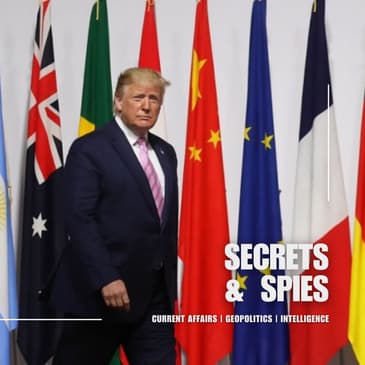
In this episode, Sam Liechtenstein from RANE (Risk Assistance Network + Exchange) joins us to dissect their annual geopolitical forecast. We discussed a range of pressing issues, including:
- The deteriorating global climate cooperation
- The evolving conflict in Ukraine
- The shifting political landscape in Europe
- The Israeli-Palestinian conflict
- US-China tensions
- Political uncertainties in Asia
- North Korea's military threats
- Taiwan's strategic position
- India's rising influence
- Pakistan's instability
- Jihadism in Sub-Saharan Africa
- South Africa's political dynamics
- The implications of a potential Trump presidency
Support Secrets and Spies
Become a “Friend of the Podcast” on Patreon for £3/$4: www.patreon.com/SecretsAndSpiesBuy merchandise from our shop: https://www.redbubble.com/shop/ap/60934996
Subscribe to our YouTube page: https://www.youtube.com/channel/UCDVB23lrHr3KFeXq4VU36dg
For more information about the podcast, check out our website: https://secretsandspiespodcast.com
Connect with us on social media
Bluesky: https://bsky.app/profile/secretsandspies.bsky.socialInstagram: https://instagram.com/secretsandspies
Facebook: https://facebook.com/secretsandspies
Spoutible: https://spoutible.com/SecretsAndSpies
Follow Chris and Matt on Bluesky:
https://bsky.app/profile/fultonmatt.bsky.social
https://bsky.app/profile/chriscarrfilm.bsky.social
Secrets and Spies is produced by F & P LTD.
Music by Andrew R. Bird
Secrets and Spies sits at the intersection of intelligence, covert action, real-world espionage, and broader geopolitics in a way that is digestible but serious. Hosted by filmmaker Chris Carr and writer Matt Fulton, each episode unpacks global events through the lens of intelligence and geopolitics, featuring expert insights from former spies, authors, and analysts.
Hosted by Simplecast, an AdsWizz company. See pcm.adswizz.com for information about our collection and use of personal data for advertising.
[00:00:00] We are Teresa and Nemo and that's why we switched to Shopify.
[00:00:04] The platform, which we used before Shopify, has used regularly updates, which have sometimes led to that, that the shop didn't work.
[00:00:11] Our Nemo Boards shop makes so much on mobile devices a good figure.
[00:00:15] The illustrations on the boards come now very clearly, what is important and what our brand also makes.
[00:00:22] Start your test today for 1€ per month on shopify.de.
[00:00:31] Due to the themes of this podcast, listener discretion is advised.
[00:00:37] Lock your doors, close the blinds, change your passwords.
[00:00:42] This is Secrets and Spies.
[00:00:57] Secrets and Spies is a podcast that dives into the world of espionage, terrorism, geopolitics and intrigue.
[00:01:04] This podcast is produced and hosted by Chris Carr.
[00:01:07] Hey everybody, it's Chris here. Happy New Year to you.
[00:01:10] So today I'm joined by Sam Lichtenstein and we're going to be taking a look at the RAIN 2025 global forecast.
[00:01:18] Because I don't know about you, but I always sort of find January is the month where I'm trying to figure out what's going on in the year ahead.
[00:01:24] So Sam joins us today to break down the world by region and we're going to take a look at kind of the important things to keep an eye out for in 2025.
[00:01:32] I hope you find this episode interesting. Take care.
[00:01:36] The opinions expressed by guests on Secrets and Spies do not necessarily represent those of the producers and sponsors of this podcast.
[00:02:01] Sam, welcome back to the podcast. How are you?
[00:02:03] Really great to be here. I feel like we speak every year around this time.
[00:02:07] Yes.
[00:02:08] And it's pretty fun for me because it's a good opportunity to look at the team's hard work in forecasting for the next year.
[00:02:15] Yeah, fantastic. Well, for the benefit of new listeners, Sam, please can you just tell us a little bit about yourself and RAIN and kind of what this sort of annual forecast is that they produce?
[00:02:25] Sure. So this is probably our best known product. It's certainly the hardest analytic thing that we do throughout the year.
[00:02:31] But, you know, risk assistance network and exchange, which is what RAIN stands for.
[00:02:35] We're a U.S.-based firm, but we have global coverage analysts across the globe and we provide a huge array of different types of risk intelligence.
[00:02:43] We're talking primarily with you about, you know, our geopolitical and security forecasts.
[00:02:49] But we also do everything from business intelligence, cyber intelligence, et cetera.
[00:02:54] The way that our forecasting process works is a multiple stage process.
[00:03:00] And I should note, you know, we do three quarterly updates.
[00:03:03] So, you know, a lot of companies will do an annual forecast, which is which is great.
[00:03:07] But we offer three quarterlies because, you know, inevitably stories come up that candidly no one foresaw their changes to our stories.
[00:03:16] You know, we'd like to think that we do as good of the job as we can forecasting.
[00:03:20] And we call it forecasting, not predicting because no one can ever predict.
[00:03:24] So, you know, we hold ourselves accountable throughout the year.
[00:03:27] And so, you know, if you invited me back on at another point, we can talk about some of these things that we're talking about today.
[00:03:33] And there are very well maybe new things.
[00:03:35] But the basic process is a multiple week long thing.
[00:03:39] Our whole analytic team will get together and we'll first start with just some general brainstorming.
[00:03:43] You know, our analysts are divided by region.
[00:03:46] And so we have our Africa team that will meet, our Europe team that will meet, et cetera.
[00:03:50] And they'll brainstorm.
[00:03:51] And then we do kind of a larger team brainstorm.
[00:03:53] And, you know, we try to focus our forecasts on approximately three to four, sometimes five main stories per region.
[00:04:03] Sometimes, you know, they're focused on a single country.
[00:04:06] Sometimes they're focused on a wider region or sub-region of a different geography.
[00:04:12] Sometimes it's focused more on a theme or a topic.
[00:04:16] So looking at technology, crime, what have you.
[00:04:20] But, you know, we're always in the business of projecting forward.
[00:04:24] That is the definition of a forecast.
[00:04:26] But crucially, explaining what it means.
[00:04:28] What is the so what answer?
[00:04:30] What's the impact that our readers and clients can take away?
[00:04:34] And so, you know, we have kind of our own in-house forecasting methodology that we use on a day-to-day basis when we're writing.
[00:04:41] But it's even more important when you're trying to forecast a full year's worth of events.
[00:04:47] So, you know, our teams will put together their drafts.
[00:04:50] All the analysts will comment on each other.
[00:04:52] And then myself as one of the analytic directors and my co-director will do kind of a final review.
[00:04:58] And so now we hope, having input our forecasts and our editing team working on them now,
[00:05:04] that nothing changes in approximately the next two weeks before we publish on January 6th.
[00:05:09] Yes.
[00:05:09] Yeah.
[00:05:09] Fingers crossed for you there.
[00:05:11] So before we discuss each region, can you give us a kind of overview of what the 2025 forecast believes lies ahead for this year?
[00:05:20] Because 2024, one of the big themes was elections, wasn't it?
[00:05:24] Yeah, you're right.
[00:05:25] 2024, and, you know, I'll be honest, we were certainly not the only company to point this out.
[00:05:30] We do like to think we did some of the better coverage.
[00:05:33] But pretty much the entire globe realized that this was an unprecedented year for election.
[00:05:37] We had literally billions of people that went to the polls.
[00:05:41] So there was a very obvious theme.
[00:05:42] You know, you had the European Parliament, the United States, India, some of the largest, you know, accumulations of people on the planet that were voting.
[00:05:50] This year, obviously, there are some notable elections.
[00:05:53] Actually, you know, in your own neck of the woods in Europe, obviously, the German election will be very soon in the new year in February.
[00:06:01] But there's no kind of unifying theme around elections.
[00:06:04] That's very obvious in the way it was for the past year.
[00:06:06] Instead, perhaps, you know, what I would offer and the way we're framing a lot of our coverage is around trade as a theme.
[00:06:14] And this is perhaps no surprise with our own incoming President Donald Trump making a variety of threats, promises, however you want to interpret them, regarding tariffs and other trade measures.
[00:06:26] And so, you know, our way of thinking about 2025 is really shaped by the geopolitics of trade and how, you know, the world's largest and most important economies, you know, the United States, the European Union, China, etc.
[00:06:42] are going to be adjusting their trade policies, either lowering the frequency of interactions, changing the terms of them, redirecting geographically their trade or in some other way kind of just transforming the nature of their business ties.
[00:06:57] And we really see that as kind of a unifying theme.
[00:07:01] Obviously, there are a whole lot of other things going on.
[00:07:04] But if we were to put our framing on the globe, that's how we're looking at it.
[00:07:10] And are there, trade aside, are there any kind of global trends that we should be, we should expect to see in the year ahead?
[00:07:17] Yeah, I mean, you know, putting aside the idea of trade and the global economy, which certainly brings a lot of things to the fore for us.
[00:07:24] One of the other things that we're really focusing on is global climate cooperation, and notably that it's going to weaken.
[00:07:32] Unfortunately, I don't have a good news story here.
[00:07:35] And, you know, amid all the discussion of trade and conflict, one of the things that certainly gets lost is the conversation about how we, as a globe, confront climate change.
[00:07:47] And the short answer here, and something that we truly feel like is a unifying theme for the globe, is that we see cooperation declining in 2025.
[00:07:56] You have the United States that under a Trump administration is going to reverse a huge amount of green policy into the Biden administration.
[00:08:04] You have a number of governments in Europe across the political spectrum, not just on the right side, but also on the left that are rolling back, weakening or in some other ways changing their climate policies.
[00:08:17] And so, you know, when you're looking at also the pressure that will put on other countries like India and China as major emitters, if, you know, established Western economies are not being aggressive, you know, there's no hope of pressuring these large emitters to do the same.
[00:08:31] And I would also flag the country's nationally determined contributions, these NDCs, which are basically a fancy way of saying the individual plans that countries have made under the Paris Agreement, their updated ones are due by February.
[00:08:47] These are supposed to strengthen their commitments going forward, but, you know, we don't see these as gaining much traction.
[00:08:55] But if you're thinking of kind of a tangible way that we can see this weakening of climate change cooperation, this would be it.
[00:09:02] Yeah, yeah. And that doesn't bode well for the following years, does it?
[00:09:06] No, I've always had a concern about climate change because I think what we're going to potentially see in the future is more countries acting selfishly over resources because I think this, you know, cooperation is the key to sort of surviving climate change.
[00:09:23] And I fear that we're all about to sort of lose any progress on that front.
[00:09:28] And it sounds like this year coming is the year where all that's going to start happening.
[00:09:33] Yeah, listen, there are certainly positive things that are happening.
[00:09:37] You know, I would frame it as the pace of positive change is not sufficient to keep up with the scale and the speed that it needs to happen.
[00:09:44] You know, there are plenty of, you know, nice data points you can provide about the amount of funding, the amount of green energy that's, you know, rising as a percentage of total energy use, etc.
[00:09:56] But the short answer is that these things are not happening at the scale and at the speed that's necessary to address the most harmful impacts of climate change, you know, as basically all scientists seem to agree.
[00:10:08] Yeah, that's very unfortunate. Well, let's take a look at each region mentioned in the report.
[00:10:14] So maybe you can kind of give us an overview of each of the key things.
[00:10:17] And obviously, if there's anything important to you that stands out of each region, just let me know.
[00:10:22] So we'll start with Eurasia. What should we expect for 2025?
[00:10:26] Yeah, it's funny that we're starting in Eurasia because this is also where our forecast starts.
[00:10:31] And I suppose that it's not a coincidence, of course, the war in Ukraine will continue to dominate the conversation.
[00:10:38] But what's distinctive about 2025 is that for the first time since February 22, 2022, when Russia invaded, you know, the likelihood for some sort of ceasefire talks is high.
[00:10:50] We do believe that there will be some sort of talks between Kiev and Moscow, perhaps even directly between Washington and Moscow and cutting out Kiev in some respects.
[00:11:01] But some sort of discussions over how to de-escalate this conflict, we do see as likely.
[00:11:07] The problem, though, from our perspective, is reaching that deal will involve a lot of stumbling blocks.
[00:11:13] And even if there is some sort of de-escalation in fighting, whether it's an actual ceasefire, whether it's restrictions on fighting just in one area of the country or some other deal that kind of brings fighting at least to a lower level, even if you were to get that, the likelihood of a larger peace deal is still going to be elusive.
[00:11:34] Fundamentally, the perspectives from Ukraine and Russia are too diametrically opposed in terms of what they're demanding for a sustainable peace deal.
[00:11:42] So, you know, our message is, you know, there is a hope and significantly more so than we've seen in 2022, 2023 or 2024 that some sort of ceasefire talks are going to happen.
[00:11:53] But we should not mistake that with there being a sustainable peace agreement that ends the fighting in a significant and long lasting way.
[00:12:02] That, of course, has a huge amount of repercussions outside of Ukraine.
[00:12:07] You know, obviously, this horrific conflict will still persist in some capacity, even if perhaps in a slightly less intensity, if you do get some sort of a ceasefire deal.
[00:12:17] But, of course, you know, this conflict has transformed geopolitics in terms of pushing Russia farther into the hands of China, Iran, North Korea and others in terms of now that you're going to start to see a transatlantic split between the United States under a Trump administration that has made very clear that it does not want to be involved in Ukraine in the same way that the Biden administration has been seeing that split with Europe.
[00:12:40] So the implications of, you know, how this war changes are going to be profound.
[00:12:45] You know, I would caution, you know, despite Trump's rhetoric, you know, we should never assume that, you know, he is simply just going to pull out U.S. support, you know, militarily, financially, you know, automatically.
[00:13:00] You know, for all the kind of the bluster, you know, Trump is not one that likes to be seen as kind of proverbially cutting and running.
[00:13:08] There's going to be a lot of pressure on him from people in his own administration and people that, you know, he does respect to, you know, still provide some level of support for Ukraine.
[00:13:17] And, you know, I say this because, you know, for all of the, you know, what can at times be almost hyperbolic discussions about, you know, whether Trump is some sort of Russian pawn, you know, he doesn't like to be humiliated.
[00:13:29] And American strength is a big deal to him.
[00:13:32] And he fundamentally is a dealmaker.
[00:13:34] He sees himself as a big pragmatist.
[00:13:37] He's very transactional in his foreign policy.
[00:13:39] And, you know, I don't say that offering a judgment on it.
[00:13:42] That's just our interpretation of how he how he conducts foreign policy.
[00:13:45] So this is all to say that, you know, yes, we expect U.S. support for Ukraine to be lower.
[00:13:52] But if tensions with Russia stay high and Putin is, you know, Trump sees Putin as continuing to go against his desires to de-escalate, we should not expect that, you know, the United States is just going to remove all support for Kiev and, you know, completely back out.
[00:14:07] So this conflict is going to persist.
[00:14:10] And the tensions between the United States and Russia, even if perhaps slightly at a lower level, are still going to be there.
[00:14:16] And the friction over Russian coordination with China, which is, of course, a huge Trump priority, means that there's going to be massive bilateral tension between Moscow and Washington, you know, even if there is a de-escalation in Ukraine.
[00:14:29] Thank you very much for that.
[00:14:31] Yeah, I mean, I do hope, you know, that there is some sort of positive outcome for Ukraine.
[00:14:36] And it's been encouraging to see that Trump has been in talks with Zelensky just recently in France with the reopening of Notre Dame Cathedral and everything.
[00:14:46] So, yeah, fingers crossed for Ukraine and for Americans of leadership on that issue.
[00:14:52] Is there anything else for Eurasia you'd like to add or should we move on to Europe?
[00:14:56] Yeah, you know, I'll just briefly mention that, you know, believe it or not, there are a number of other important countries in this region geopolitically.
[00:15:04] And I would just briefly flag, you know, these countries, unfortunately, just don't get the attention as Ukraine does because there's not an active horrific conflict going on.
[00:15:12] But, you know, particularly Georgia and Moldova are going to be two additional countries to watch in 2025.
[00:15:19] You know, in Moldova, you had a very contentious presidential election at the end of 2024 that brought back to power a pro-Western leader.
[00:15:29] This is a big deal because there are parliamentary elections that will be happening early in 2025.
[00:15:34] There is a massive pro-Russian movement in the country.
[00:15:37] The Kremlin has been up to all sorts of dirty tricks there.
[00:15:40] And so you might end up in a situation where there is a pro-Western president in a parliament that is pro-Russian, so to speak.
[00:15:48] And even if that doesn't, yeah, even if that's not the case, you know, expect a lot of pre-election dirty tricks from the Kremlin, a place to watch.
[00:15:58] And then kind of where we've already seen this story play out is Georgia, where, you know, only a few years ago, everyone believed Georgia was on a clear path to Western integration over the past year.
[00:16:10] And as we continue to see, even as we're, you know, filming this, you know, a pro-Western protest movement is claiming all sorts of irregularities in recent Georgian elections.
[00:16:19] You have another situation where there's now a pro-Russian prime minister who really has the power and a pro-Russian parliament, but a pro-Western president who's being forced to step down.
[00:16:33] And, you know, Georgia has only recently kind of reversed their beliefs about integrating with the European Union, etc.
[00:16:39] So this would be another country to watch.
[00:16:42] And it's another place where, you know, this kind of battle proverbially between East and West is going to play out in 2025.
[00:16:48] So what lies ahead for Europe?
[00:16:50] Because obviously you've got the big election in Germany coming up in, is it February, isn't it?
[00:16:54] Yeah, I believe it's set for February 23rd at the moment.
[00:16:58] Yeah, so, I mean, we can start with Germany.
[00:17:01] This has been, you know, a real tragedy for Europe because the two real engines of the European Union are, for instance, Germany.
[00:17:08] And both are and will, for the foreseeable future, into 2025 be mired in some sort of basically domestic political dysfunction, which leaves a huge gap at the, you know, supranational EU level.
[00:17:20] You know, Germany is in a comparatively better position, I would say, because, you know, you've had this coalition government throughout all of 2024 that just continued to lose popularity.
[00:17:29] And at least with this election now, you have the opportunity to reset and get more stability.
[00:17:35] So there will be a prolonged period still of uncertainty, you know, even after the election is over.
[00:17:42] It will probably take some time to form a coalition government.
[00:17:45] But there is an opportunity here to get a government that's more capable of implementing policy.
[00:17:50] It's probably, and I say probably, you know, we're still two months away.
[00:17:55] So, you know, we can only divide so much from polls and other expectations.
[00:17:59] But it's probably going to be a coalition led by the center-right Christian Democratic Union alongside another, you know, one or two junior partners.
[00:18:08] We're looking at probably the center-left Social Democrats, maybe the Greens, maybe the Free Democrats.
[00:18:14] You know, in general, the smaller the coalition, i.e. the fewer parties, the more stable it will be.
[00:18:19] You know, one of the problems with the current coalition of three parties is on many issues they have quite divergent interests.
[00:18:25] So if you get a coalition that's led by the CDU with, say, one party will be even better for stability.
[00:18:31] Two parties, perhaps a little more challenging.
[00:18:34] But either way, it will likely still at least have a greater capability to do things like approve a budget, really inject some dynamism and some investment to help Germany's economy, which has really been struggling.
[00:18:48] You know, one of the big things we're looking at is whether or not they're going to reform what's commonly known as the debt break, which is this very contentious constitutional borrowing limit that really limits the fiscal space to do a whole lot of things.
[00:19:02] This was something that was implemented a number of years ago under Chancellor Angela Merkel, which at the time was seen as fiscal prudence and has now really come to be seen as really harming Germany's economy.
[00:19:13] But, you know, the outlook for Germany there is positive in the sense that, you know, a new government after a fresh election with a new mandate should be able to begin to kind of dig the country out of a bit of a hole that it's fallen itself into.
[00:19:29] France, as I alluded to, is in a comparatively worse position, unfortunately.
[00:19:34] You know, right now, we just had the appointment of yet another prime minister and, you know, this kind of continuing cycle of political dysfunction.
[00:19:44] And, you know, unfortunately, this crisis is going to continue well into 2025.
[00:19:48] You know, basically, you know, to make a long story short, President Emmanuel Macron called these elections, took a big gamble last year.
[00:19:56] Or, excuse me, well, this year will be last year when we're in 2025.
[00:20:01] And that gamble spectacularly failed.
[00:20:03] He basically ended up with a parliament that was even more divided.
[00:20:06] And so now you have center, right and left parties that all claim various, you know, reasons why they should lead the government.
[00:20:16] And no one can really agree on basically anything.
[00:20:19] You know, we've already seen one prime minister who was just forced out of office.
[00:20:25] We've seen another one just come in.
[00:20:27] You know, this deadlock will continue.
[00:20:30] They have been able to basically roll over their current budget into 2025.
[00:20:36] But at some point, they're going to need to pass a new budget.
[00:20:39] That's another flashpoint to watch.
[00:20:42] And candidly, you know, if nothing changes, there's an ability to call fresh elections yet again sometime in the summer.
[00:20:50] And so, you know, there's no reason to expect that this volatility is going to ease before then.
[00:20:55] And candidly, you could end up with another election that basically just results in the same deadlock.
[00:21:01] So, you know, really the two most important countries within the European Union to drive policy are going to be mired in, you know, for at least, you know, especially in France's case, still a prolonged period of dysfunction in 2025.
[00:21:16] The UK, I would say, you know, is in a slightly more favorable position, at least internally.
[00:21:22] You know, the Labour government has very clear hold on power.
[00:21:26] That being said, you know, I certainly don't need to tell you, but even just, you know, after a few days or weeks now, months in power, you know, there's been much more significant pushback against the Labour government, both through some unforced errors and then some, you know, that maybe they're really not their fault, but they're still being blamed.
[00:21:44] You know, and the UK is going to basically try to strike a middle ground as it has done for a long period of time, you know, balancing between the United States and the European Union.
[00:21:54] You know, it's on the one hand is going to try not to lean too hard towards a Trump administration where, you know, they're a Labour government and Trump are certainly not going to see eye to eye on a lot of things.
[00:22:07] But, you know, naturally, you know, free market British economy generally aligns more with the United States in many respects, obviously on foreign policy.
[00:22:15] They're largely in lockstep. But at the same time, you know, the UK's most important trading partners are in the European Union.
[00:22:24] And so when you're looking at, you know, the just economic drivers for that continuing relationship, you will almost certainly have to see, you know, some balancing also towards the EU.
[00:22:35] You know, a couple of things to look at, you know, we're following various ways in which Labour could try to kind of deepen the relationship with the EU, particularly on defence and security.
[00:22:47] You know, trade is going to be harder because there's still honestly just a lot of bitterness over the fallout from Brexit.
[00:22:53] And there's still a lot of things that, you know, the two sides don't necessarily see eye to eye on.
[00:22:58] But defence and security is one area where definitely we could see a lot more integration.
[00:23:03] Obviously, there's a lot of overlap among NATO members.
[00:23:06] But, you know, just generally, Europe is, of course, coming to realise that especially under a Trump administration that, you know, says, you know, Europe, you need to do more, that they, in fact, need to do more on their own.
[00:23:18] And so there are more points of convergence there.
[00:23:21] Yeah, yeah, that's good.
[00:23:22] Is there anything else for Europe you'd like to add or should we move on to Asia Pacific?
[00:23:27] I would flag just two brief kind of more tactical security things.
[00:23:31] You know, what's really dominated, honestly, European security over 2024 is Russia's sabotage campaign.
[00:23:37] And we've seen that grow progressively more risk tolerant over the course of 2024.
[00:23:43] And, you know, we should not expect this to meaningfully slow down in 2025.
[00:23:47] You know, there may be some reasons, for instance, that there is some sort of de-escalation in Ukraine for there to at least not be a further acceleration.
[00:23:56] But, you know, the disputes between Russia and Europe seem to be only intensifying.
[00:24:01] So we, you know, expect this to also play a role in 2025.
[00:24:05] And, you know, another more tactical thing.
[00:24:07] But Europe is, of course, also, you know, just by virtue of its geography, going to be exposed to a higher threat of Islamist terrorism in 2025.
[00:24:16] You know, it already faced one in 2024 with the fallout of, you know, Israel's invasion of Gaza.
[00:24:21] That, you know, was sustained with, of course, you know, threats coming from the invasion of Lebanon, etc.
[00:24:26] But, you know, as we're looking now at 2025, you know, the same drivers for this threat are there.
[00:24:32] And obviously, we're all very concerned in watching how Syria plays out and if it becomes, you know, another stronghold for the Islamic State to really plot external operations.
[00:24:41] But candidly, you know, even if that's not the case, there have been so many disrupted terrorist plots across Europe this past year, which on the one hand is a good news story.
[00:24:49] You know, security services are mostly having success.
[00:24:52] We've had, thankfully, very few successful attacks.
[00:24:55] The bad news story is, of course, there are so many of these plots.
[00:24:59] And, you know, basically, you don't go a week without some security service warning that they're becoming overstretched.
[00:25:04] The threat environment is worse than ever.
[00:25:06] The proverbial, you know, red flashing light is going off.
[00:25:10] Indeed.
[00:25:11] And in fact, even the threshold of what is a terrorist act is much easier these days.
[00:25:18] You know, you can just drive a car into a crowd of people with 3D printing of firearms.
[00:25:22] It's become an issue that's flagged up after that shooting in the States and things.
[00:25:27] There's all sorts of things that can happen now that are very kind of low grade and require very little skill.
[00:25:33] Yeah, absolutely.
[00:25:33] I mean, we always talk about the distinction between a more sophisticated directed terrorist attack from abroad,
[00:25:38] where you have a group, say it's Islamic State, one of its provinces that, you know, is deploying operatives, training them, providing them with weapons, sketching out a coordinated plan.
[00:25:47] And, you know, your Paris 2015 scenario, which thankfully, you know, we have far fewer of those, thanks in part to Islamic State being significantly degraded over time and vastly improved counterterrorism capabilities in Europe.
[00:26:01] But then on the other hand, you have a proverbial more likely, but perhaps less intense threat, where, as you said, some individual can just go out with a knife and, you know, stab people.
[00:26:10] He thankfully is hopefully not able to cause significant carnage.
[00:26:13] But, you know, honestly, if you're in a dense crowd, you have a vehicle, you have a firearm, you know, the scope for damage can still be quite high.
[00:26:19] Yeah, indeed, indeed.
[00:26:21] And no, worrying on that front.
[00:26:24] Well, let's move over to, well, actually, let's look at the Middle East and North Africa.
[00:26:29] Let's go there first.
[00:26:31] And then, so what do we think is in store for the Middle East and North Africa?
[00:26:35] Yeah, I mean, this is probably the other most dynamic region, you know, after Eurasia, just because obviously we have our ongoing wars in the Middle East, you know, on multiple fronts.
[00:26:46] You know, 2024 was an exceptionally dynamic year in the region.
[00:26:51] And truly, we're leaving the end of 2024 truly transformed compared to how we entered it.
[00:26:57] And so 2025 is going to be a highly fluid year, basically trying to figure out what this new norm looks like, so to speak.
[00:27:05] You know, I would say in general that the intensity of conflict is going to be lower.
[00:27:10] You know, we're ending the year with Iran and its proxies significantly on the back foot, retrenching.
[00:27:16] So, you know, the signs for a de-escalation, and mostly speaking, are positive.
[00:27:21] But the amount of flashpoints that remain are remarkable.
[00:27:25] And so you can easily see a reflaring of conflict.
[00:27:29] So, you know, on Iran, as I just alluded to, you know, we've seen just setback after setback over the course of 2024.
[00:27:36] You know, they have lost their chief proxy, Hezbollah, which has been significantly hammered by Israel.
[00:27:43] We have a ceasefire in place that is a temporary deal that's going to come up for renewal or potentially not in January.
[00:27:50] You know, but that's one flashpoint to monitor.
[00:27:54] And, you know, obviously Iran has just lost its major, you know, client in Syria with the fall of Bashar al-Assad's regime.
[00:28:02] So, you know, you have a lot of incentives for Tehran to be retrenching, focusing at home, trying to engage in some sort of talks with the incoming Trump administration.
[00:28:13] You know, Trump has pledged very clearly a maximum pressure 2.0 campaign on Iran.
[00:28:20] But let's not forget, you know, Trump is the dealmaker.
[00:28:22] He would like an ultimate deal.
[00:28:24] The problem is that we do not foresee that as likely.
[00:28:28] It's something to bear in mind, and Iran will certainly hope it can engage in some sort of negotiation.
[00:28:33] But fundamentally, we don't see the two sides able to come to an agreement that's workable for both of them.
[00:28:38] So, you know, as we see this, you know, maximum pressure 2.0 campaign plays out, you know, the logical response from Iran's perspective, having lost its major regional strategy, which is to use all these proxies, you know, the most likely outcome is that it basically falls back on a nuclear weapons push.
[00:29:01] You know, we don't see, you know, a conflict in 2025 as at all likely, just to be clear.
[00:29:06] You know, we don't see it kind of breaking out and just racing for a bomb.
[00:29:11] That's not, you know, our forecast.
[00:29:13] But we do see from Iran's perspective that if this outreach to the United States does not work, if it's now dealing with all of its proxies having either fallen from power or been significantly degraded, you know, from its perspective, you know, the most logical thing to do in order to establish deterrence is to refocus on its nuclear program.
[00:29:31] And so that's one thing that we see in 2025 that's going to really play out, honestly, in future years.
[00:29:37] And, you know, there are still some lower likelihood scenarios that would be much higher impact where you had Israel that's now significantly emboldened, for instance, after a year 2024, where it's, you know, beating back basically all of its enemies.
[00:29:49] You have a Trump administration that's going to be even more supportive of those aggressive Israeli action than the Biden administration was.
[00:29:54] Because, again, not saying that an Israeli strike on Iran's nuclear program is likely, but we have seen Israel now strike Iran twice.
[00:30:02] And so that taboo has been broken.
[00:30:04] So now there's, you know, it has become more likely, at least than it was in prior years.
[00:30:08] And obviously, if that were the case, you know, we're in a regional war scenario and all bets are off.
[00:30:14] Yeah, indeed.
[00:30:14] Any thoughts on, obviously, the new government in Syria and how that may play out?
[00:30:20] Yeah, I mean, this is obviously a question that will not surprise you.
[00:30:23] A lot of clients have been asking us at the moment.
[00:30:26] You know, I think, candidly, anyone who has a very clear forecast for Syria probably doesn't know what they're talking about because I think you have to be realistic that this is so uncertain at the moment.
[00:30:37] You know, the best we can do is basically think about different scenarios.
[00:30:40] It's really hard to make an extremely clear forecast.
[00:30:44] You know, this is our basic, you know, forecast is that, you know, you consider where the power centers are.
[00:30:51] Obviously, HTS, Hayat Riyal-Hasham, being the most important armed group in the country, but one of many.
[00:30:57] You consider the main external powers.
[00:30:59] In this case, it would be Turkey.
[00:31:01] And so, you know, when you look at those different, you know, players, and bear in mind, obviously, there are many others from other armed groups to, of course, the United States, Israel, et cetera.
[00:31:12] You can kind of start to divine a bit of a forecast.
[00:31:15] So, you know, in general terms, we basically expect Syria is going to be on basically quite a volatile and unsteady transition period over the year.
[00:31:25] You're going to have different armed groups within the country that are basically going to all be vying for power, and you're going to have different external actors that are doing the same.
[00:31:32] You know, in the first few days after overthrowing Assad, and as we've seen thus far, there is a proverbial kind of kumbaya moment.
[00:31:39] We're extremely happy.
[00:31:40] We've overthrown this common enemy.
[00:31:42] You know, we're going to have proverbial good vibes and say all the right things.
[00:31:46] But at some point in 2025, you know, all these armed groups are going to basically realize, okay, what are our interests?
[00:31:54] And sometimes they're going to be in alignment with others.
[00:31:56] Very often, they're not, though.
[00:31:58] And they all come with their own unique desires or unique areas where they hold greater influence.
[00:32:04] You know, HTS, while it's the largest and most powerful group, it certainly does not control, you know, all of Syria.
[00:32:10] You have significant portions that other groups control.
[00:32:14] And so, you know, at some point in 2025, you know, these disputes are going to come to a head.
[00:32:18] Now, whether they result in all-out, you know, Civil War 2.0 again, less certain.
[00:32:24] But certainly, you know, we don't expect this to be a very clear, very, you know, fully peaceful democratic transition.
[00:32:31] There are going to be a lot of bumps in the road.
[00:32:33] You know, we've talked about potential elections.
[00:32:36] Elections can be a good thing in that they provide, you know, a new government.
[00:32:40] But they can also actually just bring out the worst of everyone because everyone feels like, okay, we need to use this as our time to take advantage.
[00:32:46] And, of course, you then add in all the outside actors, you know, Turkey and the United States, for instance, have very different feelings here.
[00:32:54] Turkey wants to, you know, establish its influence, create a buffer zone and go after the Kurds.
[00:32:59] The United States has historically been the biggest backer of the Kurds.
[00:33:02] You know, these are going to be flashpoints that need to be dealt with.
[00:33:04] And so, you know, expect a very rocky 2025 for Syria.
[00:33:10] Yeah, it's a shame, but not unexpected, sadly.
[00:33:14] Is there anything else for the Middle East or North Africa you'd like to mention before we move on?
[00:33:18] You know, I would just briefly say that, you know, we do still have to think about Gaza and the West Bank.
[00:33:24] You know, there may be, again, just as there has been with Hezbollah, some sort of a deal in Gaza.
[00:33:31] But even if there is, you know, Israel's military is going to reoccupy.
[00:33:35] You will certainly see some settlers that try to take territory.
[00:33:40] And in the West Bank, we're expecting Israel to expand its annexations.
[00:33:43] And so, you know, all the grievances between Israelis and Palestinians, even if you see this, you know, again, big decrease in fighting, they're still going to be there.
[00:33:52] And it's going to create a lot of diplomatic challenges for Israel.
[00:33:55] It's going to introduce a lot of frictions within its own communities.
[00:33:58] And so just on an Israel domestic front, a few things to watch there.
[00:34:02] And I suppose we'll have more then protests in the West in regards to their actions as well.
[00:34:09] So that'd be...
[00:34:10] Yeah, and, you know, also domestically within Israel, you know, this government is still incredibly divisive.
[00:34:15] And, you know, regardless of what the Niyahu's administration is doing regarding Gaza and the West Bank, you know, they're still looking at judicial reforms.
[00:34:24] They're still looking at all these other reforms that are incredibly contentious.
[00:34:27] You know, it seems like so long ago that that was the major story in Israel, but these things are still out there and they still stoke a huge amount of grievances across the spectrum of politics.
[00:34:37] Let's take a quick break and we'll be right back.
[00:34:55] Let's move on to Asia Pacific because this also could be quite an interesting area in the year ahead.
[00:35:02] Yeah, I mean, you know, I certainly don't want to make this U.S.-centric, but, you know, it's hard to escape the elephant in the room of the United States and China, you know, really being the two largest economies that are, you know, tussling, to say the least.
[00:35:17] You know, if we were looking, you know, at Trump's threats of tariffs on the European Union against Canada and Mexico, but of all of them, we see the ones against China as being the most likely to happen.
[00:35:29] Now, the rate of which they will happen, the scope of them, the carve-outs that might happen, you know, that's all up for debate.
[00:35:37] You know, Trump has floated tons of numbers.
[00:35:39] So, you know, no one knows precisely where they – the level at which they will be set, but we do believe that they will happen.
[00:35:46] And that will have huge implications for the world because, you know, we're talking about the two largest economies here.
[00:35:53] You know, if, for instance, you know, just in terms of thinking how other countries are affected, you know, if you start to see Chinese goods being significantly tariffed entering the United States, that's going to push them elsewhere.
[00:36:04] For instance, towards the European Union that will, you know, not particularly like a lot of more Chinese goods flooding its markets, like it's already trying to put up walls to protect against EVs that are coming in.
[00:36:15] So, you know, the way in which U.S.-China trade tensions play out has huge ramifications.
[00:36:21] One area within Asia that this is really important is, for instance, Southeast Asia.
[00:36:25] You have a lot of companies now that are moving out of China because they don't want China-origin goods to be taxed or tariffed entering the United States.
[00:36:34] And so what countries proverbially win in Southeast Asia and South Asia as well, you know, that could be benefits here.
[00:36:41] What countries are going to get even more scrutiny?
[00:36:43] You know, the country besides Mexico that has now opened up the largest trade or from the U.S. perspective, trade deficit is Vietnam.
[00:36:52] This is a big country to watch.
[00:36:54] So, you know, you also have a lot of shifting U.S. tariff policies that could ensnare a lot of other Asia-Pacific countries.
[00:37:03] Beyond that, you know, usually we think of Japanese and South Korean governments as being some of the most stable in the world, certainly compared to lots of other places in the region.
[00:37:15] You know, entering 2025, there's actually a huge amount of uncertainty.
[00:37:18] You know, I certainly don't mean to suggest that, you know, we're entering any sort of like massive civil, you know, conflict in these countries.
[00:37:27] But, you know, we've now had major fragility, to say the least, in Japan and in South Korea.
[00:37:34] You know, we've obviously even had, you know, an actual declaration of martial law, even if it were for only six hours, that, you know, kind of threw out all these norms we thought had existed in the past few years.
[00:37:44] And so, you know, both of these countries are, of course, hugely important from, you know, the United States and the Western perspectives, you know, encountering China and North Korea and Russia.
[00:37:55] And now they're really going to be forced to be focused much more internally.
[00:37:59] You know, in Japan, the ruling Liberal Democratic Party is likely going to lose its majority in the upper House of Parliament.
[00:38:07] You may see Prime Minister Oshiba again be another one who has to resign, which seems to be a recurring theme here.
[00:38:15] So, you know, whatever happens, it's going to be challenging to policymaking.
[00:38:21] And even if you have, you know, these individuals that the LDP that stays in power in the upper House, even if you have Oshiba that still stays in power, they're really going to have a hard time getting much done, given just the way the seats in Parliament are arranged.
[00:38:37] You know, South Korea is in an even tougher position because obviously you have President Yoon Suk-yul, who's now formally been impeached.
[00:38:46] You know, we do expect that that will be confirmed by the Constitutional Court at some point in the first few months of 2025.
[00:38:54] And assuming that's the case, you know, you'll have a fresh presidential election.
[00:38:58] And the policy shift here would be notable because, you know, you have a very conservative Yoon who is likely going to be replaced by a very liberal opposition leader.
[00:39:08] And that matters because, you know, the policies would significantly change here.
[00:39:13] You would have less cooperation with the United States and Japan.
[00:39:17] You would have a more dovish approach to China and North Korea.
[00:39:21] And bear in mind, you know, we still have thousands of U.S. troops that are stationed in South Korea.
[00:39:27] And so, you know, what that does to relations with the Trump administration, you know, one can only know or one can only guess, excuse me, certainly not know.
[00:39:34] But we know in the first term that there were a huge amount of frictions between Seoul and Washington over, you know, for instance, how much South Korea pays to support the U.S. troop presence there.
[00:39:44] So expect more of those things to emerge, especially if you get this more liberal presidency that really, I don't want to say completely changes, but certainly shifts the level of cooperation with the United States.
[00:39:59] And what do we think may happen with North Korea?
[00:40:02] Because they've had quite a sort of interesting 2024 with their relations with Russia and obviously sending troops to Ukraine.
[00:40:09] Yeah, you know, this is another one where, you know, anyone who actually knows what goes through Kim Jong-un's head, you know, please reach out to me.
[00:40:17] I would love to know.
[00:40:18] So I do think anyone that can say with certainty is probably deluding him or herself.
[00:40:24] But, you know, we tend to get hyperbolic about the North and, you know, read into a lot of symbolism and kind of describe almost like a character villain and like a cartoon to this regime.
[00:40:37] But, you know, there's a lot of pragmatism here in what they're trying to do.
[00:40:41] You know, I do think one notable thing about the fallout from South Korea is that, you know, the Union administration was extremely hawkish on North Korea.
[00:40:50] And the two sides over the course of 2024, you know, just sniped and sniped and sniped, removed a lot of confidence building measures, doubled down on threats of military aggression.
[00:41:00] And so if you do get a more dovish leader in South Korea, that does lower the risk of what otherwise could easily turn into a border incident.
[00:41:09] You know, North Korea certainly has no interest or capability at the moment in, you know, just invading the South.
[00:41:15] But they are really trying to improve and test all of their military equipment.
[00:41:21] You know, sending troops, for instance, to fight in Ukraine is a tangible way to get combat experience, test out things.
[00:41:29] And also, of course, to get significant cooperation from Russia on things like, you know, it seems to be improvements to, you know, rocket, missile, satellite technology, all things that really improve those capabilities.
[00:41:41] And, you know, I would just note, you know, a lot of times you read Western press about, you know, North Korea symbolically firing this thing.
[00:41:49] And sure, there's, you know, symbolism to certain actions that it does.
[00:41:52] But a lot of these are for very tangible reasons.
[00:41:55] It's looking to test this capability, wants to understand, you know, the progress it's making on these things.
[00:42:00] And so we should expect more of that type of activity in 2025, especially because, you know, we do believe that, you know, while the terms of this North Korean act with Russia are not precisely clear, you know, that Russia is transferring technology and know-how to support the North Koreans in, you know, improving a lot of these things.
[00:42:19] What's very interesting in this dynamic is this is really interfering in what China sees as its backyard.
[00:42:25] You know, China has historically seen itself as the one that really has the most sway over Pyongyang.
[00:42:32] And the more that Moscow and Pyongyang draw closer, you know, that's an irritant in the relationship between Russia and China, which is also, of course, growing.
[00:42:41] And so how these two giants kind of battle for influence in North Korea is also something to watch in 2025 and whether that at all has any impact on what, you know, they consider to be, you know, their budding relationship that has no limits, so to speak.
[00:42:56] Is there a likelihood with China looking to retake Taiwan in the year ahead?
[00:43:02] You know, this is a question that we get.
[00:43:05] If I had to rank the client inquiries that we get, China-Taiwan scenarios might be at the top.
[00:43:11] It's certainly in the top five.
[00:43:13] And so we do give a lot of thought to this, you know.
[00:43:15] Bluntly speaking, no, we do not see any sort of a Chinese invasion of Taiwan in 2025 as at all likely.
[00:43:22] In fact, we don't see it likely in 2026 either.
[00:43:25] We can already get that out of the way for the next time we chat.
[00:43:29] But it's been very clear with these series of, you know, military exercises that China has done over the past few years that, you know, it is practicing for different contingencies.
[00:43:39] Again, this is something that Western press tends to talk about, you know, all these symbolic drills, you know, intimidate Taiwan.
[00:43:45] And sure, part of it is that.
[00:43:47] But it's also literally testing different contingencies.
[00:43:50] You know, it's been very clearly practicing how to blockade Taiwan, how to maybe take its outlying islands.
[00:43:55] Bear in mind, there are islands that are not the main Taiwanese island that are far closer to the mainland coast.
[00:44:01] So, you know, it is practicing these things.
[00:44:03] It's testing Taiwanese air defenses.
[00:44:05] How long does it take fighter jets to respond?
[00:44:07] Where does it maybe not have, you know, maritime surveillance that it can move ships into?
[00:44:11] So there's a very clear strategic logic here.
[00:44:14] And so, you know, our concern is not so much or not at all that there's an invasion, but rather that there are all these proverbial short of war scenarios.
[00:44:24] You know, things that China could do to coerce Taiwan that stop far short of, you know, firing a bullet, so to speak, but nonetheless would be, you know, highly concerning.
[00:44:35] And so, you know, for instance, looking at some of those outlying islands, you know, as just one example.
[00:44:39] And of course, there's a huge amount of kind of asymmetric things it can do, you know, for instance, in cyberspace that, you know, can coerce Taiwan.
[00:44:47] But in terms of an actual invasion, no, we don't see that.
[00:44:51] Is it the cards?
[00:44:52] Yeah.
[00:44:52] Well, yeah.
[00:44:53] What is what lies ahead for South Asia?
[00:44:55] Yeah.
[00:44:56] You know, this is I feel like, you know, we we I want to talk more about India because, you know, I do feel like it's the the true elephant in the room of this massive power that just disproportionately doesn't get the attention that it deserves.
[00:45:11] And, you know, the the Indian government is really going to be, I think, in a position where it's kind of managing ties with the United States.
[00:45:20] You know, it's going to be focusing on boosting domestic manufacturing at home and then trying to perhaps make some concessions to the U.S. to to avoid a trade war.
[00:45:31] You know, it is it is very concerned about that, as many other countries are.
[00:45:35] India has a trade surplus with the United States.
[00:45:37] It's obviously a massive economy and that increases the risk of the Trump administration imposing some sort of tariffs on Indian goods.
[00:45:45] You know, so that's the first priority in terms of the incoming administration will be to, you know, perhaps increase purchases of more U.S. goods, you know, try to align more with certain U.S. policies.
[00:45:56] But, you know, India has its own interests that are divergent from the United States and the West in many respects.
[00:46:02] You know, it's made this very clear over the course of the war in Ukraine, where it's still doing a lot of business with Russia.
[00:46:06] It's purchasing a whole lot of Russian oil at very favorable terms.
[00:46:11] And so, you know, expect this kind of India first, so to speak, policy to persist.
[00:46:17] There may actually be some room for rapprochement with China in 2025, which would be notable.
[00:46:21] Obviously, you know, Beijing and New Delhi are huge giants in the region and are regularly at odds.
[00:46:28] But, you know, now that we have seen some progress to kind of de-escalate their border conflicts, you know, we do see an opening now for some cooperation in other areas.
[00:46:38] You know, we're not expecting New Delhi and Beijing to become, you know, close, you know, in very strategic respects anytime soon.
[00:46:47] But, you know, I do think you'll see some things that point towards some sort of improvement in ties.
[00:46:52] For instance, like, you know, reducing restrictions on trade investments, perhaps even doing some sort of, you know, some sort of military confidence building measures between the two to, you know, kind of play on this, you know, reduction in border tensions.
[00:47:09] But, you know, again, you're still going to see this competition, but I think you will see some softening in that relationship.
[00:47:15] And is there anything else for South Asia you'd like to cover?
[00:47:18] You know, I would just flag, you know, Pakistan, in my opinion, is the country to watch in 2025.
[00:47:25] You know, they've had many years now of unrest, unfortunately.
[00:47:30] 2024 is ending with, you know, again, just massive challenges from both like an Islamic extremism perspective.
[00:47:37] You know, they just continue to have, you know, cross-border attacks from Afghanistan, their own domestic extremists.
[00:47:42] They have a huge amount of bulwarch liberation and nationalist group activity that's just wreaked havoc on their security, particularly, by the way, against, you know, Chinese investments in the country.
[00:47:53] And then they had this massive, you know, political problem dealing with the opposition party of now jailed former prime minister Imran Khan and his PTI party.
[00:48:02] You know, I don't know precisely, you know, if we're going to come to, you know, a truly ahead like we saw in Bangladesh in 2024.
[00:48:13] You know, I don't think that is the most likely scenario.
[00:48:15] But I do think that the level of violence and unrest that we're seeing in Pakistan is a concern.
[00:48:21] And obviously, you know, not to be hyperbolic, but this is a nuclear-armed nation, you know.
[00:48:26] So you do always have to think, okay, this is an area where, you know, you have to pay close attention.
[00:48:31] And if I were thinking about another country that is at risk of that kind of, you know, unrest, Pakistan would be on the list, particularly because, you know, it's, you know, basically trying to deal with the International Monetary Fund like multiple other South Asian governments.
[00:48:46] And, you know, this, you know, has the ability to write some of Pakistan's finances.
[00:48:51] The problem is that the more the government agrees to, you know, the terms of these austerity measures and fiscal consolidation, the more that just frustrates the people because it means higher taxes, fewer subsidies, et cetera.
[00:49:05] And so there's a real concern here that you have all of these, you know, deadly forces in the mix.
[00:49:12] And again, I'm not suggesting there's going to be, you know, some sort of Bangladeshi government overthrow scenario.
[00:49:17] But I do think if you were concerned about domestic unrest, Pakistan would be a country certainly in the region.
[00:49:23] And I would put it near the top of my list for the world to watch in 2025.
[00:49:27] Yeah. Yeah. Well, thank you for that, Judy.
[00:49:30] I think it was President Obama used to say the one country always used to keep him up at night was Pakistan.
[00:49:36] And that was back in during his presidency.
[00:49:39] So, yeah, it's an interesting place to keep an eye on.
[00:49:42] Let's move on to sub-Saharan Africa, because that's, again, a very interesting area.
[00:49:47] I know last year we talked a bit about it.
[00:49:49] And are there any sort of developments you anticipate there that may be of concern?
[00:49:55] Yeah. You know, one of the most underrated security stories of recent years is that sub-Saharan Africa has become the center of global jihadism in terms of fatalities, attacks, influence.
[00:50:06] It has truly shifted from the Middle East of sub-Saharan Africa.
[00:50:10] You know, you have this epicenter in the Sahelian states, Burkina Faso, Mali, and Niger.
[00:50:15] But it's increasingly creeping over into coastal West Africa.
[00:50:19] Nigeria already was dealing with this problem.
[00:50:21] And it shows no sign of slowing down.
[00:50:24] You know, we've seen no reason to believe that the strategies, these now Hunter-led governments in these three Sahelian states, you know, that they are having any success.
[00:50:34] There's no reason to believe they'll have any more success in 2025.
[00:50:37] And so this creeping advance of jihadism farther across this hell, deeper into coastal West Africa, is going to continue.
[00:50:44] You know, this is something to really pay attention to because while right now these groups still are focused locally, you know, local groups tend to have, you know, this problem where they eventually focus globally.
[00:50:57] And so, you know, again, at some point in the coming years, this problem is going to affect the West in a more direct way.
[00:51:04] And so this is why, you know, it's a concern for us.
[00:51:08] You know, at a more strategic level, you know, I do think that, you know, from the U.S. and Western perspective, you know, as Saudi is often the case, Africa takes a backseat in foreign policy.
[00:51:19] When you have, you know, crises going on in Ukraine, the Middle East, China, you know, at some point there's only so much time you can devote to global problems.
[00:51:27] And Africa tragically often falls towards, if not at the bottom of the list.
[00:51:31] You know, one thing I would note here is, you know, China as a point of Western competition could re-spark some new interest from the United States and Europe in trying to confront Chinese influence on the continent.
[00:51:45] And so I do think that's a dynamic to watch.
[00:51:49] You know, I would also just point out, you know, we're going to be in the, you know, South Africa, you know, just as the sub-Saharan African heavyweight here.
[00:51:57] That's going to be now in another year in which the African National Congress and Democratic Alliance are going to be in ruling as part of a coalition.
[00:52:06] This was, of course, when this happened in 24, extremely notable because it was the first time since apartheid that the ANC was not able to rule on its own in the majority.
[00:52:15] You know, candidly, a lot of, you know, analysts and to some extent some of us, myself included, thought that the ANC and the DA would have an either rockier relationship than they have thus far.
[00:52:26] They've actually done quite well governing together.
[00:52:29] But, you know, there is a honeymoon period and that period will presumably be ending, you know, at some point in 2025.
[00:52:37] So, you know, we do see that there, we do foresee that there are likely to be more tensions between the two.
[00:52:44] But, you know, they have done pretty well thus far.
[00:52:47] So, you know, some sort of massive split does not seem likely.
[00:52:51] We don't see a collapse as the likely scenario in 2025.
[00:52:54] But we do see some greater frictions.
[00:52:56] And this really matters because South Africa has a whole lot of challenges to confront in its economy, in its security, in its energy sector.
[00:53:05] And, you know, I would just flag, you know, one thing to keep in the background.
[00:53:08] This former president, Jacob Zuma, is going to be on trial in one of his many cases, this one over corruption.
[00:53:15] You may recall in 2021 that unrest after, you know, legal allegations against him was like massively destructive to the country.
[00:53:23] We had like 300 people who died, you know, billions of dollars in damage from violent unrest.
[00:53:29] And so this is a case to watch.
[00:53:31] You know, we don't foresee the scale of that as likely being replicated.
[00:53:35] The South Africans have learned a lot of lessons for that episode.
[00:53:38] But it's very clear that especially when Zuma and his party are railing against this ANCDA alliance in government that, you know, cases against him are salient to a significant portion or at least a significant minority portion of the population.
[00:53:53] And so this is something to watch from an unrest perspective as well.
[00:53:56] Yeah.
[00:53:57] Yeah.
[00:53:57] So what, well, let's talk about the Americas then.
[00:53:59] So what do you think is in store?
[00:54:00] Yeah.
[00:54:01] You know, we have a lot going on in a lot of different parts of the Americas, which I think it's actually one of the more interesting parts of the world in 2025.
[00:54:10] You know, I'll put the United States to the side for a second and just focus on Canada and Latin America.
[00:54:15] And I want to start with Canada because even though we, of course, usually think about the Americas as everything below the United States, you know, Canada is there.
[00:54:23] And 2025 is going to be an important year for Canada.
[00:54:25] I don't often get to talk about Canada being a crucial country in a year, but in 2025 it will be.
[00:54:31] And that's because, you know, you know, candidly, Chris, even as we're talking, you know, I think the government as prime minister, Justin Trudeau, is reforming itself.
[00:54:40] Another shuffle of its cabinet because, you know, he's been under incredible pressure.
[00:54:46] Now, new elections are due by October 2025 regardless.
[00:54:51] We do foresee it as likely that they will be called earlier.
[00:54:55] But no matter when they are called, the Liberal Party is almost certainly going to be trounced by the Conservatives.
[00:55:01] And so after a decade of Liberal rule, you will see a huge shift in policymaking in Canada when the Conservatives come back to power.
[00:55:08] You know, you're going to see reversals of a lot of policies.
[00:55:12] But, you know, the one I would focus most on is environmental policy.
[00:55:16] You know, Canada has implemented a big carbon tax that has really been contentious.
[00:55:21] And so a conservative government that, you know, reduces, let alone removes that, certainly will pull back on a lot of the climate commitments that the Trudeau government made.
[00:55:30] I mean, Canada actually is quite a large emitter, especially given itself as a major oil and gas producer.
[00:55:36] So these things significantly matter not only for Canadians, but really the globe.
[00:55:39] And so, you know, I would first start just flagging Canada will be a country to watch in 2025 for sure.
[00:55:45] Yeah, yeah, indeed.
[00:55:47] And what do we think will be happening in Latin America?
[00:55:50] Yeah, I mean, you know, we have to start with Mexico, which is, of course, you know, really facing the brunt of a lot of Trump's ire.
[00:55:57] You know, we do believe that Trump's threatened tariffs against Mexico and Canada, certainly at high rates, are unlikely.
[00:56:07] You know, and we do foresee them as particularly unlikely against Canada.
[00:56:11] You know, I suppose if I were ranking, you know, there would be perhaps slight more opportunity for tariffs to be implemented against Mexico.
[00:56:19] But even then, you know, we think that this is more of a negotiating position and that there would just be too much blowback and resistance in the United States.
[00:56:28] Having said that, you know, these are real threats and, you know, Trump could easily start with a, you know, a very low level and then ramp up from there.
[00:56:36] So Mexico is going to be having to deal with a lot of issues, to say the least.
[00:56:42] You know, you also have what will be the first full year of the new government of President Claudia Sheinbaum.
[00:56:47] You know, she is really in a tough position in a lot of respects.
[00:56:52] You know, she is going to be overseeing the first elections of these new judiciary elections, which were, you know, you may recall this extremely contentious reform there.
[00:57:03] We're likely to see more labor reforms.
[00:57:04] And, of course, she's going to be after dealing with what's likely to be mass deportations from the United States that could cause some real shocks to Mexico's economy, let alone if these actual threatened tariffs come through.
[00:57:16] And, you know, if I can just go beyond 2025 for a second, you know, something that's going to be driving 2025 and won't come to a head until 2026 is that we're going to have the renegotiation of the USMCA agreement, the US-Mexico-Canada free trade deal that Trump instituted in his first term that replaced NAFTA, the North American Free Trade Agreement.
[00:57:37] So that comes up for renewal in 2026.
[00:57:39] So a lot of 2025 is going to be about the talks over how to reform that, how to ensure that it lives on.
[00:57:48] We foresee these negotiations as being very contentious.
[00:57:52] And so, you know, the government in Mexico is going to have plenty on its plate.
[00:57:56] Is there anything you foresee for, like, Venezuela?
[00:57:59] Because there have been some interesting sort of movements over this year over there.
[00:58:03] Yeah, you know, unfortunately, I don't have any good news story there.
[00:58:06] You know, President Maduro, you know, is clearly in power.
[00:58:10] You know, the Trump administration, you know, especially under Marco Rubio as Secretary of State, you know, is someone who has frequently criticized leftist governments.
[00:58:21] Trump has certainly did the same in his first term.
[00:58:23] And so, you know, relations between the US and Venezuela are likely to be rocky, to say the least.
[00:58:29] Having said that, you know, I would go back to what I mentioned at some point earlier, that Trump is a dealmaker and he's a pragmatist.
[00:58:35] And as much as he may ideologically dislike the Maduro government, and while, you know, the most likely outcome is for a contentious relationship between Washington and Caracas, you know, Venezuela is also, for instance, a major sender of migrants to the United States.
[00:58:50] You know, something like a third of Venezuelans have left the country, which is a startling figure, like 6 million people in the past few years due to just, you know, the complete economic collapse and insecurity there.
[00:59:00] So if there is a deal perhaps to be made where Venezuela, you know, takes back, you know, some people in exchange for some sort of softening, perhaps, of US sanctions or more engagement, I do think that's a possibility.
[00:59:12] I do think, though, that, you know, before we get to that, if we ever do, this is going to be a contentious relationship, you know.
[00:59:19] And one of the other major things to flag is, you know, the emergence of Trenda Aragua, this Mexican, or this, excuse me, Venezuelan criminal group that has really spread its tentacles across Latin America and is increasingly coming to the United States.
[00:59:32] You know, this thing that Trump has loudly criticized.
[00:59:34] And so, you know, expect that to also be a major point of contention.
[00:59:38] And is there anything you'd like to add to the United States?
[00:59:40] Because obviously we've got an incoming Trump administration and so possibly very interesting times ahead.
[00:59:47] Yeah, I mean, take your pick on what to go with here.
[00:59:51] But, you know, there's going to be a massive shock to US policymaking.
[00:59:54] You know, a whole host of issues that the Biden administration has championed are going to be completely reversed.
[01:00:01] And a whole host of things that they didn't do, the Trump administration will pursue, you know.
[01:00:06] So, you know, things that matter for other parts of the world in particular.
[01:00:11] You know, I would first put out environmental policy, you know, is going to be a huge shift.
[01:00:17] You know, you're likely to see the Trump administration again pull out of the Paris Accord, again roll back different climate targets, scale up oil and gas exploration as much as it can.
[01:00:29] You know, even though Trump has railed against, you know, what's improperly termed the Inflation Reduction Act, even if he's unlikely to completely roll that back because, you know, this actually has done a huge amount of benefit for Republican districts in particular.
[01:00:44] You know, things like minimizing the tax credit for electric vehicles is likely.
[01:00:49] So on environmental policy, huge shifts.
[01:00:51] Obviously, immigration we already spoke about.
[01:00:54] And of course, you know, there's a huge amount of foreign policy, you know, that's going to change, you know, aside from what happens to inside the country.
[01:01:01] You know, we've already spoken about some of these shifts.
[01:01:03] But, you know, you have to consider more hawkish policy against Iran, more hawkish policy against China, which is one of the few bipartisan issues it seems the United States.
[01:01:14] Growing contentious relationship with Europe.
[01:01:17] You know, so there are a whole host of different foreign policy issues here, some of which we've touched on already to consider.
[01:01:24] Well, thank you very much for that.
[01:01:25] We've pretty much covered the world.
[01:01:27] Is there anything else you'd like to add before we wrap up today?
[01:01:30] I mean, I could go on for another hour, Chris, but I don't think you or your listeners want me to do that.
[01:01:35] So I'll leave it there.
[01:01:37] OK, well, thank you so much for your time on the show, Sam.
[01:01:40] So where can listeners sort of find out more about you and where can they get a copy of the global forecast?
[01:01:45] Yeah, the best place to go is rainnetwork.com.
[01:01:48] R-A-N-E-network.com.
[01:01:50] We'll be publishing our forecasts on January 6th.
[01:01:54] And, you know, for anyone that's interested in the different services we can provide, you know, please feel free to go there and hopefully we can help.
[01:02:01] Fantastic.
[01:02:02] Well, thank you again for joining me today and happy new year to you.
[01:02:04] Thanks, Chris.
[01:02:04] You as well.
[01:02:05] Thanks for listening.
[01:02:37] This is Secrets and Spies.
[01:03:38] We are Teresa and Nemo.
[01:03:40] And now we have to shopify.com.
[01:03:42] We have to get started.
[01:03:43] The platform, the we have used before Shopify has used, has used to have regularly updates that have been used to have to have been used to, that the shop didn't work.
[01:03:50] Endlich makes our Nemo Boards Shop so far as the mobile device is a good figure.
[01:03:53] And the illustrations on the boards come now very, very clear about what is important to us and what our brand is also caused.
[01:04:06] We are Teresa and Nemo.
[01:04:10] And now we have to shopify.com.
[01:04:12] We have to get started.
[01:04:13] The platform, the we have used before Shopify, has used to have regularly updates, which have sometimes been brought to the shop.
[01:04:20] Our Nemo Boards Shop makes our mobile device a good figure.
[01:04:24] And the illustrations on the boards come now very, very clear about what is important and what our brand is also made out.
[01:04:38] We are Teresa and Nemo.
[01:04:40] And now we have to shopify.com.
[01:04:42] The platform, the we have used before Shopify, has used to have regularly updates, which have sometimes been brought to the shop.
[01:04:50] Our Nemo Boards Shop makes our mobile device a good figure.
[01:04:54] And the illustrations on the boards come now very, very clear about what is important and what our brand is also made out.
[01:05:23] And the illustrations on the boards come now very, very clear about what is important and what our brand is also made out.
[01:05:53] And the drawings on the boards come now very, very clear about what our brand is also made out.
[01:06:01] Start your test today for 1€ per month on shopify.de.
[01:06:09] We are Teresa and Nemo, and therefore we have to Shopify.
[01:06:13] The platform, which we used before Shopify, has used regularly updates,
[01:06:17] which have sometimes been made to the shop that didn't work.
[01:06:20] Our Nemo Boards is a good figure of the mobile device.
[01:06:24] The illustrations on the boards come now very clear,
[01:06:27] what is important to us and what our brand is also making.
[01:06:31] Start your test today for 1€ per month on shopify.de.
[01:06:39] We are Teresa and Nemo, and therefore we have to Shopify.
[01:06:43] The platform, which we used before Shopify, has used regularly updates,
[01:06:47] which have sometimes been made to the shop that didn't work.
[01:06:50] Our Nemo Boards makes our own mobile device a good figure.
[01:06:54] The illustrations on the boards come now very clear,
[01:06:57] what is important to us and what our brand is also making.
[01:07:01] Start your test today for 1€ per month on shopify.de.
[01:07:09] We are Teresa and Nemo, and therefore we have to Shopify.
[01:07:13] The platform, which we used before Shopify, has used regularly updates,
[01:07:17] which have sometimes been made to the shop that didn't work.
[01:07:20] End of time, our Nemo Boards is a good figure.
[01:07:24] The illustrations on the boards come now very clear,
[01:07:27] what is important to us and what our brand is also making.
[01:07:31] Start your test today for 1€ per month on shopify.de.
[01:07:36] slash radio
[01:07:37] .
[01:07:37] .