
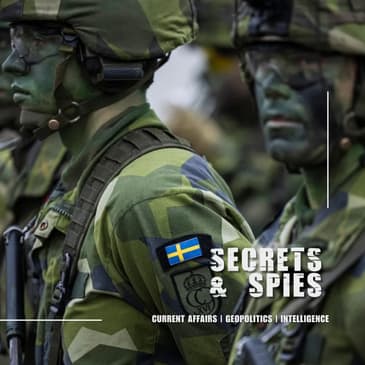
Beginning in 1949, officially non-aligned Sweden did something it kept secret for half a century: in close cooperation with the CIA and MI6, it built a clandestine civilian resistance network meant to outlast a Soviet occupation and fight on from within. Its members were ordinary people, farmers, salesmen, gamekeepers, organized into cells that never met. In this episode, Matt talks with Johan Wennström of the Swedish Defence University, whose book The Stay Behinds: Sweden’s Cold War Guardians is the first in-depth English account of the network — the tradecraft, the human cost, and why it suddenly speaks to a Europe at war and a Sweden newly inside NATO during the alliance’s most uncertain moment in a generation.
Subscribe and share to stay ahead in the world of intelligence, global issues, and current affairs.Order The Stay Behinds: https://www.ospreypublishing.com/us/stay-behinds-9781472877567/
Read Johan’s Substack, "Our Man in Stockholm": https://johanwennstrom.substack.com/
Follow Johan on X: https://x.com/johanwennstrom
Please share this episode using these links
Apple Podcasts: shorturl.at/4ur9F
Spotify: shorturl.at/Gocxr
Amazon Music: shorturl.at/nDfVJ
YouTube: shorturl.at/gnCNV
Support Secrets and SpiesBecome a “Friend of the Podcast” on Patreon for £3/$4: https://www.patreon.com/SecretsAndSpies
Buy merchandise from our shop: https://www.redbubble.com/shop/ap/60934996
Buy us a coffee: https://buymeacoffee.com/secretsandspies
Subscribe to our YouTube page: https://www.youtube.com/channel/UCDVB23lrHr3KFeXq4VU36dg
For more information about the podcast, check out our website: https://secretsandspiespodcast.com
Connect with us on social media
Bluesky: https://bsky.app/profile/secretsandspies.bsky.social
X/Twitter: https://x.com/SecretsAndSpies
Instagram: https://instagram.com/secretsandspies
Facebook: https://facebook.com/secretsandspies
Spoutible: https://spoutible.com/SecretsAndSpies
Follow Chris and Matt on Bluesky:
https://bsky.app/profile/chriscarrfilm.bsky.social
https://bsky.app/profile/mattfulton.net
Secrets and Spies is produced by Films & Podcasts LTD: https://filmsandpodcasts.co.uk/
Music by Andrew R. Bird
Photo by Jonathan Nackstrand/AFP, Johan Wennström
Secrets and Spies sits at the intersection of intelligence, covert action, real-world espionage, and broader geopolitics in a way that is digestible but serious. Hosted by filmmaker Chris Carr and writer Matt Fulton, each episode examines the very topics that real intelligence officers and analysts consider on a daily basis through the lens of global events and geopolitics, featuring expert insights from former spies, authors, and journalists.
Hosted by Simplecast, an AdsWizz company. See pcm.adswizz.com for information about our collection and use of personal data for advertising.
[00:00:00] Lock your doors, close the blinds, change your passwords. This is Secrets and Spies. Secrets and Spies is a podcast that dives into the world of espionage, terrorism, geopolitics, and intrigue. This episode is presented by Matt Fulton and produced by Chris Carr.
[00:00:30] Hello everyone and welcome back to Secrets and Spies. For most of the Cold War, Sweden sold the world a story about itself. Neutral, non-aligned, the reasonable country that kept its hands clean while everyone else picked a side. But from 1949 on, Sweden was quietly one of the closest friends the CIA and MI6 had outside NATO.
[00:00:50] It was building an army in secret, not of soldiers, but of civilians, farmers, traveling salesmen, gameskeepers, the local insurance broker, ordinary people sorted into cells that never met, trained to melt into the population and stoke a resistance if Soviet tanks ever rolled in and seized the country. Most of them carried that secret to their graves. When news of this network finally surfaced in the 1990s, Sweden decided the whole thing had been something sinister,
[00:01:20] a rogue, undemocratic plot cooked up and lyingly. My guest today is Johan Wenström, a historian and research fellow at the Swedish Defense University. And his new book makes the case that it's almost the exact opposite, a stranger, more Swedish, and frankly, more impressive story than the myth ever allowed. And with Russia at war in Europe again, and Sweden doing the once unthinkable and finally joining NATO,
[00:01:45] the questions his secret army was built to answer aren't just history anymore. Thanks for listening. Thanks for watching. Take care. The opinions expressed by guests on Secrets and Spies do not necessarily represent those of the producers and sponsors of this podcast.
[00:02:17] Johan, welcome to Secrets and Spies. Great to have you with us. Thank you. It's my pleasure. Sure. I'm sorry if I look a bit disheveled on the video as a Swede. I'm not used to the Kandahar heat that we currently have here in Washington, D.C. That's true. You know, August in D.C. is definitely not for the faint of heart when the founders in their infinite wisdom thought to build the capital on top of a swamp.
[00:02:47] But, you know, that's kind of how it goes. Yeah. Write a passage for anyone visiting D.C. in the summer for sure. Yeah. Like being on the sun sometimes. But yeah, so we're here to talk about your new book, The Stay Behinds, Sweden's Cold War Guardians. It's the first real history of a secret network Sweden built to survive a Soviet occupation.
[00:03:10] And one that turns out to have a lot to say about where Sweden and all of Europe finds itself today. There's plenty I want to get into with you, but let's start with you, your background and how you came to this story.
[00:03:25] So just to summarize, as a starting point, I might say that this is the first book to appear in English on the stay behind, the first qualified book, I should say, to appear in English on the stay behind phenomena in Western Europe during the Cold War.
[00:03:48] So-called stay behind units, civil resistance networks were set up in every Western European country, including a non-aligned Sweden and Switzerland, to prepare for meeting the global threat of Soviet communism in the world.
[00:04:19] And this phenomenon and these networks, they have been the subject of disinformation and myth-making. And it's still actually the subject of Iranian and Russian propaganda today. So it's really important that we understand this phenomena properly.
[00:04:48] And my book is a case study of the Swedish stay behind organization set up at the dawn of the Cold War in 1949. What was the research like? It was an interesting experience, I have to say.
[00:05:03] I was sort of warned by grander historians than myself that this was an impossible subject to research because, you know, it had been so secret. It was one of the most secret things that we had in Sweden during the Cold War.
[00:05:29] But I, you know, doggedly did my research. I wore out my shoe leather in public and private archives, following Robert Caro's golden rule of turning every page in the archive. Mm-hmm.
[00:05:49] And I also interviewed some 40 people who, in one way or another, had been involved in the organization, either directly in the organization at various levels, or through the fact that they had been, you know, government ministers, for instance, you know, responsible for the organization in cabinet.
[00:06:15] And, yeah, so the book is really a mix of archival history and oral history. And I had to work, since this was never really supposed to be disclosed, I had to work almost like a spy, you know, putting the pieces together, joining the dots, as it were,
[00:06:43] from a mosaic of empirical materials, you know, letters, diaries, even, you know, pocket diaries, pocket calendars, and government documents. And also comparing and contrasting, you know, different testimonies with each other. So I spent four years doing this research.
[00:07:12] Mm-hmm. And one of the more sort of serendipitous aspects of this research was the fact that the headquarters of this secret organization in Stockholm, at least one of its headquarters actually was next door to where I lived in Stockholm, just a block away from my own door,
[00:07:42] you know, a door that I passed on my way to work every morning. So there is a kind of mysterious aspect to research. It seems that, you know, certain discoveries are sort of reserved for the right researcher. Right. And I guess when you have a passion for the story you're telling, it doesn't really feel like work. It's more of a treasure hunt, I guess, you know? Yes, exactly. Exactly.
[00:08:11] And I mean, it was really interesting to learn the technique of interviewing, you know, witnesses, which I had never done before. But I was quite proud when someone who had formerly been in Swedish intelligence, you know, said to me at the conclusion of our interview that you would have been, you know, a really good interrogator. Very good.
[00:08:41] Yeah. You have ways of making them talk. Yes, indeed. Yes, indeed. How many folks from like the beginning of this network are still around? Well, I was fortunate to meet a few of the lost, to my knowledge, lost surviving members of what I call the first generation of this network, spanning from 1949 to 1978.
[00:09:15] Unfortunately, one of them actually, you know, passed away shortly after I had spoken to him. He was 80, 80 years old at the time of our interview. But there are younger surviving members, members of the sort of late second and third generation of this movement who were active in the sort of 80s and 90s. And they are now in their sort of 60s.
[00:09:45] And yeah, so I've met quite a few of them. And there are still, you know, surviving members in an active age, you might say, who are not involved any longer, of course. But, you know, might have been useful had the network continued today. Yeah. So setting the scene here, you know, it's early in the Cold War, late 40s, early 50s.
[00:10:11] How did Sweden, as you said, you know, neutral and unaligned sitting right across the Baltic from the Soviet Union picture a Russian attack? And how real did that danger feel to the people initially planning this network? Well, we were never neutral. That's a very important point, actually. We were non-aligned. The doctrine was, you know, military non-alignment in wartime with the ambition of staying neutral in wartime.
[00:10:40] But, of course, we would never have been neutral since we were, in fact, cooperating in secret with NATO from 1949 and throughout the Cold War. We were very much a Western-aligned country, you know, projecting an image of Sweden as a kind of third-way country in order to protect ourselves from our neighbor, you know, Soviet Union slash Russia.
[00:11:09] So that's important to remember. Sweden was during the entire post-well, during the Second World War and during the post-war era, a very realist, sort of hard-nosed, realist country that did what was, you know, necessary to protect our national interests. And this included, of course, the establishment of a secret civilian resistance network.
[00:11:36] In 1949, there was a real fear in Sweden, you know, after the stolen elections in Poland of 1947 and the 1948 Prague coup. And Stalin's offer to Finland, merely hours after the Prague coup, to join the Soviet Union in a friendship and security pact.
[00:12:00] And the military and political establishment in Sweden quite rightly feared that Sweden might be next in line, given its strategic position in the Baltic area.
[00:12:11] Sweden might very well have been hit first in a wider confrontation between the Soviet Union and NATO because the Soviet Union wanted to move the entire war scenario westwards of Norway to avoid a conflict in its own territory.
[00:12:33] Later on, I mean, at the start of the Cold War, I think the scenario was a kind of, you know, massive land-based invasion, you know, sort of from the north of, coming through the north of Finland, you know, and sort of the south of Sweden.
[00:12:51] But that scenario changed quite a bit after the Soviet invasions of Czechoslovakia in 1968 and the invasion of Afghanistan in 1979, which, of course, both of which were, you know, preceded by and conducted with, you know, sort of hybrid warfare.
[00:13:17] And, you know, clandestine warfare. In Afghanistan, for instance, the Soviet Union infiltrated tens of thousands of soldiers during the course of 1979, training them in the Afghan language, issuing them with Afghan uniforms, for instance. And we know for a fact now that they had similar designs on Sweden.
[00:13:45] They had prepared, for instance, Swedish military uniforms that would be used to conduct, you know, assassinations and acts of sabotage, hindering Sweden to raise its guard ahead of an invasion.
[00:14:03] And we still see this, we saw this in Ukraine as well, in the run-up to the Ukraine war, that the tactic of Russia and then the Soviet Union is to sort of soften up a country before the conventional invasion, you know, so that it can't, you know, really defend itself. The little green men. Exactly. And that was very much the plan in Sweden.
[00:14:32] And the scenario that we planned for, actually, more or less until the end of the Cold War. So it was not, you know, the establishment of this resistance organization was not, you know, a fruit of someone's paranoia. You know, it was a very, you know, a rational response to a real threat. Right.
[00:14:55] So in the face of this threat, you know, Sweden starts quietly planning this insurance policy, this network. Talk us through sort of what that was, what it was built to do, and who was in it. It was an entirely civilian organization. Always kept away from conventional military structures. People who were active in the organization throughout the Cold War were exempted from military duty in our conscription army.
[00:15:24] And they weren't called up for military exercises because they were, you know, meant to be undiscoverable by the enemy. You know, in Sweden, still to this day, you know, it's public information who is in the army. And so the decision makers in Sweden wanted to make it, you know, harder for the enemy to discover the members of the organization.
[00:15:53] They were mainly quite ordinary people. And sort of farmers, local businessmen, traveling salesmen, low-level insurance executives, gamekeepers, etc.
[00:16:10] It was important to include people who were familiar with their local terrain and or had, you know, plausible reasons for traveling around their local environments to scout, you know, possible locations for wartime headquarters or landing sites, etc.
[00:16:35] The organization had at its top a small national leadership consisting of military and intelligence advisors, the heads of the two major labor market organizations, the Swedish Employers Association and the Trade Union Confederation, and various heads of public agencies, such as the Telecommunications Authority.
[00:17:06] And they also had a small tactical staff, you might say. And, you know, the national leadership consisted of roughly 10 or so people. And they, of course, knew each other. But below the national level, you had a set of regional directors. Below them, a vast network of individual cells.
[00:17:37] You know, it's not coincidence that I speak of, you know, the different generations of this resistance movement. It is a wink and a nod to the Bardem-Meinhof gang, you know, and similar guerrilla and terrorist organizations, which are, you know, set up in exactly this way with, you know, individual cells that don't communicate with each other.
[00:18:03] In this case, the members, even the members of the individual cells did not know each other's identities and were never supposed to meet face to face. They were supposed to communicate with each other through dead drops. And the point of this is, of course, to, you know, maintain secrecy, but also to protect the individual members of the organization.
[00:18:33] You know, it's dangerous to know things, you know. You might, you or your family might be subject to, you know, torture. So it's good that you don't know much about the organization you're a part of. And finally, it's a way of maintaining control from above of the organization and an insurance against sort of rogue initiatives, you know, from the ground level. Yeah.
[00:19:03] What would this network's role have been if the Soviets had taken the country? They had, they were trained in various tasks, I would say. Of course, in a real situation, they would have had to, you know, prioritize certain missions over other things.
[00:19:25] But they were trained for, you know, conducting intelligence work, providing a Swedish government in exile and the stay behind leadership, also in exile with intelligence about what was going on in occupied Sweden.
[00:19:46] They were trained for, you know, in a real situation.
[00:20:14] They were trained for, you know, in a real situation. And as you earlier, even though, they were hired for the assassination of Reynald Heidrich. And so, you know, acts of sabotage were not really prioritized. Neither was the sort of armed struggle.
[00:20:41] I think that would have come into play towards the end of an occupation, in connection to the liberation of Sweden, as did in occupied Norway and Denmark during the war. They were also supposed to conduct psychological warfare, i.e. propaganda directed at the Swedish population. Because it's not, as you know, it's not a given
[00:21:08] that the population in an occupied country supports continued struggle against an occupying force because of the reason that we just talked about, you know, the risks of repercussions. So it is important for any resistance movement in any country to sort of keep the flame of the nation alive
[00:21:36] and, you know, do what it can with the help of propaganda to stop ordinary people from degenerating to, you know, opportunism and fear. Right. And I should also say, lastly, that I mentioned a government in exile. This network was also supposed to aid in the sort of escape of certain government members and the royal family to England in the event of invasion.
[00:22:06] Let's take a break and we'll be right back. You mentioned that the purpose of the UK is sort of a fallback in this. You know, of course, you know, officially through this whole time, as you said, Sweden was online,
[00:22:35] yet its intelligence services had a tight working relationship with CIA and MI6. What did that relationship look like? Well, I mean, there's no contradiction. We were not officially non-aligned. We were non-aligned. But, you know, as a Western democracy, it is, of course, natural to collaborate with other like-minded countries and their intelligence services.
[00:23:00] Sweden's intelligence service, particularly during the early critical decades of the Cold War, was in fact, I would argue, the main partner service in Europe to MI6 and CIA. The service was led at the time by a very interesting character, a religious historian who became head of the Secret Intelligence Service
[00:23:30] in Sweden in 1946. And he had a very close relationship with Alan Dallas, for instance. When I went through this person's personal correspondence, I found sort of Christmas cards from Alan Dallas. And he was also, you know, very close to the Gehlen organization in Western Germany and, of course, MI6.
[00:23:56] And he and the Swedish service was held in extremely high regard. Not least, I think, because we always maintained, you know, a kind of national integrity and strategic distance to our, you know, partners and de facto allies. We were always very mindful of protecting the national interest, you know,
[00:24:22] and not sort of slavishly following, you know, the wishes of Britain and America. I guess it's sort of like being a part of it, but not simply just taking marching orders. Exactly. Right. Direct Swedish control over this network was very important. Definitely. Definitely. And that was the case, more or less the case, in every Western European country.
[00:24:47] The MI6 and CIA, they acted in a more sort of advisory capacity. I was actually fortunate enough to meet someone who at one point was the MI6 liaison to the Swedish stay-behind network. And, you know, he corroborated this and said that he sort of mainly distributed, you know, radio batteries and tax-free cigarettes. Yep.
[00:25:18] But of course, we would have, you know, depended on substantial American and British aid in the event of war, you know. Just to give one example, as I said, you know, the political leadership and the leadership of the resistance movement and also some prominent military representatives would have fled either to Britain or to America, you know.
[00:25:44] So we were dependent, obviously, on their health. So when this network first surfaced publicly in Sweden, largely through journalists' exposés in the early 90s, it was framed as almost this, and I think it's been remembered largely to this point, as this almost like nefarious anti-democratic plot. What was the popular idea of this network, and why was it so hostile? Yes, well, I think you said it, you summarized it well.
[00:26:13] The sort of popular idea of all the stay-behind networks in Europe during the Cold War is quite sort of dark and suggestive of sort of deep-state structures, undemocratic, you know, octopus-like organizations secretly run from, you know, Lange.
[00:26:42] But of course, the truth is that all of these organizations were, you know, nationally established and under national command. Even the most famous example, Italy's Gladio Network. And they all had national codenames as well. There's this idea that every network fell under the name Stay Behind with a capital S, you know,
[00:27:15] you know, something akin to the Spectra group in the James Bond films. But that was never the case. And that's, you know, important to recognize. And when it comes to the Swedish case, I actually discovered the government decision from 1955 to fully legalize this movement and to put its public funds under audit.
[00:27:45] So it was very much above board, even though it was classified. Why do you think that initial portrayal image of this network got it so wrong? Like, where did that come from? Which is that these documents weren't available at the time, so in that vacuum they assumed it was, you know, bad. Combination of things. I mean, one thing is obviously Russian disinformation. That is one factor.
[00:28:11] But I also, I write about this in the book that we have in the West generally a tendency to sort of be suspicious of our own history, you know, to view it through kind of roster of anti-nationalism, anti-government sentiments, you know, conspiratorial narratives, etc.
[00:28:40] You know, traditionally you've seen this on the left, but increasingly, not least in the US, you see it also on the right, you know. So I think this history lends itself quite naturally to the sort of almost mainstream view that we have of our history in the West.
[00:29:09] And one of the points of this book, particularly its original Swedish edition, is to, you know, raise awareness of the true history, and also to hopefully instill some pride, you know, in the population over the fact that we were, you know, very clear-eyed about the nature of the Soviet Empire
[00:29:37] and that we had governments who actually took precautions to, you know, safeguard our liberty in the event of war. Right. You know, it's important not to sort of slide into that sort of conspiratorial view. I mean, Gladio was an Italian operation, you know, with, you know, support, of course, from America, but still an Italian operation.
[00:30:07] And the same is true of the Swedish case. Right. And I think, you know, what made, I don't know, what at least felt to me reading this was what was distinct about it was that the kind of aspects of Swedish life and political social culture that ran it. So labor unions, employers, farmers, a kind of like civil unity government in waiting
[00:30:32] that was largely like within the private sector, for lack of a better phrase that pops into my head. You know, why build a secret resistance network around those interest groups? Is there something like uniquely Swedish about that that enables it? Yes, definitely. That is a uniquely Swedish aspect of the stay-behind story.
[00:30:52] Throughout the post-war period in Sweden, we placed representatives of the major labor organizations, labor market organizations on the boards of, you know, various public agencies, not least the National Labor Market Board.
[00:31:15] And the reasoning was that since these organizations at the time represented almost every working Swedes and their functionaries had been, you know, democratically elected, you know, within these organizations, they provided a kind of, you know, they conferred a kind of popular legitimacy to the public agencies in question.
[00:31:42] And, you know, the same reasoning led to, you know, having the labor market organizations on the board of the resistance movement itself, particularly in the event of the political leadership being eliminated. Then people could have coalesced around, you know, the labor market organizations.
[00:32:14] Incidentally, for a long time, the National Labor Market Board and the resistance movement was actually under the same cabinet minister. So it actually, in a way, had more to do with the Swedish National Labor Market Board than NATO. Yeah, that's just the way it's built that way is interesting to me. I don't think you usually see it that way.
[00:32:43] You know, it's like directly run by, I don't know, CIA or like special forces guys or something, you know, not just, yeah, these. Exactly. Exactly. So this is, at the same time, you know, both a more prosaic and a more interesting story than the sort of conspiracy myth would suggest.
[00:33:08] So I wanted to get into the tradecraft of this more because I think that it, you know, that it was being run by these types of groups that aren't, you know, it's usually cast to this type. I think seeing that tradecraft here makes that interesting. The network's organizing principle, you say, was vertical contact. So cells could communicate only up or down the chain, never sideways. How did that work in practice? Why build it that way?
[00:33:35] It's a way to, you know, maintain secrecy and control. You know, even when cell members and regional commanders were invited to, you know, what was essentially training exercises, courses in resistance techniques and tradecraft at Stockholm headquarters, they were separated, you know, with either drapes or sort of walled cubicles.
[00:34:06] And they even had, you know, coffee breaks in private, you know, not to, in order to, you know, maintain the separation and maintain, you know, that structure of not, you know, knowing each other. Right. And what did that, think about like what that total compartmentalization costs at all in terms of capability?
[00:34:35] I mean, a network where, you know, no one can see sideways from a counterintelligence perspective, that's difficult to roll up. Does it also, though, sort of make it easier to decapitate when Spetsch does, you know, parachutes onto Stockholm? No, no, it makes it, I mean, almost impossible to decapitate, I would say. Because if you have the, as was the plan, you know, if you have the leadership of the organization
[00:34:59] escaping to, you know, a native country and the regional commanders themselves remaining in the country, you know, not knowing each other, then it's almost impossible to unravel such a network. But they would, they would, I mean, a chain of command would be maintained via radio transmissions, you know, from England to Sweden.
[00:35:27] This was because the organization's leadership was very mindful of following international law. Because international law, you know, as you know, confers some measure of protection for civilian resistance networks if they have a clear chain of command. Right, right. What's also really interesting here is the little bits of anecdotes about the kind of tradecraft that was employed by this network.
[00:35:54] And I'll save, you know, a lot of that for folks to discover in the book. We can just mention perhaps the ELK survey. Yes, that's what I was going to bring up. Yes. Yeah, that's a really good one. Yes. Well, in the book, I meet someone who was an operative for a long time in the north of Sweden. And he worked for an insurance company, local insurance company.
[00:36:21] And he was one day assigned to go up in a Cessna light aircraft to photograph, you know, places where ELKs could pose, you know, a traffic hazard. And at the same time, you know, he used that Cessna to, you know, photograph various masts and bridges that could perhaps be blown up in the event of occupation. Yeah.
[00:36:50] There's a lot of really good stuff like that in there. I also think this same compartmentalization that made the network resilient, I think also left the people inside it feeling profoundly alone, you know, isolated operatives. There's the nightmares and guilts, men who in some cases weren't even told the organization they'd been recruited into was a resistance network. What did that sort of secrecy do to them?
[00:37:18] Well, they were told that it was a resistance network, but not much more, actually, in most cases. And yes, they weren't really able to talk about this, not even with their families. And they had to carry the psychological burden of knowing that it was partly up to them whether a Soviet occupation would be successful in, you know, in their part of Sweden. And, you know, that is quite crushing, can be quite crushing, you know, for an individual.
[00:37:46] And for some of them that I've met, it's been almost therapeutic to talk to me about it, you know. Right. And they did this, you know, not for any material reward, but out of love of country and national sentiment. And that is, I think, both touching and inspirational for our present moment. Sure. Also, near the end of the book, tell this great story about Elizabeth Lyndon Crona, whose
[00:38:14] father used her as a child for operational cover and I think is a great, really human element in this tradecraft. How did you come to her story and what does it tell you about the, what that the operational history can't on its own? Well, I interviewed her, of course, for my research. But she was the oldest daughter of Alvar Lyndon Crona, who was the first national commander of the Stay Behind network.
[00:38:41] He held that position for three decades between 1949 and 1978. And, you know, like some or maybe should I say many other Stay Behind operatives, he used his daughter Elizabeth, you know, for tactical purposes. He brought her along, you know, on for, you know, public meetings regarding the Stay Behind
[00:39:10] organizations or trips abroad during which he would discuss, you know, stay behind matters with, you know, people in Europe. And she, of course, thought that she was being given special attention, you know, a special kind of love, you know.
[00:39:33] But she learned as a young adult that in fact she had been used as a kind of cover and was forced to reinterpret her entire, you know, relationship with her father. But I think what's most interesting and the really touching part of her story is that she actually
[00:39:56] accepts that her father put country before family and her specifically. Yeah. There's really interesting reporting here that Chris, my co-host, and I covered on the podcast earlier this summer. Forget the outlet that it came from off the top of my head. But it was about the resistance networks that, you know, stay behind groups that are operating right now in Russian-occupied parts of Ukraine, the Donbass and such.
[00:40:25] And there's a real interesting, you know, stood out to me in this part of the reporting that it talks about their sort of ethical hesitance to use children in these networks, even if, you know, they're teenagers and they volunteer for it and they want to because as children, as, you know, democratic Western societies think, you know, even you can't consent. Even if you say you consent, you really can't because your brain isn't cooked yet and you don't fully know what you're doing.
[00:40:55] How do you feel about that from like in sort of ethical kind of point of view? I don't know. No, no. That's a really great question. And actually, I'd be interested to hear more about that. Ukrainian, I mean, I know that... I'll look it up and send it to you. Yeah, I know that these networks were established after the annexation of Crimea, but I'd be interested to hear more. But yes, from an ethical standpoint, it is really questionable.
[00:41:22] And, you know, as a parent myself, I would really hesitate to do something like that, you know. But it is, of course, easy, you know, to say that, you know, but in a real situation might be, you know, motivated for tactical purposes. And I guess if you are living under occupation, especially a brutal occupation, you know, like
[00:41:51] the Ukrainians have suffered, you know, like we've seen in Bukha and other parts of the Donbass and everything, just utter, you know, decimation. I think once you're hit with... I'm not saying that this makes it okay. I think it's a genuine gray area and really kind of... I don't know that there's a clear right or wrong when you live in that sort of situation. Because I... You're right. I haven't. And I pray to God I never do. But, you know, if you... When you're faced with that and when you're in it for long enough, I think those sort
[00:42:18] of clean ethical lines that, you know, sitting here in on the, you know, eastern seaboard of the U.S. seem pretty cut and dry, it changes you, you know. It changes what you're willing to tolerate, even your own children, maybe. Of course. That's why... That's why... That is what, you know, survivor's guilt is really about. You know, the things that you had to do, you know, to survive, you know, in a concentration
[00:42:45] camp or during a foreign occupation. And there is no... I mean, I think we should be careful to, you know, put any sort of moral aspect on this. At least sitting, as you say, you know, in my case, at the Cosmos Club in, you know... Yeah. In DuPont Circle. Yeah, yeah, yeah. In DuPont Circle, exactly.
[00:43:12] You know, and I think we should extend a kind of empathy instead. And not be so judgmental. In my case, in the case of this book, I just think it is important to record the sort of human costs of a very important, you know, military enterprise. Right.
[00:43:36] Yeah, I guess, I guess even if it's, you know, tactically, militarily necessary from a tradecraft perspective, you know, winning, it doesn't make it the human cost of that any less bracing and ugly, you know, you have to sort of deal with both in kind. Exactly. Exactly. So I can't really... It's a really interesting discussion, but I can't give a clear answer, actually. Yeah, I don't think there is one. Yeah. Let's take a break and we'll be right back.
[00:44:21] So, I mean, looking, I guess, now to the present day and sort of what these networks can, what lessons we can glean from these, you know, Cold War networks and everything, I guess there's a lot of it here. We just mentioned Ukraine, you know, of course, so this network was mothballed in the 90s when the threat seemed to disappear. Now, of course, Russian belligerence is very much back front and center.
[00:44:46] And Sweden has done the once unthinkable and unaligned itself and joined NATO. You've argued in the past in your writings that Sweden is too starry-eyed about the alliance. What do you mean by that? Yes, you're right. We've joined NATO in its last hour. Welcome. Part of the crew, part of the ship. Yes, but, you know, in its last hour of life, you know. I hope not. I'll see.
[00:45:13] But, yes, I write in the book that we have, you know, entered NATO with the same kind of, you know, fanatical enthusiasm and self-sacrificing idealism with which we entered the European Union. You know, the Sweden that I write about in The Stay Behind is a very different kind of society and state, you know, since the 90s and onwards, we have really sort of, you know, given up the notion
[00:45:42] of the national interest in favor of, you know, international solidarity. And our posture within NATO today is really, you know, just another version of our posture within the European Union. We, you know, expect, you know, our new allies to have the same, you know, interpretation of the Mutual Defense Clause, Article 5, that we do.
[00:46:10] Namely, you know, American tanks in Sweden, you know, in the event of an invasion or, you know, Spanish and Dutch troops, you know, coming to the rescue in case we have placed our very limited, you know, military resources elsewhere, which we have. You know, we have landed in, you know, the Baltic for the first time since the 18th century. Right.
[00:46:40] And we're a country of two brigades, you know, two army brigades, 10,000 soldiers. And 17,000 active gang members. Interesting. So our posture is sort of, you know, we're acting almost like, you know, a major power within NATO, even though we're not. The comparison to the Finns is very interesting. I mean, they haven't really, you know, made a show of their membership in NATO.
[00:47:09] Like Poland, you know, they say, well, you know, I wish we could be part of all of these sort of international NATO missions, but we're too busy, you know, protecting the eastern flank of NATO, which just happens to be our own territory. Right. Right. You've used that term self-sacrificing idealism before in terms of your sort of commentary
[00:47:34] on the Swedish deployments, as you mentioned, to the Baltics and Latte and Finland. I'm curious, what do you see being sacrificed by that? Well, you know, our own territorial defense, really. You know, the stay-behind leaders that I talk about in the book, they were, you know, approached by CIA and MI6
[00:47:59] with the offer of sort of co-opting the Swedish stay-behind organization into a wider NATO structure, effectively take control of the Swedish stay-behind network. But that was firmly rejected because they wanted to preserve the stay-behind network as a national defense organization, you know, and not as a sort of pawn in, you know, the great game, as it were.
[00:48:26] And, you know, the Swedes obviously accepted advice and help, some measure of coordination, but never, you know, ownership. And I think that is the right attitude for any country within NATO to have, really. We should, you know, of course, cooperate with allies and have, you know, mutual planning to the extent that that's possible.
[00:48:56] But we can't, you know, completely give up our capability to defend ourselves, you know, because, you know, as the COVID pandemic showed, for instance, international solidarity can very quickly break down in a real emergency. You know, we might not receive those American attacks in the event of an attack on Sweden.
[00:49:26] Right. I mean, I think we agree wholeheartedly on that, you know, principle of self-reliance first as a foundation, right? You know, like, I don't, and we've talked about this on the podcast before, I don't think it's realistic or wise for, you know, wealthy, well-industrialized Western European nations, nuclear powers in some cases, to feel that they don't need a military anymore because the U.S. will always just, you know, handle it.
[00:49:55] That might have worked for a period in the 90s. That's not the case now. And sadly, that world isn't coming back. Well, it never existed, I would say, because the American help was always contingent on, you know, national self-reliance. You know, you have to have an incentive to defend a country, you know. Right. Yeah. Yeah. I mean, I think, you know, Trump is the first president to say that openly. That's just the difference.
[00:50:23] Yeah. I mean, he sort of sees it as like, you know, you're not paying your dues to a country club, right? Which isn't quite that way. Well, you're not paying your dues to an insurance company. Yes. I mean, I think a European coalition of the willing, let's say, let's sort of take all of NATO Article 5 out of it. Let's just say European coalition of the willing, right? Should be, I think, able to hold the Baltics,
[00:50:51] defend the Baltics from a country with an economy the size of Portugal's without American assistance. Like, I think that as an objective, like, that should be able to do. They should be able to do that. Not because, you know, America wouldn't want to come to Europe's aid if this happens, I pray. But because I fear a scenario where we have our hands full in the Pacific and we just can't, you know. Yes. Or indeed Iran. Yeah. Yeah.
[00:51:19] That's an extent, too, you know, with the stockpile issues and everything that we're having. Yeah. No, I agree. I agree. I mean, I would actually want to see a reformed NATO, you know, reformed along the lines of the national interest. I think we should rewrite Article 5 and make it, you know, explicitly about military support. It's not today, you know. It's vague. It's extremely vague, you know. Yeah.
[00:51:48] Which is, of course, politically expedient. And I think understandable, you know, in an alliance where everyone is expected to march, you know, to the beat of sort of the drum of the major powers and the Brussels headquarters. But if you made NATO more, you know, tolerant of the national interest and also, you know,
[00:52:14] differing interpretations of sort of world events, global events, you know, Germany was, for instance, scolded for not taking part in the, you know, fruitless nation-building exercise in Libya. Spain has now been scolded for not, you know, prioritizing the Ukraine aid over its problems with the southern border, you know. But if you inject a more tolerance of that, I think, paradoxically, actually,
[00:52:44] you would strengthen solidarity in the event of a true global threat against all alliance members. Right, right. I think, you know, also like that, to me, that self-reliance first as a foundation, in practice, forges an alliance that's more resilient and more formidable, right? Exactly. That the entire, that if you take U.S. tankers and ISR support out of the equation,
[00:53:13] the whole thing doesn't just collapse, you know. Like, that's a critical weakness. That is foolishness to depend on that, you know. But I think, you know, from a, I don't know, let's take Sweden's national interest, right, to this point. And I think there's a lot of, you could very easily look at the map, geography, and say, okay, well, Sweden is the most defend, most well-defended country in the Baltics. And that only lasts as long. Well, that's relatively speaking. Right.
[00:53:42] That, that only, that's only true so long as the line of countries on the opposite shore don't become the next Crimea, you know. So I think from that sense of a national interest, like, is it, is it more in Sweden's national interest to stop Russian troops in Narva or, or Lapland or hold them back so you can stop them when Russian troops land on Gotland, you know, like. Yeah, but, but how, how do you know that they won't appear first in Sweden? How do you know that the front will be in Latvia?
[00:54:12] You can't know that. I mean, I think from a, from a Russian doctrine and sort of Putin's need to be a czar and sort of the greatest man of Russian history, I think if he's going down a hit list, he would hit the Baltics first. Well, I mean, I, I write in the book that there, you know, was intelligence in the 60s suggesting from, from a Soviet effector, suggesting that the, the doctrine actually was to hit Sweden first because of his strategic position.
[00:54:39] You know, you break up the Northern flank immediately and you, you have control over the Baltic Sea, you know, giving you freedom to do whatever in the Baltic area. So I actually think from a strategic and tactical point of view would actually make more sense for, for, you know, a, a, an adversary to, to attack Sweden first.
[00:55:07] And in that scenario, we have, you know, our, most of our military resources placed elsewhere. Yeah. I think, I wonder if, you know, I'm just saying that because the, the stay behind organization was about, you know, planning for any eventuality, you know. Right. Whereas today's, you know, strategic thinking is really about, you know, having lots of preconceived
[00:55:32] notions about sort of Russia's intent, you know, what it may do and where, et cetera, you know, you have to, you have to plan for everything and be prepared for everything. Sure. Sure. And I think, you know, that's part of the brilliance and, and the necessity of, of how this network was, was, was built, you know, throughout, throughout the Cold War and why I, I think it would be wise for, certainly for countries on NATO's Eastern flank to be doing the same thing right now.
[00:56:00] And I would probably bet, I probably bet there are, you know, there's been some reporting and rumors in the past that a lot of the, you know, under the Biden administration, a lot of the mysterious fires and explosions and stuff that were happening in, in Russia before Ukraine ramped up their own capabilities. That there were old Cold War stay behind networks that were, or, you know, that were, that were active, that were activated for those. Yeah. Maybe. Purposes.
[00:56:25] But, you know, so that like, I don't know, like I see like these stay behind networks are a plan for after deterrence fails, right? After Sweden has already been occupied after, you know, Russian tanks are already pouring through the Swalky Gap, right? I'm calling it in, in the book, I use, use the term well-organized defeat. Yes. Right. Collected, yes. A well-organized defeat. We'll put, we'll, we'll put a pin in that.
[00:56:52] Collected defense though, is a plan for not being occupied in the first place. I don't, I wonder if the two are necessarily mutually exclusive. Like they don't really point in different directions. Well, you know, I really think that you have to put national survival first and to, you know, plan for any contingency. You know, are we really sure that, you know, you know, taking Sweden, for instance, the
[00:57:21] Soviets may have, you know, been satisfied with that, you know, making Denmark and Norway de facto client states of the Soviet Union, for instance, you know, having control of the Baltic Sea. And in that scenario, can you be sure that, you know, America would risk World War III
[00:57:46] for a population of, you know, 10 million or 3 million, as is the case in Latvia? The Norwegians certainly didn't believe that. They actually had a doctrine for national survival, survival during Cold War, which entailed escalating the situation as much as possible so that the U.S. would be forced to intervene because they didn't trust the Americans. Yeah. Yeah.
[00:58:13] I think there's, I mean, you saw in practice in World War II, as long as we sat out, as we did, right? There's a, there's, we do this thing where, you know, we sit behind our ocean and are both our two oceans and, you know, we're sort of like, okay, the rest of the world is over there and they're screwed. And that's, that's not our problem.
[00:58:37] There's a, there's a switch though that can be flipped with us and it happened with Pearl Harbor and it happened with 9-11 that you flip that switch and we wake up and we burn down half the world in response for better or for worse. I'm not saying it's a good thing when that happens and I think history shows it's, it's, it's largely not. But that's, that's there. There's a point where we do wake up and we do show up.
[00:59:06] It's just getting to the point where that gets triggered. And I would bet there's, you know, if you think about, I don't know, in terms of like Taiwan or perhaps even the Baltic too, you know, like, or how many Americans want to die for Narva? How many Americans want to die for Taiwan? You know, it's, it's how, if you're looking at this from a Russian or the strategic or Chinese standpoint, it's, I don't know, maybe how far can I, can I push that against these objectives
[00:59:34] without pushing the U S so far? For example, like firing off a bunch of cruise missiles from the port of Long Beach that you flip that switch and then we do show up and we burn down half the world. You know what I mean? Yes, but I think you, you have to be careful with the historical analogies here because, you know, both national socialism and Soviet communism were, of course, ideologies with global ambitions.
[01:00:02] That, and Chinese communism is actually another ideology with global ambitions. And, and, you know, if they, if they do take Taiwan, they might discover, as Neil Ferguson has said, an appetite in the eating, you know. They have plans. They're, they're very open about this in Chinese language, within, behind the firewall of, you know, Mandarin. They're very open about what they intend to do. They're not secret about it. Exactly.
[01:00:29] But if, if, if, if they were to, I mean, you, you might argue that, you know, the loss of Taiwan to China could, could pose, you know, global threat to, to, to, to all the Western allies because of, you know, the semiconductor industry, et cetera, et cetera. But today's Russia, Putinism is, is, I think, better viewed as a regional threat. Yeah.
[01:00:55] Rather than, you know, a global threat to, for instance, America, which is why it's even more important for individual European states to have, you know, a, a, a, a rational defense planning. What if you loop, and I think there's plenty of evidence to, to support this framing. What if you lump Russia and China together as sort of one new axis alliance?
[01:01:24] You know, does that sort of change the, does that, does that make it global? Well, I mean, we're not there yet. Far from it, I think China seems to have, I mean, I'm not an expert on China, but as far as I can glean, it seems that, you know, China's view of Russia is not, you know, very flattering. You see them as a client, they seem to have contempt for, for Russia, almost.
[01:01:52] And, I don't know, I think such an alliance would be more sort of precarious than, you know, the alliance of communist states during the Cold War. And even then, you know, China and Russia weren't, you know, best friends. Indeed, they were competitors, you know, for, for the title of, of, you know, poster name for world communism. And I think, I don't know, there's, and there's been reporting that Russian officers are worried
[01:02:21] about this, that look, China gets very hungry for rare earths and everything. And there's a lot of that in, in Siberia, very far from Moscow and hard for them to defend. I'm, I'm sure that's some anxiety in Moscow that they don't like talking about the bit. Exactly. So I think we should plan, you know, from, from what we see on the table now, you know, and of course, you know, with an eye to the future, obviously, but, but there is a tendency,
[01:02:51] I think, in the, you know, today's debate on, on, you know, world events, there is a sort of hysterical, you know, dimension to this, you know, and I think it's, we should just sort of view Russia as the, as the regional threat that it currently is anyway, you know,
[01:03:16] and, and possibly posing a danger to the Baltics and other, you know, the three Baltic nations and, and perhaps other nations around the Baltic sea. But, you know, the Soviet Union was a state whose, whose, you know, emblem was a globe with a hammer and sickle on it. And, and, and Sweden placed, you know, where very worryingly within the sickle. Yeah.
[01:03:44] I think, you know, Russia is definitely a, a regional threat for Europe. Yes. It's not, it's not unmanageable, but to do that, I think that's where that principle of, you know, self-reliance comes from. You know, you have to recognize, I have to recognize the, the, the terrain you're on and prepare for it accordingly. I think we totally agree on that. Definitely. And I think it's very encouraging that, you know, the, the Europeans are now starting to
[01:04:14] shoot down Russian drones that sort of wander off, you know, wander off to, to NATO territory because we really have to show, show some teeth, I think. And, and, you know, less high-minded idealism and more force really. Punch the bully in the face. Exactly. Exactly. Let's take a break and we'll be right back.
[01:04:54] What would you want today's Sweden, today's NATO, today's Europe to relearn from the men and women who built these networks? Well, I would say that, that most important thing is, is to learn, you know, what really drives, you know, a will to defend your country. It is not, you know, abstract notions of, you know, international solidarity or, or, or
[01:05:21] even notions about democracy and, and, you know, the virtues of the Western parliamentary system. It's really about love for your country. You know, what, uh, my good friend, the late Roger Scruton called oikophilia, you know, love of home. And that is a very, you know, underrated factor in the discussion about, you know, defense
[01:05:50] willingness today. Yeah, for sure. Fascinating book. Great job with it. Thank you for, you know, preserving this bit of history for, for the ages before it gets lost. That, that's always important, you know, a, a, a, a contribution to society and, and, and for history there. And I think people should, you know, care more about their history than they often do. Thank you. So thank you for that. Yeah. And thank you for coming on today.
[01:06:18] Where can folks learn more about you and your work? Well, um, I recently started a sub stack called our man in Stockholm. And, uh, so people can go there and, and become subscribers and read more about me and, and my book. And you don't have to worry about not finding links to where you can buy the book on my sub stack.
[01:06:45] So I think the best place is, is to go there and or else to follow me on, on X at Johan Benstrom. Great, great. Well, Johan, thank you so much for coming on. Once again, the book is stay behind Sweden's cold war guardians, and that's out September 8th in the U S and the 10th in, in the UK, I believe. Yes. Correct. Yeah, definitely. Great, great story.
[01:07:11] Um, and definitely a lot to learn from it to apply to today. I'm also, uh, narrating the audio book. So if you, if, if, if you liked my voice, you know, you got the voice for it, man. Yeah. Yeah. It was very, it was very hard, uh, to find someone else, you know, who can speak educated English and pronounce difficult Swedish names. Right. It's probably easier doing it yourself and like, yeah, I don't know, correcting, correcting, no, that's not pronounced that way. Do it this way. Do it over again. Exactly.
[01:07:41] Do it myself. Yeah. Exactly. Yeah. Great. All right. Well, we'll have links to your sub stack, your X and the book all up in the show notes. Johan Benstrom. Um, thank you so much. Thank you.
[01:08:22] Thanks for listening. This is secrets and spies.