
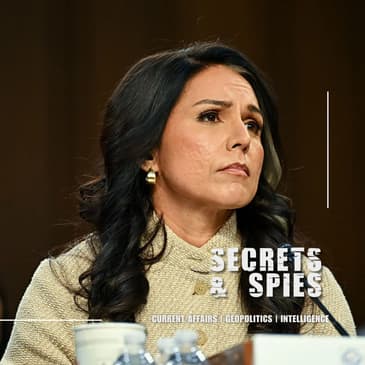
For most of her career, Tulsi Gabbard may have been taking direction from a reclusive Hawaii guru — the allegation at the center of a Washington Post investigation that shadowed her out of office as Director of National Intelligence. Her replacement, federal housing-finance official Bill Pulte, arrived with no national security background and, as The Atlantic's Shane Harris reports, may be holding the job unlawfully. Two directors in two months. Matt speaks with Shane — who's been reporting both stories — to trace them to a single fault line: an office built after 9/11 to coordinate the spy agencies has proven uniquely easy to politicize, and a bipartisan chorus, including veterans of the community itself, now wants it cut down or scrapped. Which leaves the harder question: whether an office this easy to bend should exist at all.
Subscribe and share to stay ahead in the world of intelligence, global issues, and current affairs.
"Tulsi Gabbard, her guru and the mysterious messages that helped shape her political career" by Jon Swaine | The Washington Post: https://www.washingtonpost.com/investigations/2026/06/21/tulsi-gabbard-her-guru-mysterious-messages-that-helped-shape-her-political-career/
"Trump Has a Bill Pulte Problem" by Shane Harris & Vivian Salama | The Atlantic: https://www.theatlantic.com/national-security/2026/06/bill-pulte-unlawful-intelligence-director/687684/
"Tulsi Gabbard’s Office Shouldn’t Exist" by John Sipher | The Bulwark: https://www.thebulwark.com/p/tulsi-gabbard-office-shouldnt-exist-director-national-intelligence-9-11
More of Shane’s reporting for The Atlantic: https://www.theatlantic.com/author/shane-harris/
Follow Shane on Twitter/X: https://x.com/shaneharris
Follow Shane on Bluesky: https://bsky.app/profile/shaneharris.bsky.social
Support Secrets and Spies
Become a “Friend of the Podcast” on Patreon for £3/$4: https://www.patreon.com/SecretsAndSpies
Buy merchandise from our shop: https://www.redbubble.com/shop/ap/60934996
Buy us a coffee: https://buymeacoffee.com/secretsandspies
Subscribe to our YouTube page: https://www.youtube.com/channel/UCDVB23lrHr3KFeXq4VU36dg
For more information about the podcast, check out our website: https://secretsandspiespodcast.com
Connect with us on social media
Bluesky: https://bsky.app/profile/secretsandspies.bsky.social
Instagram: https://instagram.com/secretsandspies
Facebook: https://facebook.com/secretsandspies
Spoutible: https://spoutible.com/SecretsAndSpies
Twitter/X: https://x.com/SecretsAndSpies
Follow Chris and Matt on Bluesky:
https://bsky.app/profile/chriscarrfilm.bsky.social
https://bsky.app/profile/mattfulton.net
Secrets and Spies is produced by Films & Podcasts LTD: https://filmsandpodcasts.co.uk/
Music by Andrew R. Bird
Photos by Graeme Sloan/Bloomberg, Julia Demaree Nikhinson / AP Photo & ODNI
Secrets and Spies sits at the intersection of intelligence, covert action, real-world espionage, and broader geopolitics in a way that is digestible but serious. Hosted by filmmaker Chris Carr and writer Matt Fulton, each episode examines the very topics that real intelligence officers and analysts consider on a daily basis through the lens of global events and geopolitics, featuring expert insights from former spies, authors, and journalists.
Hosted by Simplecast, an AdsWizz company. See pcm.adswizz.com for information about our collection and use of personal data for advertising.
[00:00:00] Lock your doors, close the blinds, change your passwords. This is Secrets and Spies. Secrets and Spies is a podcast that dives into the world of espionage, terrorism, geopolitics, and intrigue. This episode is presented by Matt Fulton and produced by Chris Carr.
[00:00:28] Hello everyone and welcome back to Secrets and Spies. Late last month, Tulsi Gabbard stepped down as Director of National Intelligence, and in the weeks since, two stories have landed that say more about the office she left than about her. The first, a Washington Post investigation alleging that for most of her political career, Gabbard took direction from the reclusive Hawaii guru she grew up under.
[00:00:50] The second, the man Trump named to replace her, Bill Pulte, a 38-year-old housing finance official with no national security background, who's keeping that job while he runs the intelligence community part-time, and he spent his first week firing career staffers. Two DNIs in two months, and between them, they've exposed something uncomfortable about how easily the very top of American intelligence can be bent.
[00:01:14] Here once again to help us think through what that means and whether the DNI's office should survive it is The Atlantic's Shane Harris. Thanks for listening. Thanks for watching. Take care.
[00:01:47] Shane, welcome back. Good to have you, my friend. Hey, Matt. It's good to be back. It's nice to see you. Thanks for having me. I know, of course. Always, always, always glad to talk to you. So, I have to tell folks, when I texted you last week, my plan was almost chill, if even a little bit, like, behind the news cycle. So, I wanted to have you on for a proper, like, post-mortem, I think I called it a, in, like, memoriam, on Tulsi Gabbard's run as DNI. Yes.
[00:02:17] And to talk through where the whole office goes from here, because there's been this, like, growing genuinely bipartisan chorus saying, ODNI is a bloated mistake that should be cut down or scrapped. Right. And then, in the span of that week, everything shifted. First, the Washington Post drops this bombshell investigation into Gabbard and her guru. And then, Bill Pulte, of all people, shows up to work for his first day as acting DNI.
[00:02:46] And he walks in the door and, like, the Red Wedding music starts playing in Tyson's Corner. So, we're going to get to all of that. But let's start where I originally meant to and set the guru stuff aside for a second. We'll get to it. Because I think it almost distracts from a more basic problem here with her. The case against Tulsi Gabbard was on the table before she was ever confirmed.
[00:03:15] There's the years of parroting Russian talking points, her record defending Assad, former officials warning out loud about putting her atop the intelligence community, and the Senate confirmed her anyway. So, looking back at that vote now, do you think that the vetting process, is that the vetting process failing or was it the process working as designed, just politics overriding it?
[00:03:44] I think it's more the latter. I mean, all these things that you point out correctly were known to people and were reasons why Democrats and Republicans alike had real misgivings about Tulsi Gabbard as the DNI.
[00:04:00] I look back on her confirmation hearing back last year in 2025, and, you know, it kind of opens with, you know, Tom Cotton, you know, this sort of rather stoic, you know, Republican chairman of the Intel Committee, not exactly hiding, you know, that this is a strange moment. If I remember correctly, it was something like this is not a conventional nominee. Like, he's kind of acknowledging that this is a little different and this is a little unusual.
[00:04:27] And she got in that hearing all kinds of questions from Democrats and Republicans about her qualifications, about things that she had said in the past. Notably, one of the big ones that came up was people grilling her over her closeness to Edward Snowden and trying to get her to disavow him and say, you know, do you think he's a traitor? Which is something that, you know, a lot of Republicans feel Democrats do. And she wouldn't do it.
[00:04:54] And there was a real moment there where it looked like that nomination was maybe hanging by a thread. And as I remember it, I think the key thing that worked for her and got Tom Cotton to support that nomination, which would help move it out of the committee, is he extracted a pledge from her to go to ODNI and start cutting it.
[00:05:15] And to cut personnel and to trim it back and to reduce its size because he felt, and he's not alone in this, that it had gotten too big and it strayed from his mission. And so I think that's broadly what happened. I mean, she went in, she pruned the place back massively, and she did all of the things that people were worried she was going to do in terms of the propaganda that she spewed, the Russian talking points,
[00:05:42] the spreading of conspiracy theories about the election and the deep state and all the rest. So in that way, I feel like she wasn't that surprising. But, you know, she got confirmed because she was willing to go in and blow the place up. And that's broadly what she did. Right. I mean, Tom Cotton and Tulsi Gabbard, very strange bedfellows there.
[00:06:06] Do you think it, what does that say, I guess, about how much, because it was a total party line vote in the Senate. All the Republicans voted for her. It was like 52 to 48. All the Democrats voted against her. What do you think that says about how much Republicans in the Senate wanted her to go in and slash and burn the place that they look past her judgment and her views? Which is there's a wing of the Republican Party that's that's with that.
[00:06:36] But I would say most Republicans, the vast majority of Republican senators are not. Most Republican senators, I guess if you could have took a poll, they probably wouldn't be able to tell you how many people worked at the ODNI. Right. I mean, the ones who care about that issue and Tom Cotton genuinely cares about it, wanted her to do that. But I think to the broader point, and you're right to point out that it was a party line vote. I think what this really shows you in the bigger scheme of things is the degree to which national security has become utterly politicized, just like everything else.
[00:07:04] And it's not that this is the first time we've had largely party line votes for key positions, but we have been trending towards this now for a while. And in this administration, I think it just underscores how you could have somebody who like, you know, let me just be frank about this. There is no caucus out there or a group of people you're going to find who thinks Tulsi de Gabbard as DNI was a great idea. Right. OK, they may have voted for her. That's a party line vote.
[00:07:30] And there were deep misgivings and you could see it, as I said, in the confirmation hearing. That was not enough to overcome the partisan requirement that Donald Trump's nominee be confirmed, you know, and she was just this side of like implausible entirely. Like we're not talking like when, you know, Matt Gaetz was floated for attorney general and people like absolutely not. Or frankly, Bill Pulte. Yeah, no way.
[00:07:56] When Bill Pulte's name pops up and even Senate Republicans are like, no way that's not happening. And they have their own petty reasons for that, too. But she'd been a member of Congress. She'd run for president. She was just like this close to being radioactive. And it was it was just enough to get her over the line. But like this is just this is partisanship. That's how she ultimately got in. I mean, if Tom Cotton had not supported her nomination, it would have gone nowhere. I mean, that he needed to be able to be the voice there.
[00:08:25] And he got his what he wanted. But broadly speaking, it's just it's it's pure politics. And national security is clearly not immune from that anymore. Do you think perhaps the ire and the question marks and the revulsion to someone like Matt Gaetz somewhat shielded Tulsi Gabbard and even like Hegseth to an extent? Yeah, maybe a little bit. I mean, because like Matt Gaetz is just so offensive to so many people. I mean, some of this also comes down to like personality. Right. Right.
[00:08:52] Like there are Republicans who don't like Bill Pulte. It's not that they think that, like, I'm concerned he doesn't have any qualifications to be the DNI. And he doesn't. He has zero national security credentials. They just hate Bill Pulte. Like Tom Tillis is a good example who has said publicly, I don't like him because he went after Jerome Powell, the Fed chairman. So there are like on a personal level, Scott Besant famously, like they almost got into a fight at a party one night.
[00:09:19] Yeah, literally, Besant has talked about that under our testimony. So I think that there were also look, there are Tulsi Gabbard used to be a Democrat. Right. She has friends in the Democratic Party, including people who are on that committee who I think were trying to help her. But, you know, we shouldn't take this as like, you know, unnecessarily votes on principle. Some of this is just personality and politics. Yeah, yeah, for sure.
[00:09:47] So getting back now to the to the guru story, and I want to be precise about how this is framed because religion itself, I think, is totally besides the point here. Yes. But so John Swain and your former colleagues at The Post obtained something like 25,000 pages of documents suggesting Chris Butler, the leader of this secretive Hawaii-based Science of Identity Foundation or SIF.
[00:10:14] And I wonder if Disney's lawyers have ever reached out to them about that. A religious group. Gabbard grew up in, directed her policy positions and even like her talking points for years. It's in pretty kind of like rough, abusive ways. Butler's deputy disputes this. Gabbard's people called the whole thing anti-Hindu bigotry. Meghan McCain's been very spun up about this, oddly.
[00:10:42] Apart from the cult accusations, as like a national security matter, what's the actual concern when the person who ends up running the intelligence community may have had her worldview and perception of the IC shaped off the books by a figure nobody vetted? Yeah, there really are two kind of big concerns for me that come to mind.
[00:11:03] One is that if a senior official like the DNI is enthralled to someone, and I mean like if she's devoted to this person as her spiritual leader, like it's not just like, you know, I talk to my priest, not me personally, but like, you know, someone says I talk to my priest or my rabbi. This is a different relationship and she has spoken about it differently. This is somebody who is a major influence on her.
[00:11:28] And we know from lots of public reporting demands loyalty and has a devoted following that is extreme. I mean, there have been credible reports about people collecting Chris Butler's toenails and eating them, eating the sand that he has walked on. Okay, so this is a, this is, these are people who feel extremely deeply about their devotion to this individual and the movement that he runs. And it's a free country.
[00:11:59] You are free to believe whatever you want. But when a senior official has a close relationship with that person who, according to these emails, I mean, it looks very strongly like, and it's, we should say that John Swain did an amazing job on this. He did. And he's very clear. There are places where it doesn't say Chris Butler wrote this, right? It's, it's part of the story. But, you know, if that, it's pretty obvious that people in that organization had political aspirations and wanted to influence policy. They're overtly talking about this.
[00:12:28] So that's one big problem, right? When somebody is, has that much control over a senior official, that much influence, and we don't know anything about it. And it's happening at a site. The other is, you know, Tulsi Gabbard in her position was privy to the most highly classified intelligence that the U.S. government collects. Is she, is she sharing that with him? Is she talking back to these people? What is she saying to people in her organization and this religious group that she shouldn't be saying? And there's no evidence that that happened in the story.
[00:12:58] But that's like a risk that you would immediately would come to mind, that there's a kind of a two-way street here. Butler trying to influence Gabbard and Gabbard potentially sharing information with Butler. And, you know, you don't want either of those things to happen. Yeah. Butler's own lectures, according to the Post, described intel agencies as power-hungry madmen.
[00:13:21] And I think if you look at how Gabbard's views on, say, Assad or Putin or Snowden, I don't think it's much of a stretch to think that her worldview is probably very similar to that. I mean, what does that say when that person then ends up at the top of the IC? Yeah, that gets a great point. I read John's story and I thought, oh, OK, so this is where her suspicion of the quote-unquote deep state comes from.
[00:13:46] Right. This is where her just deeply paranoid conspiratorial views about the agencies that she runs sound a lot like what Chris Butler talks about when he talks about intelligence organizations. And we're used to this kind of rhetoric. I mean, for decades, we get it. It's I mean, the conversation in the United States about secretive intelligence agencies is suffused with this kind of anxiety and paranoia. And they're all powerful and they're all knowing.
[00:14:14] And I mean, you know, people like you and me, people listen to your podcast. No, that's really far from the truth. But it always struck me like, why on earth does Tulsi Gabbard believe this stuff? Like she'd been in Congress. She had served on committees where she received classified briefings in the military. She'd been in the military. And sometimes I just found myself genuinely puzzled when I would write about her and cover her. Like, is this an act? Is she saying this because it kind of goes with the MAGA talking points about the deep state trying to undermine the president?
[00:14:43] And she did very much talk about, you know, she talked about the years long coup against President Trump, you know, which she has this whole convoluted theory about how Russian interference in 2016 and the investigation of that. And it extends in this years long conspiracy, you know, and the Justice Department is investigating this now, too. But I never knew if that was just kind of like an act or if she genuinely believed it. And so then I read John's reporting and I'm like, I wonder if she's getting it from Chris Butler.
[00:15:11] Like, I wonder if that's the the environment in which she steeped. This organization educated her. She was sent off to a school, I believe, in the Philippines that they ran, you know, separated from her parents at a young age. And I just wonder if that kind of paranoia came from her guru and informed how she thinks about things. Yeah. So the John Swain and The Post, I think, took like something like 18 months to fully put this story together.
[00:15:39] I mean, you've been inside plenty of newsrooms, the newsroom at The Post specifically. Can you speak to like that tension of when you're building a story like this that has really serious national security implications, like explosive national security implications? But story isn't there yet. You don't have the sourcing. You don't have the confirmation. However, there's this really bad stuff that you're walking around in your head with. Like, what is what is that like? How do you decide that? It's very hard for the reasons that you said.
[00:16:08] I mean, journalists who are good investigative journalists are competitive and, you know, they want to get things out there before their competition does. In this case, it sounds like they realized they probably had access to documents that no one else had, which is always a great place to be from a reporting perspective. But, you know, reporters report information to tell it to the public.
[00:16:26] And, you know, it's clear from reading John's story that they hit this point where a kind of curveball comes at them and they're not exactly sure who the author of these works or these emails and these messages are because there's somebody who comes forward to claim that, well, I wrote them and Chris Butler didn't. And I think they do a good job in the story of unpacking like, yeah, that's probably not accurate. But, you know, the reason that the Post is a very responsible news organization.
[00:16:54] Right. And I mean, I worked there for seven years and editors are not going to run a story until they are confident it's ready. And that means you can stand by every word in that article, every word. And I think there are about 7000 of them in John's article. And, you know, that story will have been deeply reported, deeply edited, deeply reviewed by layers of editors. I have no doubt that lawyers reviewed every single word of it. And there is a dialogue that goes on.
[00:17:24] Hey, with a group like that. Yeah. Yeah. That goes back and forth. And that story probably will have gone through dozens of versions, I would guess, to get it just right. And, you know, it is it's a very anxiety inducing experience when you feel like if we don't move on this now, the story is going to get away from us or it's no longer going to be relevant. And then, of course, she announces her resignation, which I have no doubt that probably kind of I got to imagine that sinking feeling that, you know, he may have John may have had.
[00:17:53] I haven't talked about this, but, you know, if I were writing a huge story for a year and a half on Tulsi Gabbard and she suddenly was like, peace out. Bye for the DNI. It's like, well, then why do we do the story? Right. Your reason for doing it has to be strong as well. And I think they actually had a very compelling reason to still do it. She was still the DNI, but also she imagines a life for herself, I think, in politics. Right. So, yeah, I mean, these kind of things. I mean, that's a long time to be working on a story and to have to live with it.
[00:18:21] But it's so rigorous and and good news organizations like The Post are so responsible. And his editors on that team, who I also know well, are terrific. I mean, they're some of the best in the business. Let's take a break and we'll be right back.
[00:18:49] So the stated reason she left was her husband's cancer diagnosis. It's a pretty serious one, which is real. And I don't want to question that. But the timing is at least, I think, worth noting, as you said, she announced her departure two days after the Post told her this story was coming. I know you said you haven't talked to John or anything, but do you have is there do you think there's some some connection there? Some element? It could be. I could imagine. And I'm just imagining this. I have no reporting on this, but I could imagine a kind of a confluence of factors. She was like on her way out.
[00:19:19] I mean, there were rumors abounding for months that Trump was going to fire her. And I think there's still like, you know, depending on whose story you believe, did she quit or was she pushed? A little bit of both. That's how it often happens with these things. But it was very clear that the president didn't really want her around. She didn't have a lot of influence with the president either. No. So she was kind of a short timer already. And we were all kind of expecting her to go pretty soon.
[00:19:45] I had actually been working on my own, you know, short piece about her, nothing like what John was doing. And then when she announced her resignation, it's like, well, OK, I mean, you know, we don't necessarily have to do that story now. It's like, well. So I could imagine like her finding out the story was coming, maybe factored into her decision to speed it up. But to your point, I mean, her husband, who is, by all accounts, an extremely central part of her life, has this terrible illness.
[00:20:12] And, you know, if that were my husband, I would probably quit my job to be with him, too. Yeah, that's fair. Moving to Bill Palti here, starting with the legal question around his appointment, because you came out pretty firmly in your piece published in The Atlantic yesterday. Link in the show notes. Folks should check it out. That this statute on his appointment governing, you know, what the DNI should be is essentially pretty, like, ambiguous. Can you speak to that? The statute that created the DNI, it's the Intelligence Reform and Terrorism Prevention Act.
[00:20:43] It's the post-9-11 legislation that created the ODNI, right, which was very much a response to the 9-11 attacks. And people said, all right, we need this new coordinator to make sure that we are sharing intelligence across the agencies and things don't fall through the cracks. Like they did before the 2001 attacks. So it says that, you know, in the event of a vacancy in the position of DNI, the principal deputy director, which is the number two, shall be the acting director.
[00:21:12] It doesn't say may be. It says shall be. So that is very clear language. I can get more into the weeds if you want, but suffice to say there are other provisions in the law where you can tell the authors anticipated that a president might say, yeah, but I have this thing called the Vacancies Reform Act. And that lets me do the following. And it essentially says, nope, you got to make it. It's the principal deputy. It's only the principal deputy.
[00:21:41] And there have been, you know, the Justice Department and Trump One kind of challenged this in a different context. But all of it, what it adds up to is that the only person who is supposed to be serving as the acting DNI is the principal deputy. And that is not Bill Pulte. It's a guy named Aaron Lucas, who is currently the principal deputy, is a career CIA officer who has ample experience for the job and is available to serve. Like he works there.
[00:22:11] And so with the argument that I'm making in the story is that, you know, Bill Pulte may be unlawfully occupying the office of the director of national intelligence. And that's a significant thing because, A, we shouldn't be, you know, putting people unlawfully in senior positions. But also he is going over there to enact pretty significant changes, including firing people.
[00:22:35] And I spoke to one attorney who made the point that, you know, if you have civil service protections, how can you be fired by somebody who's unlawfully serving in the position of your boss? Like, how does that work exactly? And, you know, I think it's in the grand scheme of things with the Trump administration, it's a minor point because, frankly, the Trump administration disregards all kinds of things that laws and rules say.
[00:23:00] But it really bears emphasizing here because not only does the law say that Aaron Lucas should be the director, Bill Pulte has no national security experience. We have more national security experience than him. A hundred percent. Like, I'm not kidding. No, that's not. Absolutely. We are not exaggerating about that. He has none. And, you know, there have been DNIs in the past who had questionable degrees of national security experience.
[00:23:27] One in the first Trump administration was John Ratcliffe, now the CIA director, whose first nomination failed and Trump won because, you know, senators were not convinced that his record, you know, was sufficient for him to fill that role. He was nominated a second time, by the way, while there was somebody else unlawfully serving as the acting DNI, which we can talk about.
[00:23:52] But, you know, even Republicans in this current Senate are like, no way on Bill Pulte. Like, he would not get confirmed. And they've made that very clear. So then, you know, there's a whole other set of issues of why Trump is moving ahead and putting them as the acting anyway. We're going to get to that. Yeah. But you've got somebody who's not qualified. He's possibly unlawfully in the position who even Republicans don't want there. So, like, what is going on?
[00:24:19] Is there a realistic path where a court blocks Pulte or unwinds something he does as DNI? I don't know how quickly that could happen. I mean, how you'd have to have standing to do this. I mean, I suppose that somebody who was fired, who's a career person, could say civil service protections. I could contest it and say I have standing to say that basically he shouldn't even be the acting DNI. You might have to do some bank shots and legal maneuvering to do that.
[00:24:46] Mark Zaid, I'm sure, is working overtime on this. Yeah. He's on it. But there is, you know, Trump has said he's going to nominate Jay Clayton, who is currently the U.S. attorney for the Southern District of New York, a qualified person who Republicans have made very clear they would support. And Democrats, he'd probably get some Democrat votes, too, I would bet. Yeah. He's waiting in the wings. There's a whole other complicated political story, which we can talk about if you want, about why that's all been delayed.
[00:25:11] But, you know, it's yet another point that, like, you don't need to have Bill Pulte doing this job. It's very clear why Trump wants Bill Pulte to do this job. He has said so. He wants him to fire people and find evidence of election fraud. Right. I mean, I've wondered if maybe the most damning thing here isn't necessarily whether this is technically illegal. It's said it's even like a debatable call. Yeah. You know, like the people who built an office this important wrote in a confirmation requirement and an experience requirement.
[00:25:39] And there's arguably a loophole wide enough for Caligula to ride his horse through, like no Senate blessing required. So whether or not a court whatever approve it or not, the fact that this administration can plausibly argue it and dare anyone to stop them while the horse makes a huge mess on the floor. Like, that's a story in itself, isn't it? Yeah, I think it is.
[00:26:03] And I think it tells you that we have a Republican Party in the Congress right now that is loathe to ever stand up to the president and say, you can't do that. Right. I mean, if Tom Cotton had come out and said, you know, Mr. President, the law is pretty unambiguous or, you know, we need to have Aaron Lucas as the principal deputy because Tom Cotton has never said I support Bill Pulte either. He's been rather quiet about that. You know, Donald Trump would light Tom Cotton up. He would go after him. There'd be a few. There'd be a brawl.
[00:26:32] You know, I want to be clear. I don't mean to suggest that like Republicans are fine with this. I don't think many of them are. I cannot imagine that that Tom Cotton is thrilled. This is the case. He has said publicly he supports for the reductions to the office. And if that's what Trump is about with Pulte, he supports that piece. Tom Cotton is a serious person who takes his job very seriously. But, you know, you've got it's the story of this Congress. Right. They don't act like the legislative branch. They don't act like the check.
[00:27:01] And, you know, you mentioned the courts. In the first Trump administration, the Justice Department came up with a memo from the Office of Legal Counsel, which is kind of, you know, the office that says here's what we think the law says. And as far as the executive branch is concerned, it sort of is the law. And it's an analogous case to what's going on with DNI, where the administration was arguing that they had the right to appoint as the acting director of the Consumer Financial Protection Bureau, which is that post 2008 financial crash office.
[00:27:31] That they could appoint an acting director, even though that law also says it shall be and it names the official who it shall be. And a court agreed with them. I don't think you can overcome that, though, even in this case, because the law that created the DNI says, yeah, yeah, we understand the Federal Vacancies Reform Act allows the president to fill positions that are vacant.
[00:27:55] And that's fine for every position at the ODNI except for one, the DNI. Like it spells this out. So, you know, courts, people who are, I think, skeptical of my argument will say, but the courts have weighed in and have said the president can do what he's doing. Not really. I mean, not precisely. The law has something to say about this. So, you know, is there a challenge for it? Maybe. But is that going to happen before, like, Bill Pulte goes over to do his work?
[00:28:25] No, that would take way too long. Right. And, you know, Rick Grinnell was appointed acting director in the first term. In avoidance of that same shall be thing, but Rick Grinnell was an ambassador. Yes. So there's, I guess, arguably the national experience there. That's true. I mean, in the sense that could you have nominated Rick Grinnell to be DNI and Trump threatened to do it? And this is another situation where Republicans didn't like Rick Grinnell and they don't like Bill Pulte. Would he have met this qualification standard? Sure.
[00:28:53] I mean, arguably, you know, Dan Coats, who had served in the position earlier in Trump one, had also been ambassador to Germany. He was also a senator. So, you know, people when Dan Coats was nominated, I think people's reaction was like, OK, maybe. Sure. And Rick Grinnell had been spokesperson, I think, at the United Nations. So, I mean, Rick Grinnell has national security experience relative to other people that held it. But he was put in there as the acting. And again, so you had the same problem, right?
[00:29:22] And this kind of this argument and this issue came up in legal circles at the time. But, you know, I think that there was maybe not as much kind of urgency around the question then because Trump had this guy, John Ratcliffe, that he wanted to nominate that people were like, maybe.
[00:29:42] But also there you didn't kind of have the experience of having just spent the first year as we do of this administration of just slashing and burning national security agencies. Right. What's different in this administration as opposed to Trump one is the dismantling of core parts of the FBI, core parts of the DNI, the dismissal of CIA officers in some cases, you know, the gutting of the State Department.
[00:30:09] The whole national security apparatus is being pulled down. And that wasn't what was happening in Trump one. And Bill Pulte is being sent over to Liberty Crossing as part of that mission. That is why he is there. And so that's different. That's a different political atmosphere that we're operating in than in Trump one, where Rick Grinnell was the acting DNI, arguably in an unlawful way because of what the statute says. Right. Well, you know, you mentioned Trump.
[00:30:39] Like Aaron Lucas, the principal deputy DNI, like right there, confirmed experience. No woke lib himself, hardly. Yeah. Already running in place day to day. But Trump took the legal exposure, the bipartisan blowback and passed him over for Pulte anyway. And I think if you get down to like the answer of why it's not just he doesn't just want another yes man at the top of the IC like he's he's already had that.
[00:31:07] He wants a yes man who will mine the depths of every high side system he can he can find and surface, you know, anything that will. Give some more lifelike mask to the fantasies and grievances. Yeah, I think I think that's exactly what he wants. And again, Trump has said as much in interviews this in the past month. I don't know Aaron Lucas. I know people who know him and I know his reputation.
[00:31:37] You're right. He's not a woke lib. A lot of the politically appointed deputies in the ODNI, some have been fired in the past 24 hours, are libertarians. A lot of them have come from right wing think tanks. They're largely on board with the president's foreign policy and national security decisions. Cato. Yeah, Cato people. There's a lot of defending that not defending democracy. What's the heritage? Defense priorities. Sorry. Oh, OK. Yeah.
[00:31:59] But, you know, I doubt that Aaron Lucas would really enjoy being acting DNI and having to tweet about the deep state and start declassifying information to, you know, prove ridiculous conspiracy theories. I mean, if he did that, I mean, he'd be abandoning, you know, his career as an apolitical, you know, intelligence officer. Right. And, yeah, there's politics and intelligence, particularly at senior levels.
[00:32:28] You have to be a pretty sophisticated operator to rise to those levels. But that's not what we mean here when we talk about the job that Bill Pulte is going to do or that Gabbard did. And I doubt that Trump would want Aaron Lucas doing it anyway. I don't know how he feels about Aaron Lucas, but I mean, you know. Does he know who Aaron Lucas is? I'm not sure he does, honestly. I mean, you know, and I mean, will he think, oh, it's a Tulsi guy or what? But he'll know he's a career intelligence officer.
[00:32:54] I think that Aaron Lucas probably has some more political connections in the administration. So Trump may know who he is. But, like, the job that Trump wants done is better suited to someone like Bill Pulte. And it's interesting Trump has even said, you know, oh, it's kind of good. You know, if he's acting, he won't be there too long. You don't want somebody to get too entrenched. You just want him to kind of be over there and do the job and get it over with. So he sees in Bill Pulte this kind of asset of a guy who's like more or less a short timer with a to-do list.
[00:33:23] And I think that's a much better fit for what Trump wants than a career intelligence officer who, if Aaron Lucas took over as DNI, would be just very much in a caretaker role. That's how he would, I would presume, see it. And that would be the normal pattern. Right. So, I mean, it's been like a week. So early days still. But what's Pulte done so far? Are you hearing things from inside the building? Yeah.
[00:33:47] So we've heard that a handful of people have been and politicals have been dismissed. We think it's around six. My colleague Vivian Salama and I have reported it's about a handful. I think it's about six. We also reported that Will Ruger, who was in a pretty senior position over there, a political guy, he's been removed. He's kind of in that category of people, again, I would say, like sort of more libertarian or kind of, you know, more on the right on defense issues.
[00:34:16] He ran a libertarian think tank before he had this job. Somebody I should say, by the way, is like respected. I mean, you know, I talked to allies who were like, yeah, we know Will and, you know, he's good. But then there's been probably a few dozen, maybe as many as four dozen career officials who have been sent back to their agencies because a lot of people who work at ODNI come from a different agency and are temporarily assigned to ODNI.
[00:34:41] And then we believe there were some other senior officials who were removed from their posts to an analytic capacities, although we're not entirely sure yet who they are. So long story short, he's firing people and removing people. The office has already been hollowed out. I mean, depending on the reports that you see, maybe around a 40 percent staff reduction since Gabbard took over. That was her goal. So there have been hundreds of people let go.
[00:35:09] It seems that it's not going to be the bloodbath that many people feared, which is to say there were some people who thought he was going to go over and just start slashing dozens or hundreds of positions. Doge it. Yeah, kind of doge it. For now, it seems like no. I mean, as with all things in this administration, that could change tomorrow, today. It could be changing right now as we're talking.
[00:35:30] The other things that we had heard from sources were that they were expecting them to make structural changes, possibly things even like removing the National Counterterrorism Center and putting that in a different agency like Homeland Security. It seems like maybe that's not going to happen. Notably, he tweeted that he had met with staff at the NCTC and said they were great patriots and look forward to working alongside them.
[00:35:55] So, like, clearly this rumor was based in some, you know, had some real basis to it that he might want to move NCTC. You could read that tweet as saying not right now. Let's take a break and we'll be right back.
[00:36:22] Focusing on the institution itself, I want to bring in something John Seifer wrote because John's also a friend of the show and he's no institutional arsonist. I mean, he spent the whole Trump era defending the civil service against exactly this kind of abuse. And yet, back in May, before Pulte, he wrote a piece for The Bulwark arguing that ODNI should be abolished. His point, I think, is pretty sharp. And that's, you know, CIA, NSA, DIA all have missions.
[00:36:50] Recruit sources, steal secrets, break codes. And missions are hard to politicize. The DNI's office has a role and that's it coordinates, it briefs, it nominally speaks for the agencies and their products with all the prestige and access. But no real kind of operational command. And he says that, like, a role is easy to politicize. So John says abolish it.
[00:37:15] Pulte is abolishing it or may in some way, but by, like, attrition and subversion. Do you think, like, if the ends are kind of the same thing, does it matter how it gets done? I think it matters, yes, how it gets done. Because what you don't want to do is do it sloppily. You don't want to do it chaotically where people are fearful or they're just distracted. I mean, anyone who's ever worked in an organization in crisis, and I've worked in a few, it's like it's hard to get work done.
[00:37:46] And, you know, I think there also needs to be a role for Congress in that. I mean, this is an office that was created by Congress, right? And they should be potentially consulted on it as well. But I think you're right to point out, Matt, that, like, this is all kind of driving in the same direction, which is that I think that one way or another, that office is going to get cut back.
[00:38:16] Mm-hmm. So the last, because you could imagine a way in which he would go in there and just so diminish the place that if it wasn't officially shut down, it basically just withers. And if you're going in and you're removing people like Will Ruger and these very senior deputy people, you're removing the leadership of the organization. And, you know, after a while, how much is that organization really functioning, right?
[00:38:41] And the tasks and the things that those people did will have to then get picked up by other agencies. I would predict where this thing is likely to end is that the DNI, quote unquote, you know, the person who has the most influence or oversight in the intelligence community is going to be John Ratcliffe. That a lot of these tasks and duties will revert to CIA where they were handled before, things like the president's daily brief and the coordination of intelligence products.
[00:39:10] Which is to say nothing of the tremendous amount of intelligence operation that goes on under the defense secretary's purview, like NSA. But, you know, I think we're kind of moving back to a pre 9-11 role in which the CIA director starts to look more like what it used to be, which was the director of central intelligence. He used to be called the DCI. And it was sort of kind of the DNI. And they had this thing at DCI called the Office of Community Management.
[00:39:41] And that kind of fulfilled some of the roles of the DNI did. But it's been drifting back in that direction for a while. I think it's probably going to go there. And, you know, whether you get there through this is not an administration that does anything, you know, according to process. Right. There's no like good order and discipline. It's not how they do things. And, you know, if I were Jay Clayton, I mean, I kind of made a joke, too. And Trump said he was going to nominate Jay Clayton.
[00:40:10] I was like, man, what did you have? What did you do to get that demotion? Like, you're the assistant U.S. attorney for the Southern District, right? The sovereign district of New York. It is arguably a demotion. Yeah. Yeah. It's like, why do you want this job? You know, maybe it'll never happen. Maybe Bill Pulte will run out his 210 or whatever days is acting. And they'll just keep going. And then, you know, it'll be like, oh, there's not really a DNI much left anymore. Could happen. Is there also like more of a devil's advocate thing here?
[00:40:38] Is there more of a danger, too, in going back to that sort of pre-9-11 status quo? I mean, that, hence 9-11, that system wasn't great either. Yeah. I think it's the most important question to ask. And I guess, I mean, I think John Seifer gets at this in his piece, too.
[00:40:53] I would say, sure, but I don't think that the DNI is the reason that the intelligence community has learned to operate more like a community in the 20-plus years since 9-11.
[00:41:11] The people in those agencies recognize what the deficiencies were in the system, where the gaps were in the community that allowed, you know, quite literally Al-Qaeda terrorists to get into the country and get onto airplanes in 2001. And a lot of that, I won't say it's all been fixed, but a lot of it's been addressed. And the community does operate more coherently now. And that's not because of the DNI, right?
[00:41:39] It's not to say that there haven't been very good DNIs who've done good work and who, you know, the closest thing that I can think of, the person who's probably served as the person who is like the central convener and like the gray beard in the intelligence community was Jim Clapper when he was the DNI. Exactly. And Jim had, you know, I think was literally the most experienced intelligence officer like in the United States government at the time. He has spent his whole career there.
[00:42:07] But, you know, I think even he would tell you like it's not like his office like told people what to do. Right. I mean, you can set policy, you can advise the president, but that office has just never been empowered. It's not when people say, oh, it's like a conductor. Not really. You know, conductors up there telling the violins when to come in and the percussion and all. That's not really what the DNI does.
[00:42:28] I mean, frankly, the national security advisor does more of that kind of role of deciding what gets put before the president to make a decision. So, you know, I think it's worth thinking, keeping in mind. But like, I don't think that if we get rid of the DNI, I don't buy the argument. It's like, oh, God, we've just gone back to the bad old days before 9-11. The community has changed and is changing again because the targets are different now than they were after 9-11. Right. Yeah. It's more.
[00:42:56] I mean, it's more back to the William Colby days. You know, yeah. Yeah. It's China and Russia. Well, now Mexico. Sure. Greenland. So, John in his in his book piece also quoted a line from James Madison that I thought was really interesting. And that's enlightened statesmen will not always be at the helm.
[00:43:19] And his point is you have to design an office for whatever whoever might one day occupy it, not just the person you wish you would like that, you know, clapper. Which is really, I think, also the thread that ties Gabbard and Pulte together. It was never about the individual. It was about an office that anyone could corrupt.
[00:43:39] So let me sort of end our wrap up our conversation here where our conversation last summer about Tulsi and DNI ended. But sort of looking forward a bit. So if, you know, no organizational chart can fix political cowardice. Right. The real failure here is a Congress that won't do oversight. Does sort of redrawling the org chart change anything at all? Or are we sort of back to reorganizing for the sake of looking like we've done something?
[00:44:09] I think more of the latter. I mean, I think that there are very good arguments for getting rid of ODNI, you know. And maybe that streamlines the org chart. The bigger problem here is Congress not asserting its role as a co-equal branch of government and performing the check and balance function. There are people in positions who are not qualified for them. And look, this whole question of like, what has qualified me in the case of the DNI literally spells it out. Right.
[00:44:38] And, you know, Bill Pulte is not. But, you know, I just think that this administration has been putting up just deeply unserious people to run hugely important organizations like life and death stakes. Like out of spite. Well, yeah. And it's because they're loyalists and because they'll do whatever the president wants. I mean, we have entered into I think you and I've talked about this before.
[00:45:00] Like there were plenty of people in Trump one who, I mean, let's be honest, would not have been at the top of the list of a normal Republican presidency. No. Good people. Fine. But like that's not your A-list who you're going to. And they nominated the people they could get. And even those people took the job seriously and ended up being kind of a bulwark against the president, even if they might have agreed with some of his policies. You don't have that now. I mean, there's nobody standing up to this president.
[00:45:28] I mean, they're all on board in the national security space. And, you know, that's its own problem. But Congress has essentially just abdicated anything like a meaningful role of oversight. And one of the easiest, most meaningful ones they have is advice and consent. Right. And, you know, you don't have anyone coming to the president and saying you can't keep nominating these people who are just not serious. And you see what we've gotten. You know, we've gotten hollowed out agencies.
[00:45:58] We've gotten into a war that was a disaster. I think the war in Iran will go down as one of the biggest foreign policy disasters in U.S. history. Since Iraq, for sure. Yeah. I mean, it's just I mean, like, what are we doing? And, you know, and the people who are at the top of these organizations, they're the ones setting the policy agendas. They're the ones firing people. They're the ones tweeting all the time. They're the ones advising the president who, of course, you know, at the end of the day just does whatever he wants. I don't know if anybody really advises him.
[00:46:27] This is exactly when Congress should step in. I mean, every minute, at every turn, they should be here because there are still some serious people left in Congress, particularly in the Senate, who, you know, we know are looking at this and privately, you know, you know, disapproving. Privately. Yeah, privately. And I get in the rare instances when like public disapproval comes out. Right.
[00:46:54] It has to be such some extreme case like nominee, like suggesting that Bill Pulte should be the DNI, which is such an asinine idea that even Republican senators say, forget it. That's not happening. But like that's how far out you have to go to get members of Congress to take seriously their prerogative as a co-equal branch of government. Right. And that's that's just where we are right now.
[00:47:22] I mean, I think that the the big political story of our time is the failure of Congress. Yeah. You know, I mean, Donald Trump became elected president for all kinds of reasons, including that he sensed the moment of where people were in this country. And has been an extremely strong, although not very effective, in my view, executive. Congress is just not showing up to work. Yeah. Yeah. Now, I tell people that all the time, you know, they're like, what? How can this happen? Like, how can you just do that?
[00:47:52] Like, is there no way to stop this? I'm like, yeah, there's plenty of ways to stop it. It's all written down. The people who are designated to do something about it just are saying, no, don't feel like it. Yeah. And we could and we could talk about, you know, ending partisan gerrymandering and not making primaries the place where the only the extreme candidates win because only the extreme voters come out. There's all kinds of systemic things here. But, you know, I mean, it's really worth remembering that if you go back to Nixon. Right.
[00:48:17] I mean, you know, much as I love the Washington Post, the Washington Post did not take down Richard Nixon. No. Right. They created the environment in large measure in which then Republican members of Congress and the Senate went to Nixon and said, you got to go. Right. And we are so far from anything that you could imagine that lawmakers would go to this president and say, we're drawing a line, you know.
[00:48:44] And, you know, he is just slamming it right back in their face. I mean, the reason that Jay Clayton has not had a nomination hearing is because Trump is tying his nomination up with this idea that he has that he's going to push through this new ID requirement for registering to vote, the Save Act. The Save America Act. Yeah. Which is not happening. Republicans have already said there's no way we're passing this.
[00:49:14] We're not doing it. And so what is he doing? Making their lives extremely difficult. Yeah. Like getting in fights in meetings with Republicans, supporting extreme primary candidates in key races. I mean, at some point, you got to wonder, like, today, Republicans, how much longer are you going to put up with just getting kicked in the teeth by this guy who has said publicly he doesn't care about the midterms? Right. He doesn't care if you lose.
[00:49:40] I mean, it's just it's amazing to me, like, how much that their ability to absorb this humiliation and punishment. I mean, I it's some kind of superpower, I guess, that they have. Yes, I could offer some ideas, but probably probably not best for this show. Anyway, some people are just into that. I don't know. Yeah. It's just how it goes. It's just how it goes. All right, my friend. Well, Shane, a pleasure as always, sir. Great to see you, Matt.
[00:50:09] For the reporting and for chatting with me. We'll have links to your work at The Atlantic in the show notes. Thanks for coming back on. Thank you. It's always a privilege to be on. Thanks, Matt. Thank you.
[00:50:45] Thanks for listening. This is Secrets and Spies.