
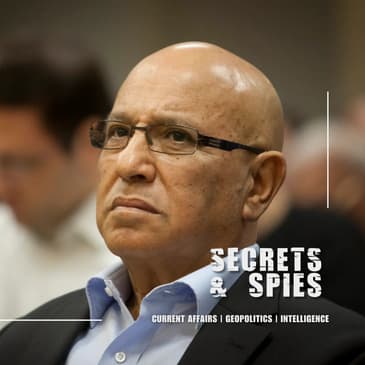
Samuel M. Katz is a New York Times bestselling author and one of the foremost chroniclers of Middle Eastern conflict, special operations, and intelligence. His latest book, The Architect of Espionage, is the biography of Meir Dagan — the Holocaust survivor turned soldier turned spymaster who reshaped Mossad from a cautious intelligence collector into a direct-action force of global reach. Chris speaks with Katz about the experiences that forged Dagan: rejection from Israel's elite commando ranks, the undercover war he built in Gaza under Ariel Sharon, and the Lebanon fighting that made him a man of war who hated war. The conversation traces his eight-year tenure as Mossad director — the covert campaign against Iran, the intelligence diplomacy that helped lay the groundwork for the Abraham Accords — and what October 7th revealed about the limits of the very apparatus he built.
Subscribe and share to stay ahead in the world of intelligence, global issues, and current affairs.
Order The Architect of Espionage: The Man Who Built Israel's Mossad into the World's Boldest Intelligence Force: https://www.amazon.com/Architect-Espionage-Israels-Boldest-Intelligence-ebook/dp/B0DV6T6XDM/
More about Samuel on his website: https://samuelkatzonline.com/
Take our audience survey: https://forms.gle/eFx59XntNtiKzNQa8
Support Secrets and Spies
Become a “Friend of the Podcast” on Patreon for £3/$4: https://www.patreon.com/SecretsAndSpies
Buy merchandise from our shop: https://www.redbubble.com/shop/ap/60934996
Buy us a coffee: https://buymeacoffee.com/secretsandspies
Subscribe to our YouTube page: https://www.youtube.com/channel/UCDVB23lrHr3KFeXq4VU36dg
For more information about the podcast, check out our website: https://secretsandspiespodcast.com
Connect with us on social media
Bluesky: https://bsky.app/profile/secretsandspies.bsky.social
X/Twitter: https://x.com/SecretsAndSpies
Instagram: https://instagram.com/secretsandspies
Facebook: https://facebook.com/secretsandspies
Spoutible: https://spoutible.com/SecretsAndSpies
Follow Chris and Matt on Bluesky:
https://bsky.app/profile/chriscarrfilm.bsky.social
https://bsky.app/profile/mattfulton.net
Secrets and Spies is produced by Films & Podcasts LTD: https://filmsandpodcasts.co.uk/
Music by Andrew R. Bird
Photo by Rex Features, Samuel M. Katz, Canva
Secrets and Spies sits at the intersection of intelligence, covert action, real-world espionage, and broader geopolitics in a way that is digestible but serious. Hosted by filmmaker Chris Carr and writer Matt Fulton, each episode examines the very topics that real intelligence officers and analysts consider on a daily basis through the lens of global events and geopolitics, featuring expert insights from former spies, authors, and journalists.
Hosted by Simplecast, an AdsWizz company. See pcm.adswizz.com for information about our collection and use of personal data for advertising.
[00:00:00] Lock your doors, close the blinds, change your passwords. This is Secrets and Spies. Secrets and Spies is a podcast that dives into the world of espionage, terrorism, geopolitics, and intrigue. This podcast is produced and hosted by Chris Carr.
[00:00:29] On today's podcast I'm joined by intelligence expert and author Samuel M. Katz and we discuss his new book, Meir Dagan, The Man Who Changed the Mossad. I hope you enjoyed this episode. Thank you for watching. Thank you for listening. Take care. The opinions expressed by guests on Secrets and Spies do not necessarily represent those
[00:00:48] of the producers and sponsors of this podcast. Sam, welcome to the podcast. It's great to have you on. Thank you very much for having me. Sam, before we dive in, please can you just tell us a little bit about yourself and what drew you to the story of Meir Dagan? I've been writing about Middle Eastern conflicts, wars, terrorism, counterterrorism, special operations,
[00:01:14] and intelligence matters for over 40 years. And I've always liked to write about units that had to work twice as hard for half the credit and individuals who were square pegs and round holes. And people who, for the sake of their DNA, for their genius, made a difference
[00:01:44] that often got overlooked in the shuffle. And in every which way you look at the history of the Middle East since the 60s, and even the history of the Jewish people before that, Meir Dagan was, his life embodied the modern Jewish nation. And he embodied the spirit most of all to live, which is odd because he made his
[00:02:10] reputation as someone, as a newspaper once wrote, who separated the heads of Arabs from their bodies for breakfast, which was hype and not at all correct. He was a visionary of intelligence work, primarily because
[00:02:31] he felt that imagination, innovation, and integration with friends and allies was a way that the Jewish state could persevere against enemies that were becoming more fanatical, more well-funded, and more determined to change the shape of the Middle East and the world.
[00:02:56] Thank you very much for that. So before we kind of dive into Meir Dagan, please could you just tell us a little bit about sort of Mossad? Can I give us a dummy's guide to it and its role in the Israeli intelligence community? The Mossad, the institute as it's also known, is Israel's foreign intelligence service. There are three primary intelligence services in Israel. The largest is Amman, the military intelligence directorate.
[00:03:25] That is the giant corporation. There is the Shin Bet, the internal security and counter-terrorist agency, also counter-espionage service. They also protect the prime minister and other high-profile, high-threat individuals in Israel. They are a combination, if you want, of the US secret service and the FBI.
[00:03:51] And there is Mossad that looks outward. It looks at areas that military intelligence might not necessarily look at. And it is relatively small. Obviously, its makeup and size are classified. But it has, over the
[00:04:11] years, become one of the dominant agencies in Israel and the world by spectacular operations that have captured the world's imagination. It is also one of the two, the Shin Bet being the other, whose director is personally selected by the prime minister. The head of the Shin Bet and the head of the Mossad answer directly to the prime minister. For many people, the Mossad has an almost mythical reputation. How much of that reputation is deserved
[00:04:41] and how much has been sort of shaped by popular culture? So, let me begin that by saying that any service, any unit's legacy is as good as its last screw-up. So, yes, Mossad has developed over time a reputation of punching above its weight. Israel being a nation
[00:05:06] of immigrants has absorbed people from every culture on the planet. It has also been very successful, in recruiting individuals from various nations through various means. And from the 50s all the way to what we're seeing now in the news transpiring in Iran, the Mossad's ability to penetrate hostile
[00:05:31] nations very far from Israel's frontiers, as well as to build relationships with friendly intelligence services and even not-so-friendly intelligence services, has brought it, as Jean Le Carré once commented to the big boys' table, where a nation of 10 million is served by one of the most important, successful and relied upon intelligence agencies globally.
[00:05:58] Who was Meerdagan and what experiences early in his life shaped the world view that he would carry throughout his career? So, Meerdagan was born in what's now Ukraine during the Second World War, in the ashes of the Holocaust. His parents had been saved from the Holocaust when they came from Poland,
[00:06:20] and when the Nazis invaded Poland and Stalin's forces took the other half. They were close to the seam line, where they could be whisked toward the Soviet Union, where his parents worked in forced labor during the
[00:06:37] course of the war. And that memory, that reality, the loss of his fathers and mothers, virtually their entire family, shaped his view of the world. He gave an interview before his death where he said that growing up he didn't really have a family, but he had lots of uncles. And he would ask his parents, where do we have all these
[00:07:06] uncles? And it was more of friends, shadow souls who survived the Holocaust in Israel, who adopted one another for the sake of the sake of the sense of community. And that instilled in his life a sense of never again.
[00:07:29] He was also a young child, a teenager, when the Mossad kidnapped Adolf Eichmann in Buenos Aires and brought him to Israel. And at that point, many young boys who were about to be conscripted thought of heroics and saving the Jewish people
[00:07:52] and avenging the Holocaust as those agents from the Mossad did in Argentina. And that, with a personality that was a square peg in a round hole, set him on a career in special operations, then intelligence, and then at the pinnacle of Israel's espionage service. A thing that was very important in formulating
[00:08:21] his personality, his vision, his exploits, was the fact that he was an immigrant. He was of a dark complexion, so he was often mistaken for a Jew from the Middle Eastern diaspora and not someone from Poland. He spoke with a bit of an accent. He wasn't the blue-blooded Sabra, the native-born Israeli that produced
[00:08:48] the state of Israel's heroic fighters, people like Ehud Barak and the Netanyahu family. He grew up in a scrap-knuckle neighborhood outside of Tel Aviv where you had to fight for yours. And that created,
[00:09:08] with his DNA, that created a machine that was ideally suited for war behind the shadows. And in the army, when he was conscripted, he wanted very much to join and be accepted into the elite
[00:09:29] commando unit, the Israeli version of 22 SAS. And he was rejected. That was a unit that was built around Ehud Barak and built around Yoni Netanyahu, the prime minister's brother. It was the unit where Netanyahu served. And that was a unit that mainly took people from the kibbutz environment, people who were young, tough,
[00:09:56] whose families had been there for a long time. And he felt like an outsider in his own country. And that shaped how he felt that he had to work twice as hard for half the credit and achieve more than others to prove his worth. And ultimately, given the opportunity to really stick out and show what he can do in the realm of special operations, he excelled.
[00:10:23] Can you talk to us a little bit about his path from intelligence officer to becoming the director of Mossad? So, like anything in life, politics and who you know matter. And when he was a young officer serving near Gaza when there was a terror uprising in 1970, he befriended the head of Southern Command, a man named Ariel Sharon. And Sharon let Mayor Dagan, who had yet, his original name is Uberman.
[00:10:51] He changed his name a few years later because having a Hebrew-sized name was considered a path toward advancement in the military. And he developed as a tactic for defeating the terror uprising, an undercover unit. One of the first military counter-terrorist undercover units that ever existed. And these individuals recruited Israeli Arabs and Israeli Bedouins and Druze,
[00:11:21] the minorities who spoke Arabic fluently. And within the matter of a little over a year, they turned a bloody uprising into almost two decades of quiet. It was a remarkable turn, and it made his name. And after the Yom Kippur War, when Israel suffered amazing casualties and it needed
[00:11:44] officers, he figured that the quickest way toward a military career, one where he would solidify his standings in the state of Israel in his home, would be to join the Armored Corps. And he became a tank officer and he served up north. And then when Lebanon heated up, a man of his talents and skills was
[00:12:07] recruited to be a liaison officer, meaning an intelligence officer with the Christian and Shia militias that fought the Palestinians. And there before his eyes in a path he had not charted, he became one of Israel's most important military intelligence officers,
[00:12:29] serving a very volatile and dangerous front. And after that stint, he went back to the tank corps. He served as a brigade commander in Lebanon, pushing his tanks all the way up to Beirut. And in that war, where as a colonel, as a man responsible for the lives of young officers and tank crews,
[00:12:54] he saw how tank battles in urban environment chewed up his men, and how many of the men that he led and that he loved were killed and wounded in action. He really began to hate war. It was said that he was a man of war who hated war. And as a result, his focus changed. And he believed that intelligence, that special operations, that what the Israelis call tweezer operations, where you pick someone out
[00:13:24] and you do amazing things with very little that have almost no collateral damage, could put the enemy at such ill at ease that it would be unable to fight a conventional war, a guerrilla war, a terrorist war, against civilians. And he developed with people he met. He was very gregarious. He spoke to people,
[00:13:48] he recruited people. He believed that everybody had worth, from a sergeant who was running a small patrol to generals who headed large commands. And he listened to people. And he liked to take specific talent from people and absorb them into the greatest picture. And before he became the head of the Mossad,
[00:14:16] he came up with new visions that one of the ways that counter-terrorism was failing was it was very kinetic, kicking down doors, arresting people, interrogating people, shooting people. Where that if you bankrupt these individuals, if you squeeze out their financial supply, you render their hate powerless. And he became, as a general, he harnessed a lot of these ideas into
[00:14:46] operational tactics and strategies. After he left the army, he headed the counter-terrorism bureau where he put the financial warfare element to play. And then in 2001, his mentor, Ariel Sharon, was elected prime minister. And when the tenure of the serving Mossad director was up, Sharon put a man that he trusted,
[00:15:13] a man who he knew and a man whose capabilities he had no doubt of. And that was Mayor Dagan. And that created what I guess could be quoted as a shitstorm of dissent in the Mossad. Because here you have this outsider. Here you have someone who wasn't one of their own all of a sudden becoming the director.
[00:15:37] There were resignations. There were reshuffling. There was almost a mini-uprising in the ranks. And initially, it rendered the service weak. But Dagan was appointed director in the middle of the second intifada, a year after 9-11. And when the Iranians had professed openly that they were pursuing a nuclear
[00:16:05] option and that their purpose, their goal was the eradication of the state of Israel. So he entered the service at a time when the agency had become somewhat complacent, had become somewhat diplomatic in terms of being intelligence gatherers, being a contractor, as some have said, for military intelligence, providing them with what they knew.
[00:16:33] And Mayor Dagan was determined, no matter what, to create the service's own intelligence and to act upon it. And to conduct operations to carry out missions that would greatly enhance the service's numbers and make an impact in the Middle East, that Israel was back to an age of daunting imagination,
[00:17:03] unbridled courage, and that wherever in the world there was a threat to the state of Israel or the Jewish people, the Mossad could and would be there. Let's take a break and be right back with more.
[00:17:30] Just before we get back into the interview, if you're enjoying this episode, please consider buying us a coffee at buymeacoffee.com forward slash secrets and spies. Thank you. Dagan argued that intelligence shouldn't simply just describe threats, but should actively shape events. What did that philosophy mean in practice and how did it change the way Mossad operated under his
[00:17:51] leadership? It meant that men who had blood on their hands and were intent on dripping those hands back in the blood would be eliminated. Dagan said in an interview before he passed away that he is not a
[00:18:11] higher authority. And that the Mossad, him as the director in the state of Israel cannot pass judgment on who will live and who will die based on past crimes. But what they sure as hell could do was prevent future suffering. And people who were planning and capable and intent on murdering civilians and
[00:18:38] harming the state of Israel, those people had to go. And there is a legal process, a very definitive legal process and all operations that the Mossad carries out must be approved by the prime minister. So this isn't just the director sitting in his office, throwing darts at a bunch of faces and saying, it's his time. It's his time. These, these are missions that have a judicial process, an operational process,
[00:19:06] a review of what blowback diplomatically might they have. And ultimately the decision is made if it is important for the future of the state of Israel, for the survival of the state of Israel, and for the safety of its citizens. And if so, it's carried out. One thing that surprised me was how much emphasis Dagan placed on sort of debate and challenging assumptions within side the organization. So why did you think disagreement was so important,
[00:19:35] especially in the intelligence services? Because yes men was the, um, was the, was the, was the cyanide of any good intelligence service. And yes men and the failure of imagination that resulted in 9-11, that resulted in October 7th, was something that he feared. He was a survivor, as he put it, of the Yom Kippur war,
[00:20:01] a war where Israel was six years removed from the most amazing military victory imaginable in the Six-Day War, where it felt that it could never be vanquished on the battlefield, and it was overconfident. And 2,500 Israeli soldiers were killed in 18 days of brutal combat based on that misconception. And he felt, and many of his generation felt, that they had been lied to. They had been,
[00:20:31] um, cheated by the system that they relied upon of providing intelligence and acting upon it. And as a result, he was determined never, never to experience that loss, especially as long as he was in a position of power. He had also understood, and this would go on later, um, in terms of his views on
[00:21:01] what should be done about the Iranian nuclear option, that Israel, for all of its military might, and for all of its intelligence capability, had very serious limitations. And starting a war that it possibly could not end, and possibly alienating its allies, was of grave risk. And here was where yes men, um, as he saw it, posed the
[00:21:31] greatest danger. Because if people who had an opinion, and opinions were valid, were not heard, or they were scared to speak up when they had a round table, an operational planning session, then all of the intelligence would be skewed. And if all of the intelligence was skewed, and people weren't living up to their potential, um, intelligence officers not thinking outside the box because they were afraid of
[00:21:58] being rebuked, then the Mossad's ability to do its job would be greatly hampered. So the Mossad isn't just about recruiting spies or running covert operations. They can also use intelligence relationships as a form of diplomacy. How important were those sort of quiet relationships with Arab intelligence services and the CIA? They were all important. Um, the Mossad always worked
[00:22:24] well with others, um, up until the point where others didn't trust it. Um, there were always problems, there were always administrations that might have viewed the Israeli, um, the Israeli perspective as somewhat duplicitous in nature. Um, he tried very hard to be personable, to be outwardly
[00:22:53] anti-Israeli in terms of not keeping everything close to the vest. Um, he also had an amazing personality. And, um, and he won over people in the Bush administration, for example, by being, um, so gregarious, by being down to earth, by, by sharing more than others had shared because he viewed that
[00:23:19] intelligence that you keep locked in a file or in a computer hard drive, and you don't do anything with it is useless. Now he was a general, his reputation in Gaza, his reputation as someone who thought outside the box and even the misnomers of his reputation that he was a man who, um, who went into battle with a dagger between his teeth, um, might not have been accurate, but it was something that was
[00:23:44] respected in the Arab capitals. And the Arab intelligence services, even those that did not have peace treaties with Israel, um, valued that they appreciated that they respected that. So he was able to do a lot more because he was able to build relationships. He was able
[00:24:05] to take operations and trust, um, his counterparts and other services because he knew and they knew that if they betrayed him, if they compromised a mission, then Israel and the Mossad certainly would never trust them again. And in that business, trust is sometimes more important than deliverables.
[00:24:31] You know, yes, a service might not be able to deliver, um, a spy or, or information that it promised. But if it tried and if it was an honest partner, that mattered everything. There was honor in this industry. Um, one's word mattered. Um, a spy chief couldn't lie to a, another spy chief.
[00:24:53] And, and that, that semblance of trust helped build, especially as far as the United States was concerned, um, a relationship that became an operational alliance that was unprecedented and that would come to fruition in operations that occurred during his tenure. And later, um, as we saw in the last,
[00:25:21] um, year or so, um, with American strikes against Iran and, and other operations in Lebanon and beyond. Throughout his career, Dagan consistently viewed Iran as Israel's greatest long-term strategic threat. Why did he reach that conclusion? And why did he favor a sustained covert campaign over a single military strike? The professed determination of a nation of 90 million people with oil money
[00:25:51] and a ring of proxies around the region, um, deep cover sleeper cells around the world. And an axis of evil, um, that helped it, that was determined to, as King Abdullah of Jordan commented, create a Shia crescent from the Mediterranean to the Persian Gulf, um, posed a threat to Israel
[00:26:15] and the Arab nations that Israel relied upon to create a new Middle East. And the proxies at first were a great threat to Israel. Um, and then because the proxies provided military cover for the Iranian effort and penetrating those proxies, penetrating that nuclear effort was something that Dagan realized
[00:26:44] was not, was not an event that would be day to day. It would not be as a, as in a espionage thriller or a James Bond film, something completed in 90 minutes with a neat bow tie at the end and someone sipping a martini. Um, good intelligence work is gradual. Good intelligence work, um, depended on
[00:27:11] establishing networks, sometimes networks that took generations, networks that required the work of minorities and, and people who, who had a grudge. And those alliances with people like the Kurds and the Christians in Lebanon and others in the Middle East was not something that you built from day to day.
[00:27:34] And I believe from people that I've interviewed for the book and after that Dagan looked at the Mossad before his arrival as one that didn't turn those relationships into actionable results. Mm-hmm. And he believed that, that nurturing those ties, nurturing those bonds was something that could help
[00:28:01] Israel use its intelligence services, use its intelligence capabilities as a force multiplier, as a force multiplier on a regional and global stage to achieve strategic results that mattered not only in the Middle East, but to Europe and the United States as well. The beeper operation, for example,
[00:28:25] was one that whose concept was thought of in his office. How can you eradicate leadership in a pinpoint way that doesn't involve massive bombing attacks, collateral damage that can only target the guilty. And that operation that was thought of one night in his office with a few close aides,
[00:28:55] when it was too late to go home and they were just brainstorming and shooting the breeze, took 18 years until it was perfected and used. Mm-hmm. That is the brilliance of intelligence work, that it's something that's allowed to simmer on a low heat
[00:29:14] until you need to use it. Now, there are operations that opportunity and need require a quicker result and solution. One was the 2007 destruction of the Syrian nuclear reactor that had evaded Israeli intelligence and Western intelligence, but that given the Syrian civil war years later could have led to
[00:29:45] an unbelievable and horrific use of atomic weapons by the Assad regime to remain in power. And it also came into fruition in the assassination of Imad Mughniyyah, the Hezbollah chieftain who was killed in Damascus in 2008, a man who had killed more Americans before 9-11 than any other terror group in the world.
[00:30:11] Um, sometimes it needed to happen in a hurry and sometimes you needed to sort of keep it, um, earning interest until, um, it's either, you know, you use it or lose it and then you need to use it. You mentioned the exploding pager operation, um, and it obviously prompted sort of very different reactions from around the world. Some describe it as a sort of remarkable intelligent success and others see it very differently. What are kind of the key ethical and strategic questions
[00:30:39] that they raise with operations like that? Well, um, there is a review board that looks at all operations where there could be loss of life. That being said, an operation where people who are issued, people in the hierarchy of command of a terror group whose mission is, um, the murder of Israelis,
[00:31:09] the murder of Americans, the murder of Westerners, the, um, the murder of Syrians. Um, Hezbollah was responsible for a hell of a lot of civilian deaths during the Syrian civil war. An organization built on a fanatic suicide death cult that served a master in Tehran that was intent on starting a Middle Eastern war,
[00:31:37] uh, multiple Middle Eastern wars, um, and that financed itself in many ways on narco-terrorism and, and criminal activity on a global scale. Um, that removing the individuals, the decision makers, who could bring that, that group to the front lines and produce something that would make October 7th look
[00:32:02] minor, was basically a no brainer. It was simply when do you use it and when do you not? Um, former CIA director, Leon Panetta, who I interviewed for the book later called the beeper operation a terrorist act. Others from the CIA and other intelligence services called it amazing. One of the greatest intelligence
[00:32:26] operations, um, um, known, um, in, in history. Um, at the end of the day, um, while some individuals, the children of terror chieftains were harmed, um, it's the same thing as if police raid a drug location and, um, um, a drug lord is used, is, is, is living alongside his family where he keeps his weapons and his
[00:32:54] explosives and his plans. Sometimes the individuals who are targeted are the individuals who have abdicated their civil rights and their rights to live. And clearly in this combatant situation where these individuals were part of the machinery of death, um, removing them, maiming them, setting an example with them to take them out of the equation was well within the justified rights of a nation
[00:33:23] state that had been attacked by Hezbollah on October 8th of 2023. And that had every legal right by UN definition to defend itself against a non-state actor that was acting at the behest of a more
[00:33:41] powerful nation. Let's take a break and be right back with more. If you're enjoying this podcast, please consider becoming a patron subscriber. Go to patreon.com forward slash secrets and spies,
[00:34:07] and you'll get access to the ad free versions of this show. Now we'll get back to the interview. Thank you for your support. So moving to the events of October the 7th, um, from an intelligence perspective, what do you think went wrong? So, um, of the three arms of Israeli intelligence, um, Mossad does not operate in Gaza. Gaza is Gaza, the West Bank, and certain elements of, um,
[00:34:33] of Southern Lebanon are the domain of military intelligence and the Shin Bet. The fact that Hamas had compartmentalized its intent so efficiently by only letting five or six people know of when it was going to happen made it so that Israel's penetration of Hezbollah and Iran wouldn't produce the intelligence
[00:34:58] raw material to pinpoint the date of an attack. Um, Hamas, um, leader Sinwar believed that the Iranians and Hezbollah were penetrated by Israeli intelligence. And he was right. Um, the, the fact that October 7th happened wasn't a failure of intelligence because the intelligence was there.
[00:35:22] The Israelis had intercepted the plans. The, um, conscript soldiers, primarily females, the, um, conscript soldiers that were on the, the border looking in, were sending in reports that something was about to happen, that something needed to be done. There was an alarm that needed to be raised. What happened was a failure of imagination. The Israelis had been, the Israelis believed
[00:35:49] that they would never be able to defeat Hamas on a battlefield because it was too entrenched, too fanatical, too suicidal. And they, the organization's dream and intent was to drag Israel into a quagmire that it could not extricate itself from.
[00:36:10] And as a result, the Israelis allowed a lot of Qatar money to come in and build Gaza up in the hope that Hamas and the Gazan civilian population would choose a better life, a more lucrative life. Um, they would choose the American dream where their children would have opportunities that they didn't have over conflict with Israel.
[00:36:37] And that failure of imagination, thinking that benevolence bought time, allowed Hamas to use the Qatari funds, to use all the international aid, um, to produce Gaza into the world's largest subterranean launching pad, and to hide its intentions. And as a result of that failure of imagination,
[00:37:03] the entire apparatus was not equipped to deal with the invasion that happened. And October 7th wasn't a terror attack, it was an invasion. The terrorists that entered Israel came through with standard military kit with numbers on their rifles. They came with medics. Terror armies never go into battle with medics.
[00:37:31] They came in with supplies, um, that could last them days. They came in with amphetamines, captagon, that could fuel their fire for days on end. And had, had the terrorists been focused, had the invasion not substituted ground achievement for barbarity, they could have pushed much deeper into
[00:37:57] Israel. And they could have captured a larger swath of territory and made a greater statement of their capabilities that the Israelis overlooked because of this failure of imagination. And they could have achieved politically far more than going on a medieval, um, rape, murder, mutilation, and kidnapping spree.
[00:38:21] One that created enormous rage inside Israel that any nation that would have been invaded would have, um, would have followed and created a situation where the war, um, was prolonged because hostages became the central piece.
[00:38:41] But, um, um, the failure of imagination and here is where, um, the powers of intelligence truly failed, was that the Israelis from a perspective viewed Iran and Hezbollah as the primary existential threats to the country. Mm-hmm.
[00:39:03] Because a plan that Hezbollah had hatched to send, um, its, its terror army underground into Israel in the north had been compromised in 2018. And Israel uncovered the tunnels, um, they sealed many of them off, and they felt that this was the greatest threat that Israel faced. And they sort of figured that, um,
[00:39:30] um, Hamas had been rendered into, um, a less than effective foe. And that whatever it would, would, would dish out Israel could, um, send back tenfold. And it didn't, it underestimated, and what I think is the greatest intelligence failure overall, it underestimated the world that we lived in in 2023,
[00:39:55] in 2023, where social media created the narrative and where, where the victim was not as important as, as a social narrative that could be created by a generation that grew up on social media, that grew up after the global war on terror began, and that this would be a war that Israel would have to fight
[00:40:25] in the tunnels of Gaza, in the mountains of southern Lebanon, over the skies of Tehran, but that would also have to fight on the streets of London, and on the college campuses of the United States. And to that war, Israel and its intelligence services were completely caught blindsided. Yeah. Just a question on sort of October the 7th, do you feel, do you feel Israel has sort of walked into
[00:40:52] a trap with its response to October the 7th? Because public opinion, you know, certainly in Europe, um, especially with younger generations is very anti-Israel now. And, you know, I was horrified by the events of October the 7th, but I was also horrified by the reactions to it. And then the kind of cycle of violence of just sort of continues. And I'm not quite sure how we get past that. So I don't know what, if you're happy to share any thoughts you have on anything I've said there?
[00:41:21] The, um, there was a, an NYU professor who went on one of the networks here who said that had October 7th emanated from Mexico and per capita, 40,000 people killed that day. Um, much of Mexico would be a radioactive wasteland. Um, I think in many ways it is fairly arrogant
[00:41:51] for the European powers to talk about the horrors of the Israeli response when during the Second World War, um, bomber command would, um, set many German cities aflame knowing that people, men, women, and children who were not working in the factories and not on the fronts and not responsible for the blitz in London
[00:42:17] would be killed. War is a horrible thing, but I think that one of the important and cruel realities that is overlooked is the fact that Hamas didn't use its civilian population as human shields. They used them as human sacrifices. Hamas built over 500 miles of underground, um, fallout shelters, so to speak.
[00:42:44] Some of the tunnels are 300 feet below ground. Not one civilian in Gaza for a war that Hamas knew would come be, um, was allowed to seek shelter there. Hamas wanted its civilians to perish. Because for every, for every casualty real and produced by a propaganda machine, you'd have a thousand students at King's College in London or Columbia University in New York City,
[00:43:13] protesting and shouting from the river to the sea. Because this became something larger than a nation defending itself against terror army that, um, that oppressed women and murdered homosexuals and didn't allow anyone of an outside faith to live there in peace. And whose, whose charter called for
[00:43:37] the eradication of the Jewish people, this was about, um, um, social, um, projecting, um, a sense of morality that was produced on TikTok. And had the outrage been, been, been directed at Hamas for not saving its people,
[00:43:58] for not protecting its people, for not handing over, um, um, the hostages. Um, a great many people would not have been killed. During the Second World War, there were a great many people in Europe, in Germany and Nazi-occupied Europe, who sheltered Jews, who saved Jews, who risked their lives and sometimes paid with their lives
[00:44:26] to save their fellow citizens against an atrocity, against an evil of mankind. There was not a single Palestinian that sheltered a hostage that did anything to protect and save the lives of an 85-year-old grandmother or a young woman who was sexually abused repeatedly.
[00:44:51] And I think that that, in the political landscape that we live in, has been overlooked. And I think that's one of the greatest tragedies. Because that is an intelligence campaign, that is a form of asymmetrical war, that Israel and any Western country cannot win. Hmm. What would Dagan have made, if he were alive today, what would he have made of, um, October the 7th and the intelligence failures that preceded it?
[00:45:20] It would have broken his heart. Um, Prime Minister, um, former Prime Minister Ehud Omer, who Dagan served under as Mossad director said, it would have shattered him. And he would have been the first one to march out, um, to the front lines and do what he could, as other generals who had long since retired had.
[00:45:42] And, um, and, uh, Omer said, he would have been the first one to sit in front of the Prime Minister's residence, um, on a hunger strike and demand that everything and anything be done to bring the hostages home.
[00:45:57] Um, the, the human tragedy that was October 7th in terms of hostages was something that, um, beyond the criminality of it, just, just the scope of individuals held underground, beaten, abused. Um, some of the survivors are now coming out with stories of their sexual abuse, the gang rapes, um, surgeries being done.
[00:46:27] Um, um, on them by people that didn't know anything about medicine, just the absolute cruelty. Um, and the politicization of that cruelty has, in my mind, is one of the tragedies, um, of, of that conflict. Um, will Israel ever be caught by surprise again like that? It's, um, not, certainly not within the next couple of generations.
[00:46:55] Um, but, um, as, as we saw, the, the focus of, of Israeli intelligence had been on Lebanon, Syria, and Iran. And when Gaza was, um, was taken care of, um, the intelligence assets in place came into play.
[00:47:21] Okay. So, I, I think it's important to, to add that the intent of October 7th was to create a larger war. Sinwar's hope was that the moment that his, his Inukkah terrorists had captured a major city in Israel, had seized a chunk of southern Israel,
[00:47:44] that the West Bank would erupt in a full-blown intifada, that southern Lebanon would erupt, and that scores of Hezbollah, Radwan, special operations terrorists, would come across the frontier. That the Syrians would, um, would launch ballistic missiles against Israel and launch a conventional strike. That the Iraqi Shia militias in support of their Palestinian brethren would launch an attack.
[00:48:13] And that the Iranians would launch their ballistic missiles. And that Israel would find itself under attack on a multi-front element, coordinated, unified. Something that Israel might not have been able to recover from without foreign assistance and without the risk of a global world war. But, because it had not informed its allies, Hamas, um, only received piecemeal support.
[00:48:43] And allowed Israel to, uh, to carry out its counter-attack, its counter-offensive, um, in this, in a list of priorities. First Gaza, then Lebanon, then Iran. And to the extent by which Lebanon and Hezbollah and then the Iranians were penetrated, shows the neglect on the Hamas front for years that allowed October 7th to happen.
[00:49:11] But it showed the complete mastery of that battle space. Mastery to the point that Hezbollah was defeated in such a way that the Syrian, um, regime ultimately fell. Mm-hmm.
[00:49:28] Mastery to the point that the Iranians, um, regime, uh, and that the Iranians, the, uh, the great epicenter of the axis of evil, would have many of its top officials assassinated. It would have Hamas officials staying inside a presidential guesthouse in Tehran, killed by, by an operation. So, this was a war that had been brewing.
[00:49:53] This was a war that, um, most certainly in many ways caught Israel by surprise. But another point that needs to be stressed, and this is something that, as the head of the Mossad, Dagan would have known. On October 5th, 1973, the Israelis learned definitively that the Egyptian and Syrian armies would attack.
[00:50:20] And it could have launched a preemptive strike to hit before being hit. And Prime Minister Golda Meir made the calculation that, uh, it was best to absorb the attack and be the victim rather than be the instigator and risk any lack of political support.
[00:50:43] So, just imagine, and this is not something that could be proven, but just imagine that on October 6th, um, at one o'clock in the morning on October 7th, um, in 2023, when Prime Minister Netanyahu knows definitively, absolutely that in five hours Hamas will launch this invasion. And he telephones, um, um, President Biden in Washington and says, this is the intelligence.
[00:51:12] We're going to hit them hard. What would Biden have said? You can't hit them until they hit you. You will be seen as the aggressor. We will be unable to support you. There's a presidential election coming, coming along. Would Israel have been able to absorb the attack? Clearly, you could have had other forces on alert and ready, but that would have sent a signal. That maybe, and you didn't know if this was accurate or not.
[00:51:40] So, Israel is unique among nations in that it cannot preempt invasions and attacks and be seen in the public light as doing what any other nation on earth would do.
[00:51:56] And, and that is the trapping of Israel being in many ways an isolated nation, a nation that is not flavor of the day of many political powers and political parties, especially in Europe. And it is a danger that Israel has to contend with and include in its intelligence and strategic assessments. Let's take a break and be right back with more.
[00:52:21] Looking back over his career, what do you think Mayor Dagan's greatest contribution to Israeli intelligence actually was?
[00:52:43] That he, he took the Mossad from being a reactive and analytical force into a direct action force of actionable impact.
[00:52:59] And that he established the ability by which the Mossad could enhance the state of Israel's security and put a dent, perhaps cripple for a long time.
[00:53:21] The ability of its enemies to think of and put into play strategies of annihilation against Israel, where Israel would have its back against the wall and a bayonet against its throat.
[00:53:40] But I think most importantly, beyond instilling and reestablishing a sense of dare in an agency whose reputation and capabilities are centered around dare. I think that Mayor Dagan would have been proudest of the alliance that he built with the United States.
[00:54:06] Former acting director Mike Morell of the CIA said that in many ways, the Mossad's impact on American intelligence is greater than that of Five Eyes, of the Five Eye Alliance.
[00:54:18] But I think most of all, I think that Mayor Dagan would be proudest of the fact that the Arab states, the states that he developed intelligence diplomatic relations with,
[00:54:37] the espionage diplomacy that he carried out, helped to create on paper, as a fact on the ground, the Abraham Accords, with Morocco, the UAE, Bahrain, Sudan.
[00:54:52] And on a less than official note, that this relationship, while not formally sealed in a treaty, exists with the Saudis, with the other Gulf Arabs,
[00:55:10] and probably will develop with the Syrians and others, creating a new Middle East, one where Israel's future is enhanced on the basis of capability, technology, and dare,
[00:55:29] but dreamt upon and acted upon because of a hope of a future where the wars that a man of war who hated war would no longer need to be fought. And I think that that would be his dream.
[00:55:44] And if he could prevent, or if he established the framework by which never again meant never again, which is hopefully what we're seeing take place with Iran, and hopefully later with the diplomatic connections that will follow, I think that he would have felt that he had achieved something.
[00:56:10] Thank you very much for that. Is there anything else you'd like to add before we wrap up today that's important to you that maybe we haven't discussed, or something else you'd like to kind of look over again? All intelligence agencies, especially the Mossad, and especially the Mossad under Dagan, are known by either their failures or their successes. Most of the failures and successes never make it to print.
[00:56:40] They never become known. But I think it's important, especially for a global audience, and especially for Europe and the United States, that people realize that there are two Middle Easts, actually three. There's the Middle East of diplomacy, the Middle East of presidential tweets, of state visits. There's the Middle East.
[00:57:07] There's the Middle East of what's happening on the streets of Europe, on college campuses in the States, on social media. And there's the real Middle East. The Middle East of men of power who lead units and services and armies, meeting clandestinely and defining the destiny of their nations.
[00:57:33] And on that ground, the Middle East is not unstable. Politicians will pontificate because that's what politicians do. And the lost generations of young people will protest and groan and moan and become keyboard warriors.
[00:57:52] But the real Middle East, the one that keeps the lid on the boiling pot, the one that makes sure that nations can continue and persevere, is really in the hands of a handful of individuals that travel in secret, that fly on private jets,
[00:58:16] that go in disguise and meet in capitals and countries where they don't have ambassadors or diplomatic relations. And they chart out a future where crazy won't be the currency of day-to-day living. And I think that we owe anyone interested in the Middle East, and it's the same for people in the services in the UK and Europe and the United States,
[00:58:45] that we owe a debt of gratitude to these individuals unnamed and in the shadows, who risk a lot to make sure that normalcy is what we realize for most of the day. Any recommendations for people who are listening who are curious to get a kind of a different picture on the Middle East to maybe the one that they have at the moment, especially in the West? I would avoid learning about the Middle East from tweets.
[00:59:16] And I would avoid learning about the Middle East from the op-ed columns. Newspapers have agendas. Networks have agendas. Whether it's in the UK or here. I would try and read individuals who don't have a political agenda, who look at the history, who understand the history,
[00:59:43] or who, more correctly to say, make an effort to understand the history. Because anyone who says they understand the Middle East is full of it. The Middle East changes. The Middle East is defined by many, many factors. And try and avoid the razzle-dazzle. And try and read some deep and compelling histories.
[01:00:11] Because much of the Middle East was created years ago in conflicts where the victor defined the future. And we are still cleaning up that collateral damage. Thank you very much for that. Well, Sam, where can listeners find out more about you, your work, and your book? You can go on my website, samuelkatzonline.com. I am on Twitter.
[01:00:37] I am on various forms of social media. You can Google and see things that I've written. And on my website, there's a portal where you can send comments and ask questions. Fantastic. Well, thank you so much for joining me today. I really enjoyed the conversation. Thank you so much. So I greatly appreciate it. Well, everybody, that's it for today's episode. Thank you again for listening. If you enjoyed this podcast, please consider becoming a Patreon subscriber. Go to patreon.com forward slash secrets and spies.
[01:01:07] You'll get access to the ad-free versions of this show. Thank you for your support. Thank you for listening. Take care.
[01:01:44] Thanks for listening. This is Secrets and Spies. Thank you.