
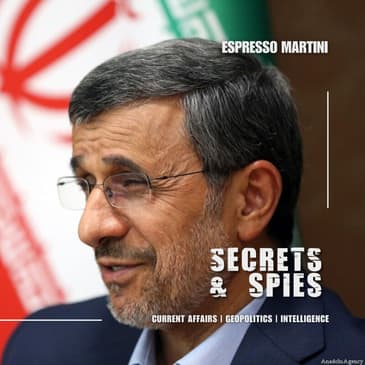
For years, according to a New York Times report, Mossad quietly cultivated former Iranian president Mahmoud Ahmadinejad, the Holocaust denier who once called for Israel's destruction, as the man it hoped to install in Tehran. The plan collapsed on the opening day of the war, when he lost his nerve in a Mossad safe house. Chris and Matt trace how a run of tactical brilliance curdled into strategic fantasy, then turn to Pickaxe Mountain — the buried nuclear site Trump keeps threatening to strike, but that even America's largest bunker-buster may not reach — and ask whether hitting it ends anything. They also examine how Japan has become a haven for Russian procurement networks supporting its war machine in Ukraine, and the forces driving political violence across the West after the killing of Ann Widdecombe, before closing on the life of the late James Woolsey, Bill Clinton's first CIA director.
Subscribe and share to stay ahead in the world of intelligence, global issues, and current affairs.
Take our audience survey: https://forms.gle/eFx59XntNtiKzNQa8
Support Secrets and Spies
Become a “Friend of the Podcast” on Patreon for £3/$4: https://www.patreon.com/SecretsAndSpies
Buy merchandise from our Redbubble shop: https://www.redbubble.com/shop/ap/60934996
Buy us a coffee: https://buymeacoffee.com/secretsandspies
Subscribe to our YouTube page: https://www.youtube.com/channel/UCDVB23lrHr3KFeXq4VU36dg
For more information about the podcast, check out our website: https://secretsandspiespodcast.com
Articles discussed in today’s episode
"‘It becomes inevitable’: the toxic mix fuelling deadly political violence around world" by John Henley | The Guardian: https://www.theguardian.com/politics/2026/jul/18/inevitable-toxic-mix-fuelling-deadly-political-violence-world
"Inside Israel’s Secret Operation to Cultivate Ahmadinejad" by Mark Mazzetti, Julian E. Barnes, Farnaz Fassihi & Ronen Bergman | The New York Times: https://www.nytimes.com/2026/07/13/us/politics/israel-mahmoud-ahmadinejad-iran.html
"Israel Thought It Could Spur Rebellion Inside Iran. That Hasn’t Happened." by Mark Mazzetti, Julian E. Barnes, Edward Wong & Ronen Bergman | The New York Times: https://www.nytimes.com/2026/03/22/us/politics/iran-israel-trump-netanyahu-mossad.html
"Trump’s Threat To Strike Iran’s Pickaxe Mountain Bunker’s 'Front Door' Underscores Targeting Challenges" by Joseph Trevithick | The War Zone: https://www.twz.com/news-features/trumps-threat-to-strike-irans-pickaxe-mountain-bunkers-front-door-underscores-targeting-challenges
"How Putin Turned Japan Into a Den of Spies" by Jane Bradley, Michael Schwirtz & Adam Goldman | The New York Times: https://www.nytimes.com/2026/07/12/world/asia/russia-spies-japan-war-drones-electronics.html
"A Russian Spy, Suddenly Cast Into the Spotlight, Flees Japan" by Michael Schwirtz, Adam Goldman & Jane Bradley | The New York Times: https://www.nytimes.com/2026/07/23/world/asia/russian-spy-flees-japan.html (published after recording)
"James Woolsey, CIA director under Bill Clinton, dies at 84" by Bob Drogin | The Washington Post: https://www.washingtonpost.com/obituaries/2026/07/21/james-woolsey-cia-director-under-bill-clinton-dies-84/
Connect with us on social media
Bluesky: https://bsky.app/profile/secretsandspies.bsky.social
X/Twitter: https://x.com/SecretsAndSpies
Instagram: https://instagram.com/secretsandspies
Facebook: https://facebook.com/secretsandspies
Spoutible: https://spoutible.com/SecretsAndSpies
Follow Chris and Matt on Bluesky:
https://bsky.app/profile/chriscarrfilm.bsky.social
https://bsky.app/profile/mattfulton.net
Secrets and Spies is produced by Films & Podcasts LTD: https://filmsandpodcasts.co.uk/
Music by Andrew R. Bird
Photos by Fatemah Bahrami/Anadolu, Ebrahim Noroozi/AP
Secrets and Spies sits at the intersection of intelligence, covert action, real-world espionage, and broader geopolitics in a way that is digestible but serious. Hosted by filmmaker Chris Carr and writer Matt Fulton, each episode examines the very topics that real intelligence officers and analysts consider on a daily basis through the lens of global events and geopolitics, featuring expert insights from former spies, authors, and journalists.
Hosted by Simplecast, an AdsWizz company. See pcm.adswizz.com for information about our collection and use of personal data for advertising.
[00:00:00] Every team, every topic, everywhere. This is Belief. Secrets and Spies presents Espresso Martini with Chris Carr and Matt Fulton.
[00:00:30] Hello everybody, welcome to Espresso Martini and hello to all our new subscribers on YouTube as well. It's certainly exploded in the last few weeks so thank you very much for that. Before we go into the episode, Matt, how are you? I'm doing good, Chris. How are you? Good to see you. Yeah, not too bad. Not too bad. Just recovering from a summer cold, which is never fun in the heatwave, but I'm alright now. My voice is still a little bit gravelly so I apologize about that. But apart from that, I'm good. I'm good.
[00:00:58] Yeah, we've got quite a big episode today. Got a lot of topics to cover. We've got political violence on the rise, particularly in the UK. We've got the latest developments with the ongoing war with Iran. We're going to look at some reporting about Japan becoming a den of spies, particularly Russian spies. And then we're going to be looking at the death of former CIA director James Woolsey.
[00:01:18] So I will kick us off our first story, which is mainly a UK one, but it does have, I think it's sort of the UK and then the wider Western world kind of thematically. So I'll kind of go into it.
[00:01:31] So last week, Anne Widdecombe, who is a former member of the Conservative Party and now a Reform UK spokesperson, was murdered at the age of 78 in her home in Devon. Prosecutors alleged that Joshua Kerry, 28, drove around 300 miles from Rotherham in South Yorkshire to rural Devon before the attack, before then making the return journey.
[00:01:54] Widdecombe was reported missing after failing to attend a scheduled television interview and was then found dead at a home the following morning. Kerry has appeared in court charge with murder and he has been remanded in custody. Counterterrorism police are leading the wider investigation and are examining whether there was a political or terrorist motive.
[00:02:15] An inquest has been opened and suspended pending the outcome of criminal proceedings and with a provisional trial set for June next year. The killing has also renewed kind of concerns about the rise of political violence in Britain and across the West. And it comes a decade after the murder of Labour MP Joe Cox and five years after the murder of Conservative MP Sir David Amos.
[00:02:40] While politicians across the political spectrum continue to report increasing levels of abuse and threats, experts say attack on elective representatives are becoming more common across many Western democracies, driven by political polarisation, declining trust in institutions, disinformation and increasingly hostile rhetoric. Security officials warn that many recent attacks have been carried out by lone actors, often radicalised online, making them especially difficult to detect and prevent.
[00:03:09] And obviously, just a quick note before I hand over to you, Matt, for your thoughts. As the murder of Anne Whittacombe is going to trial, we're not able to publicly speculate on the details of the case. We can only discuss what has been reported as fact in the public domain. And we could also talk a little bit about the sort of wider issues of political violence away from this particular case. So, Matt, what are your thoughts on this? Yeah, the Guardian article that you chose for this list, this almost like really sobering roster of incidents of political violence,
[00:03:39] not just in the UK and the US, too, in the last few years. And it really sort of crosses the whole, you know, political gamut. So I think, you know, most concerning here isn't just the body count listed in that article. It's what, you know, Europol is quoted in the article in there as saying as well that, you know, that threat has shifted from organized extremist groups to isolated lone actors,
[00:04:04] radicalised in these nihilistic digital communities with this, you know, ideological fluidity, conspiracies, anti-sort of government narratives broadly, personal grievances blended together, often really no kind of coherent ideology at all. I think it's really a pattern that you see. And for me, you know, the nihilism has always heard the bleakest part of this. But also like that when you consider like, OK, like how do we how do we stop it?
[00:04:33] How do we do something about it? How do you how do you counter it? I mean, the whole the entire post 9-11 Western counterterrorism apparatus was built to catch organized threats. Right. When you think about, you know, organized at its peak, Al Qaeda offered its members paid time off and expected like receipts attached to their expense reports. When yeah, when when when ISIS occupied a Syrian town, it delivered, you know,
[00:05:02] the mail and picked up the trash like these basic quality of life municipal services along slide alongside the slavery and the and the beheadings, you know. So for this case, the threat didn't really grow. It just sort of evolved out from onto the tools to stop it. Indeed. Do you know what? And there's been a recent poll in the UK. So it's basically it was called Britain Under Strain and it was published by the UK Extremism and Democratic Resilience Center.
[00:05:32] And they found that apparently 61 percent of Britons believe the contract between citizens and the state is broken because politicians failed to deliver on promises. And then further polling in that same in that same poll, they also found that 15 percent of respondents believed that political violence could be justified in certain circumstances. So that that's kind of worrying as a pattern of growing disillusionment and in both our societies.
[00:06:02] And I think certainly in the UK, many would point to the Brexit referendum as the turning point in the tone of British political debate. And then obviously in the United States, elections are becoming increasingly framed as battles for the country's survival rather than content, contests over policy.
[00:06:21] And obviously, while responsibility for this climate is not shared equally, politics has become more polarized and with opponents increasingly portrayed as threats rather than people with different views. And then we've seen how quickly this shapes public reaction because after the attempted assassination of Donald Trump in 2024, some commentators on the right were kind of basically saying that America is on the brink of civil war. And even said that it would have been civil war had Trump successfully been shot.
[00:06:48] And in this week, I've seen following the murder of Anne Whittacombe, some people online have already started labeling the suspect a dirty liberal before the motives really being established. So there is all this instinct to fit every act of violence into this sort of partisan narrative these days and before the facts are fully known. And like with the shooting of Trump, or the attempted assassination of Trump, the two people who have been arrested for the two failed attempts. Three. Well, it's three attempts now and one's dead.
[00:07:17] Even now, we still don't fully know their full motivations. It's still very murky. And again, like to what you were saying earlier, kind of their ideology is kind of this weird mishmash of things. It's unclear. Yeah. Yeah. I mean, the Butler assassin is a lot more kind of out there and unknown kind of in that general kind of nihilistic space. The other ones are, you know, they're kind of all over the place, too. But I think their motives were a bit clearer.
[00:07:47] I mean, you know. To that point, I think this is really an everyone problem here in this moment. You know, like Joe Cox was killed by the far right. David Amos by an ISIS supporter. Paul Pelosi's attacker is a right-wing conspiracy theorist. We said, you know, as you said, Trump's three would-be assassins sit all over the spectrum. So different ideologies, same sort of phenomenon coming for it, you know. As you said, you know, we don't know why Anne Whittacombe was targeted.
[00:08:14] But I think it's worth saying, at least from this side of the Atlantic, I think reform is among the greatest arsonists of the U.K.'s political discourse right now. So that dehumanizing incendiary rhetoric is their art form and their business model. But, you know, when that fire gets going, it kind of burns indiscriminately. So it's a good idea to not start it in the first place.
[00:08:34] Exactly. And I think, sadly, you know, Trump and reform in the U.K. have definitely set fire to the political debate, both our sides. And, you know, Brexit definitely changed the temperature in this country. So, yeah, as you're saying, it kind of affects everybody in the end. Because if you destroy sort of civil society, what do you expect is going to happen? Right. It's not good. It's not good at all.
[00:09:01] And I don't want to live in a world where people shoot each other for differing views. And also, I don't want to live in a world where people lie and demonize other people either, which is kind of what does happen. And I've certainly seen Nigel Farage do that. He's demonized people over immigration for years. And that doesn't help matters at all. So, yeah. And he even, when Joe Cox was shot, he expressed zero regress over that.
[00:09:29] He, in fact, made a comment after the Brexit referendum went the way he did. He said something on the lines of, we managed to do it without a shot being fired. And that was just outrageous. That was definitely not good. Well, it's not even just, you know, big sort of central political figures like Farage or Trump or, you know, Musk even.
[00:09:48] And, you know, like the, it came out, I think earlier this year, like all those networks on X of like bots, essentially, you know, that are proclaiming to be either pro-Trump accounts or pro-whatever kind of accounts, you know, that are stirring the pot. Turns out it's a lot of, it's, you know, like teenagers in Nigeria and India who have a bunch of like burner phones set up in an apartment somewhere. And it's just this stuff churning out this slop all day long.
[00:10:17] And these platforms are configured to, it generates outrage. It gets clicks and engagement. And that makes money. You make money off of that in a very kind of fucked up way that this has all been set up. Like what did we expect? Yeah, indeed. And I'm noticing, just kind of coming off what you're saying, like the two extremes of the political spectrum, so far right and far left, just to give it some proper balance here. The rhetoric gets increasingly, what's the word I want? Angry.
[00:10:47] And the problem is, or inflammatory. And the problem is that sort of stuff shares online. And then over time it becomes normalized. And it's what they call the changing of the Overton window, believe I remember correctly. And certain extreme talking points are becoming more commonplace.
[00:11:03] You know, at the moment in the US, you've got the, not that the democratic socialists are terrible or anything, but at the same time, you kind of got the rise of that kind of far left politics as a kind of consequence to the rise of far right politics in America. And we certainly had it here when Brexit happened. And then we had the rise of Jeremy Corbyn, who was the sort of far left of the Labour Party, et cetera. And he kind of cashed in on some of that far right sort of thing.
[00:11:31] And I think it's born out of a perception that people have. And there's a lot of truth in it that, you know, the systems and standards and norms and stuff that people defended on, that people depended on for so long just don't work anymore or aren't responsive. Or sort of the reason that we, as a sort of Western society at large, find ourselves in this mess, you know. So you look for alternatives. You look for people who are, you know, on the fringes, I guess, who are, you know, saying, oh, hey, I'm going to do it differently.
[00:12:01] I'm going to fix it, you know. I mean, I was really bothered by how after the shooting at the White House Correspondents' Dinner a couple months ago, how, like, almost immediately there was, like, conspiracy theories. Oh, it's staged. It's a false flag attack. It didn't happen. Like, people in my family are, like, saying this. Like, people that I know who are not, you know, cuckoo nuts conspiracy theorists who are just sort of, like, reaching for it.
[00:12:27] And it's so, like, I don't know, like, if that becomes the norm, if that just becomes the regular state of nature that we're all in, like, we are all of us all well and truly fucked, you know. And there is no hope of making life better for anyone, you know. We just become another collaborator in making all of this worse. Yeah, yeah.
[00:12:55] That whole false flag narrative, I remember that well. And certainly on Blue Sky, that was very popular. I think they call it Blueanon because, yeah, it's not healthy at all. And ironically, that's kind of that conspiratorial thinking is what led to the Tea Party, which led to the rise of Trump and so on. So if we kind of end up mirroring that, we just become as bad as they were in many respects. Yeah. Yeah, it's not good at all.
[00:13:22] When I heard it, I shouted it down immediately hard. Like, no, no, no, no, no. We're not going there. We're not doing it. No. Stop. Yeah. Stop. And I always talk to me about the logistics of faking something. As soon as you start trying to plan, tell people how you would plan to fake something, you start to realize how complicated it is and how many moving parts there are and how it becomes almost impossible to really do without somebody detecting it. So, yes.
[00:13:47] If I was trying to plan a false flag conspiracy assassination attempt, I would not do it in a ballroom with every political journalist of consequence in the country in attendance. Yeah. It'd just be easier to do the real thing. So, it's like, it's just, oh, it's crazy. So, yeah. Yeah. That's where we're kind of getting to. So, yeah. So, I just, this whole case has been a big thing in the UK.
[00:14:12] I mean, Anne Whittacombe, you know, transparently, I was not a fan of her politics, but she did not deserve to be murdered in this way at all. It's horrendous. And then, you know, and I just think then, like what we were saying earlier with this recent poll where, you know, 61% of Britons think that the contract between citizen and state is broken because politicians fail to deliver on their promises. That's a nasty cocktail that is leading to an uptick in terrible things. We've got to be really careful.
[00:14:41] So, I wanted to bring this up just really as it kind of paints a very concerning picture of the future of where our societies are going if we're not careful. Yep. So, yeah. So, you know, my thoughts go out to Anne Whittacombe's family and friends. It's a horrendous thing to go through the loss of somebody you're close to. So, yeah, I would not wish that on anybody. I really wouldn't. So, yeah. So, that's why we talk about this today. So, yeah. Is there anything else you'd like to add to that, Matt? No. No.
[00:15:09] Well, I think let's take our first break and then we'll come back and we'll talk about Iran because that's going to be quite a big one. Fun stuff. Yeah. We'll be back in a moment. So, welcome back, everybody. So, Matt, we are now going to be talking about the latest developments in Iran.
[00:15:38] There's been quite a few since our last discussion on Iran just like two weeks ago. A couple interesting developments. I mean, not the latest latest because that's sort of like an impossible moving target that goes from one second to the next and like who knows what the hell is going on. But there's a particular story development that came out last week as a recording that's very interesting that I wanted to get into. I don't know if you want to set it up any more than that. Before I go into it. No, go for it. Over to you. So, yeah.
[00:16:05] So, like I said, earlier this month at the funeral procession for Ayatollah Khomeini, there was one man in attendance almost no one expected to see. Former President Mahmoud Ahmadinejad wearing a heavy jacket in 90 degree heat, a surgical mask pulled down to his chin, head bowed, flanked the whole way by guards. It was his first appearance in public since late February when he vanished from his home in Tehran.
[00:16:32] Why he disappeared is a subject, one of the stranger spy stories I've heard, at least in recent history. So, last week, the New York Times reported that for years, Mossad had been quietly grooming Ahmadinejad as an asset, paying for his housing and travel to meet covertly on the sidelines of climate conferences in Guatemala and Budapest. All of it building towards one objective, installing the former president when the moment came as a new leader of Iran.
[00:17:00] The man who, throughout his time in office from 2005 to 2013, loudly called for the Jewish state's destruction and denied the Holocaust, selected as Israel's chosen successor in Tehran. The former chief of Israeli military intelligence, Tamir Haman, said on the record that Ahmadinejad was part of a planned, quote, sequence of special operations meant to topple the regime.
[00:17:24] And that came to a head on February 28th, the war's opening day, when a precision airstrike struck his compound, destroying the building housing his watchful IRGC bodyguards. In the chaotic aftermath, Black Peugeot whisked him to a Mossad safe house, and then the whole plan collapsed. I'm not really sure exactly why. I think there's some reporting at the time that he was injured to some extent in that airstrike.
[00:17:50] Not because Iranian counterintelligence caught it, but because Ahmadinejad himself got cold feet and walked. But installing Ahmadinejad wasn't a side plot. It was one prong of a whole regime change campaign, alongside a never-launched effort to push Kurdish opposition fighters from northern Iraq to Tehran. The bet was that the right man in the wings and a decisive blow at the top could bring the regime down fast and relatively clean.
[00:18:20] Five months of war later, we're living in what that bet actually produced. So is there any version of this plan, pick your man, decapitate the regime, install that man, that's ever more than wishful thinking? Or is this the shape it always takes, a once ambitious agent losing his nerve at the point of no return and the war grinding on without any plan at all? Chris, what do you think? Yeah.
[00:18:46] I am fascinated on why on earth did anyone think Ahmadinejad would be worth cultivating in the hopes that he could become a new leader in Iran? It does strike me as a very odd choice, especially with his past anti-American and anti-Israeli views. Did the CIA and Mossad see him as a known quantity and a lesser of two evils? I'm not sure. Or is this a sign that Mossad have kind of lost the plot with regards to Iran and Israel's strategies toward Iran? I don't know.
[00:19:15] He's, since he left office, he sort of went through somewhat of, I guess you could call it a moderation and a populist streak, becoming sort of progressively more and more willing to speak out against the regime and the supreme leader. He wrote letters to Trump and Mohammed bin Salman in Saudi Arabia, a bit of a renegade, bit of a wild card. But I don't think anyone would have expected him to be, you know, a Mossad agent.
[00:19:45] Yeah. Well, no, exactly. I mean, I still, I personally still don't, can't quite understand how somebody did want to wipe Israel off the map and who hosted conferences on questioning the Holocaust. That was a strong support of Iran's nuclear program is anything but maybe a political opportunist. And I think if I were in the CIA, I'd be very cautious about wanting him as my asset. I really, to me, it just strikes me as very poor choice.
[00:20:13] But again, you know, you can't always pick people you want. If you're in the business of regime change, you can't always expect a kind of Nelson Mandela figure to always turn up where you want one. You know, we talked about this like with Russia and all these hopes that somehow Navalny or some sort of moderating force would take over in Russia when the political situation in Russia just doesn't produce people like that.
[00:20:38] Or create an environment where people like that can thrive, even with CIA backing. So, yeah, I am fascinated by that. Also, I think from an Iranian perspective, it must be quite a massive deal to have your former president revealed as a Mossad spy. And no doubt the regime and critics of Israel will seek to exploit this. And what the hell is going to happen to him? Because the fate of Israeli spies is never pleasant in Iran.
[00:21:06] And to have your former president be hanged, which is possibly what's going to happen to him, would be quite a massive ordeal. I mean, imagine if, I don't know, pick a president and it turned out they were working for pick a country. Yeah. And then your country. Yeah. Do you stick them in solitary confinement like Aldrich Ames? I don't know. What do you do? Give them the job again. I don't know. Yeah. Yeah.
[00:21:29] So it's, yeah, interesting times for Iran right now in many ways with regards to that one issue. Well, we know we have proof of life from at least the funeral, which was a couple of weeks ago. I don't know. I'm assuming the heavy jacket in 90 degree heat is covering up something, you know, that isn't for the cameras to see. But, you know, he was alive then. He was there.
[00:21:56] A couple other former Iranian presidents were not there, like Rouhani and I think Mohammed Hatsumi. He was another sort of moderate reformer person. He wasn't there at all. But, you know, you think that question, you know, was he a good asset? Was he was Mossad foolish to kind of get in bed with him at all?
[00:22:19] I mean, there's some you can think like, OK, so this reporting in The Times talks about how when Ahmadinejad was going to the airport to fly to a climate conference in Guatemala, where it's believed one of the meetings with the Israelis took place on the sidelines of that. Right. The security services wouldn't give him like a pass to board the plane to leave the country. Right.
[00:22:45] They held him up and he had this big like sit in public spectacle. Like he he he made a scene. Yeah. Powered by social media, wasn't it? Yeah. Yeah. Yeah. Yeah. Yeah. So he was a big he was a big pain in the ass for them there. And they eventually they they let him go. And he and he went to Guatemala. He also. So there's an IRGC unit called the Ansar al-Mahdi Corps, which is sort of like the Iranian Secret Service. Right. They guard the Supreme Leader's residence or they did before it got blown to hell.
[00:23:13] A lot of, you know, like senior regime officials, former presidents and everything. Right. So. When he went to Budapest in June of last year for another climate conference at a university where we know for sure that he had a meeting with David Barnea, Mossad's director general on the sidelines of that. Right. The Mossad director general himself he met with, which will show you like what an important deal he was to to the Israelis.
[00:23:39] So, you know, like B.B.'s getting the B.B. knows about this minute by minute as it's happening. Right. So on the during that trip to Budapest, he shook his security detail from the Ansar al-Mahdi Corps so brazenly that his detail confronted him for it. You know, he said he was meeting university professors. But OK, like, is that is that from if you're Mossad running this guy like is that reckless? Is that bad tradecraft?
[00:24:09] Is that asking to get, you know, hung or shot or worse, you know, but anything also. OK, you know, that reckless that recklessness also could be a decent cover. Like his whole post presidency career was sort of being this loud populist gladfly. So, you know, it's not in that if you look at it in that lens from an Iranian CIA, you know, officer or something.
[00:24:36] OK, it's not necessarily operational behavior. It's just him being a prickly asshole, you know, him being hard to handle. Also, he's a he's a he's a figurehead. He's not a spy. And you don't recruit a former Iranian president to, you know, keep secrets. You're cultivating him to install him.
[00:24:56] I think the real figure the real failure here isn't isn't handling its political imagination, which, you know, kind of leads into the whole plot to begin with that he was supposedly a part of. Well, yeah, I just think I mean, again, I think we said this before, like the Trump administration were clearly thinking this is going to go like Venezuela. And this was their plan to recruit Ahmadinejad and install him.
[00:25:21] Because also we had the Shah of Iran son would appear in public from time to time in the States or claiming that he could potentially be a new leader for Iran. But if Ahmadinejad was really the plan, it was doomed from the very beginning, I think. OK, so at the time at the start of the war, right, when that sort of when that reporting first sort of came out that Trump called Kurdish opposition leaders in Iraq.
[00:25:48] And there was that planning at the CIA Special Activity Center was trying to push weapons into the hands of Kurdish fighters. And the Israeli Air Force in northwestern Iran, which is sort of the traditional Kurdish part of the country. Right. The Israeli Air Force was bombing police stations like local village police stations, not, you know, IRGC barracks police stations. At the same time, you know this from our conversations for my other fictional stuff.
[00:26:17] At this point, I'd been sitting here for the better part of it of a year at that point. Thinking through for my own purposes, my own reasons. OK, like, can you use organized Kurdish separatist groups to go into northwestern Iran and open up the gates of hell? Right. So as soon as I saw the Israelis bombing those police stations and everything, like I knew exactly what they were doing is trying to make the area ungovernable.
[00:26:45] Right. To sort of clear the way. And, you know. It seemed very sort of haphazard and kind of they ran into their first sort of setbacks and resistance in Iran. So, I don't know. Trump hits the panic button like, hey, you know, come on, come on, Kurdish fighters, go ahead over there and, you know, we'll cheer you on. But like, you don't. It's just so like. Like, the thought that you would.
[00:27:13] And it says this in the Times reporting that they were going to come in from Iraq. The plan was they were going to mobilize in from Iraq, go into northwestern where they're based, go into northwestern Iran, hold territory there and then march on Tehran, which is just like. I don't know if you've seen there's an old commercial here from back in like the aughts and it's like these two old ladies and they're fighting and the one stands up and she's like, it's not the way this works. It's not how any of this works. And that was me. Like, you're not.
[00:27:40] No, like at the hours that I've spent thinking through this of could you do it? How would you do it? What would it look like? How would the scenarios go? Like, it's a it's a mess. Either way, you shake it. I mean, at best, these forces fix IRGC ground forces and the besieged riot police in the northwestern cities. So that's Mahabad, Urmia, it's a breeze making the regime spend blood and guns there instead of on people in Tehran if they do rise up. Right.
[00:28:09] Holding terrain and marching on the capital is just never like it's just never on the table. You know, like these Kurdish fighters that are based in Iraq, you're not even one block. Right. So you have the KDPI, which is the Kurdish Democratic Party of Iran, which is self splintered. And we've talked about this in a previous episode.
[00:28:27] A lot of their a lot of their leadership was based in Europe, has been systematically assassinated by Iranian intelligence over the years to keep them from organizing, you know, effectively and being like a real fighting force. You also have Kamala, which is sort of a sort of socialist kind of Marxist kind of group. But they're based in northern Iraq. Their training camps have been consistently bombed for the course of the war.
[00:28:53] There's Pajok or PJAK, which is the Kurdish Free Life Party. They're more affiliated with with with with PKK, the Kurdish separatist groups in Turkey. So different ideology, different command structure. All these groups have feuded in the past. It's not essentially like what happened in that in the Syrian civil war, where all the sort of Kurdish groups were brought together under one umbrella. Right. The SDF, the Syrian Democratic Forces. Right. That's never happened. The groundwork for that has never been done.
[00:29:21] The work for that has never been done, which takes years of like at best a painstaking effort to put that together. And that never happened. Trump picking up the phone and calling Masoud Barzani in Erbil and saying, hey, send guys over into Iran is not how you do that. Right. Right. So lumping them into one sort of army is just an incoherent strategy to begin with. It's also furthermore, it's counterproductive to your ultimate mission of regime change.
[00:29:51] If that's what you claim your mission is. Right. A foreign backed Kurdish separatist offensive is the best gift you can hand a wobbling regime. Right. So nothing rallies the center in Iran like a territorial threat from Israeli and U.S.-backed separatists.
[00:30:08] It poisons the Tehran uprising that you're counting on and it hands the regime a clean foreign plot, separatists, terrorists, you know, sponsored by the great and the little Satan coming here to overthrow your proud Persian state. You know, it tars any sort of genuine uprising by association. The irony here, again, spent countless hours sitting at this desk thinking about this.
[00:30:36] Just orchestrating a Kurdish invasion kills the dream of regime change for that moment. It's either or, you know, like you have this long, proud tradition of nationalism, Persian history in Tehran. So even Iranians who loathe the regime and have every right to overwhelmingly reject that sort of territorial dismemberment and foreign imposed leadership.
[00:31:00] Right. You can think back to, you know, Mossadegh, Operation Ajax, the CIA MI6 plot back in the 50s that overthrew Mossadegh and reinstalled the Shah. Right. The national mobilization against Saddam's forces in the Iran-Iraq war. I don't know. Stop me from sort of getting ahead here. But it's it's what what's.
[00:31:27] Crazy to me is when you step back and you look at this plan that that like Rowan and Bergman and Mark Mazzetti in the Times reported as a this is the same Mossade that did that pager up. That managed to get in. It managed to get into the supply chain of the personal pager to start to insert explosives into the personal pagers of Hezbollah's entire middle management layer.
[00:31:54] And like in many cases, literally blow their junk off in the grocery store with the press of a button. Right. That same Mossade. Right. That sort of tactical and operational brilliance. Right. The the the the Nasrallah airstrike, the putting a bomb inside an Iranian state guesthouse to kill Hamas's leader, political leader, Ismail Hania.
[00:32:20] All the sort of just the patience and the brilliance and and the precision and the tradecraft that you need to get that degree of of of of of penetration versus this sort of strategic and political like question of what happens across 90 million people once Hamani is gone. That level of forecasting, intelligence services are historically very bad at.
[00:32:49] The tactical stuff, yeah, they can do. It's the big political. OK, what happens next? How do we build the country from scratch? That's the stuff that they fail at. I mean, the CIA, yeah, Iran has run many flawless, brilliant, daring operations. It also gave us the Bay of Pigs, you know, these go have it at the same time. Yeah, well, this is the difference, I think, between intelligence, covert action and political decision making, because like, you know, Mossade obviously no doubt recruited.
[00:33:18] Armandine Jad. Was their plan. Was it Mossade's plan to use him to overthrow the government or was that the president's plan as in? Bibi's? Yeah, was that Bibi's plan? Saying use use use use that guy, put him in charge. I don't care who it is. Just get get rid of the Ayatollah. Maybe. Yeah, because politicians frequently are the ones who drive the policies that then we blame the intelligence services for.
[00:33:46] It happened again with Iraq as well. A lot of people were of the belief that the CIA directed the American intelligence services to invade Iraq, but it was actually the Bush administration that directed the CIA to gather intelligence to justify their decision to invade Iraq. It seems like, and it's not just in this Times reporting, there's other reporting that sort of put this out there. It seems like David Barnea, he's no longer the Mossade director now, he left a couple months ago, but it seems like he was one of the biggest cheerleaders of the theory of the case that, you know,
[00:34:16] one sort of punch at Hamani would be the domino that brings the whole thing down. He was sort of one of the biggest cheerleaders of that. And boy, it did not work out that way. No. Well, then, you know, also October 7th happened on their watch. You know, they're not exactly all seeing and all knowing. Well, OK, so I think there's something to that, right? It's that kind of like victory disease, right? And in a way, I think Venezuela gave that to the Trump administration, right?
[00:34:43] So if you look at Mossade, right, after October 7th to this point, you have an intelligence service that has had a historic, it is yet 18 months into a historic, unbroken run of stunning tactical wins, right? It's at the peak of its confidence post that stunning failure of October 7th, right?
[00:35:06] And this is like the time that is most likely to believe they can also do the impossible. To that point, you know, I think like the pager op doesn't really live in contradiction with the Ahmadinejad plan at all. It kind of like psychologically enabled it. I mean, this is like for an intelligence service, this is like the equivalent of De Niro at the end of heat, turning the car around at LAX because he just has to smoke Wayne Grove too.
[00:35:34] Mm-hmm. Yeah, yeah, indeed. Good analogy. Speaking your language with that one. Yeah, yeah, indeed. It's, yeah, I just think it just reveals that all the people who are the architects of this very ill-thought-out plan to invade Iran really were a bit out of touch with reality, is my opinion. I just think this has been a bit of a shambles from day one. And like I've said this before, the Trump administration is clear.
[00:36:04] They've ignored a lot of historic war planning. It's led to some very bad choices that's now leading to a situation where even worse choices are having to be made to try and get things back to normal because they've kind of kicked over the hornet's nest. And now all sorts of things are going on, Strait of Hormuz being the main issue. And then obviously now with the Houthis blocking ore shipping. Yeah. I mean, my goodness.
[00:36:31] If we thought we're in difficult financial times at the moment, I mean, things could get really bad real fast if we're not careful. And I don't think Trump's going to be able to bomb his way out of this one because already you've depleted enough of your ammunition over this and it's led to very little results. So how much more bombings it take to resolve this? I just don't think there's enough bombs on planet Earth other than, you know, to resolve this.
[00:36:57] Running out of targets or actionable targets that we can verify with intelligence, which is why you're seeing them hitting more fixed structures like bridges and power plants and everything, which comes with its own sort of nastiness and complications and everything. But that's because it's easier to hit a bridge or a power plant or even a barracks.
[00:37:18] It's sort of a static fixed object rather than, I don't know, you know, an IRGC commander who taking him out would be really useful. But you don't have the intelligence network anymore to pin down where he's going to be at X amount of date, you know. I mean, the Israelis certainly had that, you know, look at the stuff last summer, the drone base that they built inside Iran and like wiped all sorts of people out, you know.
[00:37:48] And like a single night, you know, it's weird, man. It's like they were playing Russian roulette for 18 months and they just, you know, should have put the barrel down before that one last spin, you know, and it all would have been okay. Yeah, indeed. Well, it's just thinking like, you know, I think it's a big mistake to kind of think that tactical success is equal strategy.
[00:38:18] And I think that it's very easy to blow stuff up and have a successful operation like Venezuela. But had Venezuela gone on for a few days, I think it all would have fallen apart very quickly. And I think this is, you know, this is where I think the current administration have very short term thinking.
[00:38:40] And when you start doing what they're doing on an international scale, it actually requires a lot of long term thinking to successfully pull this off. Look at the global war on terror. It took like 18 plus years and ultimately it didn't succeed. And like this is, there's a danger. There's a lot of discussion at the moment because obviously Trump is trying to get more funding to continue on with military action.
[00:39:06] And people are asking, well, are we about, you know, are you guys about and maybe us as well in time? Are we all going to get into another forever war again, which was supposedly what the Trump administration was supposed to be against? Yeah. And yet we're kind of sleepwalking into it again. It's not good. Not good at all. Yeah.
[00:39:25] So, so Matt, you mentioned a moment ago, just like, you know, America's running out of targets, but one target keeps coming up at the moment, which is Pickaxe Mountain, which is not its proper name, but it's the name that's all been dubbed in Western press. Do you want to talk to us a bit about that? You don't want to give its real Persian name? I'm going to let you pronounce that. Are you sure? All right. I don't think I'm going to, my Persian is good enough. It's not in Welsh. It doesn't have a Welsh name. I think I'd be crying uncle on that. Yeah.
[00:39:54] So, so yeah. Last week, while calling into Hugh Hewitt's radio show, Trump was asked about an Iranian nuclear facility called Pickaxe Mountain and whether the U.S. planned to strike it. Trump answered that, that the mountain is a target for, quote, a nice big fat shot right in the front door and that the U.S. would, quote, probably give Pickaxe a shot relatively soon.
[00:40:20] So, Pickaxe, and its real name is Kuye Kolang Ghazla, sits beside Iran's, spent a lot of time with this stuff, Chris. Yeah. That's good. It sits beside Iran's primary uranium enrichment site at Natanz, which was attacked, has been attacked a few times. And it may be the single hardest target in the country. So, it's two tunnel networks buried deep beneath a mountain.
[00:40:47] The newest, believed to have been dug since 2020, are believed to be built for centrifuges, maybe a full enrichment plant. No inspector has ever been inside. So, what's really down there is largely a guess. And when the U.S. struck Iran's nuclear sites last year in Operation Midnight Hammer, and again this year, Pickaxe was largely left untouched, the most heavily fortified site in the country, and it's the one the U.S. keeps passing over.
[00:41:14] A detailed piece by Joseph Trevithick at The War Zone points to why. The facility's main caverns sit deeper than even the largest American bunker buster, the 30,000-pound massive ordnance penetrator, can reach, which casts Trump's own words in a curious light because a shot at the front door is what you threaten when you can't reach the vault.
[00:41:36] So, David Albright, who runs the Institute for Science and International Security, did really good stuff on this topic, like detailed technical analysis from satellite imagery, offers two reads. So, he says either nothing valuable was ever inside, or Trump won't leave it standing now that Iran looks to be rebuilding for some extent.
[00:42:00] Also, for what it's worth, just recently there was another report that came out of Israeli intelligence claiming that some centrifuges and perhaps some of Iran's enriched uranium was moved inside Pickaxe Mountain, but take that for what you will. But Trump's comment lands in the middle of a war that flared back up this week after the latest ceasefire collapsed.
[00:42:22] So, I keep wondering whether a, quote, shot at the front door is a strike that's actually coming or a message to Tehran dressed up as one. Maybe that's even the wrong question, because if you can't destroy Pickaxe or only keep knocking on the door, then a strike like this doesn't end anything. It just guarantees a next time and a next time after that. Chris, what did you think? Well, I'm sure there's a penetration joke in this somewhere. I just can't find the best one to add to that.
[00:42:49] All the names of these bombs are the deep penetrator and this, that penetrator. Yeah. I mean, obviously, the mission itself feels a bit like the mission in Top Gun Maverick. So, you know, the Air Force are looking for some sort of like air vent where they can basically fire the weapon through and get as deep down as they can. And then I'm assuming that the tactics will then to be dropped further subsequent bombs on roughly the same area to kind of keep going further and further down.
[00:43:18] But I think the best thing that they're ever going to be able to achieve, and I think this might be the same with the previous sites, is all they could do is really block access to the underground networks and then delay Iranian access to the facilities. I don't think they're ever going to be able to destroy the facilities. I think they're just going to be able to delay people getting into it for maybe a few years as you burrow a new tunnel in to get to the previous tunnel. I think that might be the best they can hope for. I think anything beyond that is probably wishful thinking.
[00:43:45] This is where something like a cyber attack might be more effective, because if you can somehow turn the equipment inside into the weapon, then you could cause some sort of meltdown or something. I would think they've air gapped all that stuff, and it could just be like storage. It depends if the centrifuges are even on, or if there are centrifuges in the caverns there, if they're even on, what systems they're connected to. And at this point in the state of war that they've been under for months now, there's no way. There's no way.
[00:44:15] Well, no, exactly. So then the next option would be either, as the Israelis have done in the past, target the scientists and workers at the facilities, or if you can find someone to sneak some sort of weapon into the facility or sabotage the equipment. That's the best bets you've kind of got, really, for really causing kind of long-term damage to this thing. So I don't think the options are particularly great.
[00:44:38] And I think, again, it feels like another one of these sort of Trumpian so-called tactical successes that, you know, we blow something up. It looks amazing. People lose their shit over it in various forms of media and think, oh, my God, this is amazing. And like Trump last year claimed he eliminated Iran's nuclear threat, but now he's claiming it's still a threat. So I'm like, I just think this is all theater. I really do. I think this is just complete nonsense. It's a problem.
[00:45:08] You can't bomb your way out of it, you know? You can be as macho about it as you want. You can't do it. Physics are physics, you know? Geology is theology. You can't close the tunnels. You can't close the tunnels forever. You can close the tunnels long enough while you hopefully get a deal so that, you know, understanding on the nuclear program. You can't solve every issue with a bomb, unfortunately. No.
[00:45:38] You need the negotiating tables, how you resolve this one, which is supposedly what they were doing two weeks ago, this so-called memorandum of understanding. Yet again, people were sort of popping champagne corks over only for it to all fall apart very quickly. And yeah, so I think the wiser minds would be try and get best in negotiating table ASAP because I think that's the only way you're going to resolve this.
[00:46:01] And then interestingly as well, like the Trump administration now in negotiations with Saudi Arabia to have a domestic nuclear energy program, which is surely going to present some interesting kind of challenges with trying to dissuade Iran or kind of poke holes in Iran's justification for having a domestic energy program. So it's all a bit messy.
[00:46:52] The Sims and create a couple of those and then we can use them. That'd be good. That'd be good. Yeah. Well, is there anything else you want to add to that? Because obviously it is some interesting stuff, but it's all a bit, yeah, a bit, yeah, a bit crazy at the moment. The Ahmadinejad stuff is wild, man. There's going to be a book about that at some point. And I want to hear the conversations or at least transcripts of the conversations. I just want to understand why they thought this, he was the man and what he said to make them think that way.
[00:47:21] Because it kind of feels a bit like that guy in Germany, the one who gave the false intelligence. Is that the guy that gave the false intelligence over the Iraq war? Oh, no. Wow. I'm thinking World War II. No. Ahmed Chalabi. Is that his name? Yeah. What was his code name? Not Stakelife. That was the IRA guy. What was his code name? It was something. It's Ahmed Chalabi. Yeah. The head of the Iraqi National Congress. Yeah. Yeah. I don't know why. It just kind of reminds me a little bit of that.
[00:47:49] If we're looking for analogies here, I would say the Shah's son is more of a Chalabi figure than Ahmadinejad. I think what made, if there's anything that made Ahmadinejad attractive to the Israelis is that he at least was a creature of the regime. You know? You know, like that he had the prospect of if you're going to have a proxy that you're going to, you know, rather than doing the whole bringing back the peacock throne and all that sort of stuff. Like, we're not going to do all that.
[00:48:19] You know? Here's someone who's a former president who potentially has more legitimacy to run the country. You know, he is of Iran. He hasn't lived in the U.S. for, you know, his whole adult life. The issue, though, is when it comes out that you're a Mossad asset, then that whole legitimacy sort of gets shot to hell. Totally. Well, I want to know what guarantees they had that Ahmadinejad wasn't going to just turn on him once he got into power.
[00:48:49] The Israeli Air Force? Mossad hit teams? Maybe. But, yeah, I don't know. I'm just really intrigued by the mindset behind it all. Maybe it's just me. I mean, I have memory of Ahmadinejad just sort of being very fire in his rhetoric in the early 2000s. Yeah. He was like after. So in like the in like the seasons of the Bush administration after Saddam got killed off, he was like the next big bad for like a few years.
[00:49:18] So maybe that clouds my view on him. But yeah, it could be that. It could be that. But we shall see. But anyway, I'm sure in time more information. And who knows? I mean, we don't know what his fate will be. I mean, we could all sorts of things could happen. He might not even be alive right now. I don't I don't know. I mean, he was alive at. But I mean, his funeral, you know that from that point on, I have no idea. Unless they negotiate some weird double bluff to save everybody's face like he was somehow trying to entrap the Israelis or something.
[00:49:48] I could almost see that. But it's going to be hard. Yeah, it'd be very hard. We will see. I'm sure we'll find an update in the next few weeks. So, yeah, well, let's take a break and we'll be back with more. Welcome back, everybody.
[00:50:17] So our next piece is about Japan, which apparently has turned out to be a den of spies. So a really interesting piece from The New York Times, all about how Russian spies are operating in Japan and smuggling out components to Russia. So Japan has emerged as an important battleground in the intelligence war over Ukraine.
[00:50:37] Western intelligence officials believe Russian military intelligence officers from the GIU are using diplomatic and commercial cover to acquire advanced technology and components that can be diverted to support Russia's defense industry, despite international sanctions. The concern centers on Japan's advanced electronics and manufacturing sectors. Ukrainian officials estimate that many Russian missiles and drones recovered from the battlefield contain Japanese made components, including semiconductors,
[00:51:06] circuit boards and other dual use technologies. There is no evidence that Japanese manufacturers knowingly export these items to Russia, with many believed to have reached the country through third party nations. Intelligence officials say Russia has exploited Japan's relatively weak espionage laws and export control systems to build procurement networks. One alleged Russian military intelligence officer is said to have operated under the cover of an employee of the state airline Aeroflot,
[00:51:36] whilst cultivating relationships with logistics companies capable of moving goods through intermediary countries before they reach Russia. So Japan has imposed sanctions on Russia and has provided support to Ukraine, but officials acknowledge the country remains vulnerable to foreign espionage.
[00:51:52] And in response, Tokyo has begun strengthening its intelligence capabilities and export controls amid growing concerns that hostile states are exploiting Japan's high-tech economy to circumvent Western sanctions and sustain Russia's war efforts. So Matt, what are your thoughts on that? First thing that's brought to mind for me is that it's a continuation of, you know, commercial cover as a Russian intelligence tradition. You know, GRU officers have used Aeroflot cover, the, you know, Russian state airline.
[00:52:23] Since the Soviet era, you know, the woman opening the door with the Orthodox cross is almost too on the nose, you know. So Aeroflot, TASS, going back to Soviet days, like the official news agency. The Orthodox Church itself, which using the clergy as cover is a big no-no for Western services for good reasons. All along Soviet and Russian pattern of non-official commercial cover. Yeah, non-official commercial and institutional cover.
[00:52:52] You know, of course, it sort of, it's more valuable for them now, considering that diplomatic expulsions, all their intelligence officers who got PNG'd following the start of the war in Ukraine in earnest in 2022.
[00:53:11] I mean, it's, it's, can't exactly, you know, PNG a commercial cover person, even if you identify or suspect them. You know, there's no diplomatic status to revoke. So, you know, there's some benefit in that. But I also think it's sort of indicative of the, of the even larger issue that's likely happening in Japan right now.
[00:53:40] I mean, certainly happening in, in Japan right now. Like, if a small, if a small GRU, GRU unit can use an aeroflot operation to run electronics procurement from the 22nd floor of a Tokyo high-rise to a 10-minute walk from Japan's National Police Agency.
[00:53:59] I think that's pretty instructive for what the vastly more capable and better resourced Chinese Ministry of State Security is doing all across Japan right now with far better tradecraft, especially as Japan increases its defense spending and, and, and development.
[00:54:16] You know, there's also this sort of issue with like Japan's sort of modern Japan's like dormancy in areas of, of defense and, and national security with the post-1945 laws. You know, like their, their, their intelligence weakness here that they're having, their, their sort of difficulty that they have in, in dealing with this issue, even if they recognize it is sort of a, it's a, it's a deliberate post-war settlement. Right.
[00:54:44] So unwinding it is part of the same national debate as like remilitarization, right. The sort of pacifist tradition since 1945 versus the reality of 21st century geopolitics. And, you know, that's, that's not something, this isn't an issue that Japan has failed to notice. I don't want to suggest that they're like asleep at the wheel or they don't care about this stuff. They definitely do. It's just, it's a, it's a big not to unwind and it's a, it's a controversial one.
[00:55:12] Um, this is, this is a problem that exists just due to a lack of tools, not will necessarily. Well, it's reminiscent of the situation in Germany and now the reforms that are going through at the moment about their intelligence services. Yeah. Um, you know, the post-war restrictions on Japan have now kind of created, uh, modern issues.
[00:55:31] Um, and I think that, uh, yeah, the world has changed since obviously the cold war and Japan is a big ally and an important component to certainly American plans with, uh, potential conflicts with China over Taiwan. And so having such a, an intelligence blind spot is very bad for American planning. Um, and Japan have reciprocal relationships with the U S military and the British military. So then again, weapons could be spied on and things like that.
[00:56:00] So I think now is the time to really encourage Japan to push through reforms in their intelligence services, or if they don't want to, if that's for some reason, an uncomfortable question in this day and age, which I don't think it should be, but it might be for some. Um, then Western intelligence needs to step in and really, um, fill that gap. Um, and I'm sure MI6 CIA, et cetera, do operate quite a lot in, in Tokyo and are probably watching spies.
[00:56:29] Um, but to, to the fact it sort of took the, well, I guess we only know of it now because New York times reporting, maybe an intelligence service knew about this long time ago, but nothing was done. Um, if they did know, um, and so it's, I don't know why this popped into my head, but like, it is all very well knowing things is sitting on intelligence, but intelligence got to lead to something.
[00:56:51] You can't let things kind of fester and you can't let like, you know, uh, Russia smuggle stuff out unless you're somehow monitoring their channels, but there's only so much monitoring you can do before you need to kind of disrupt things. So I don't think this is something necessarily that Western intelligence services were sitting on. I think it is this reporting that's really exposed a lot of this. So yeah, we shall see, we shall see, but it's, um, now puts, uh, Tokyo on a long list of spy cities.
[00:57:18] Um, so we've got London, Vienna, Berlin, New York, Washington, DC, Istanbul, Dubai, Brussels, and now Tokyo. Um, so yeah, so there are congratulations for being on that list. Congratulations, Tokyo. You made it. Certainly an interesting place from a spy tourism point of view. I definitely would like to go to Tokyo myself one day. Um, I've only so far been to, um, South Korea and he said North Korea, but never been to South Korea, which I've been to Seoul, but I've not been to Japan. You went to Hong Kong technically.
[00:57:48] Yeah, true. I did technically go through Hong Kong. That is true. That is true. So yeah. Yeah. So, so that's Japan. There's not much else I could really add than other than I hope that they do get some reforms going. Um, certainly their military is going through reforms at the moment. So it makes sense. Their intelligence services should too. I think they'll get there. It, it, it, it just takes time. It's a, it's a, it's a lot to, to, to, to work through, but I mean, it's the reality of the neighborhood that they're in right now.
[00:58:15] You know, it's not a good neighborhood to be a pacifist. No, sadly, sadly not. Those times are long gone. They're long gone. So, uh, well, let's move into James Wolsey.
[00:58:26] So former CIA director, James Wolsey died at the age of 84 following a stroke and, uh, Wolsey led the CIA from 1993 to 1975 during a turbulent period marked by the end of the Cold War and the arrest of Soviet spy Aldrich Ames and growing political pressure to redefine the agency's role in a rapidly changing world. I'm not 100% sure how popular he was because I think there were a lot of firings during that era in the agency. There's a lot of things going on.
[00:58:55] I think, um, is it Robert Bayer, uh, talks a lot about that period and there was a lot of stuff going on then. Yeah. Bayer was around at that time. I mean, it was also like the nineties in general were just a very tough run for the CIA. You know, and it started to like rudderless, like, what do we do now? Um, you know, it was hard across the board. He was, yeah, he was director from, he was Bill Clinton's first DCI. Uh, he was in from, uh, 93 to 95.
[00:59:24] He was there when, uh, Aldrich Ames was, uh, was arrested. Yeah. And he, interestingly as well, he, he warned against overreacting with its, with excessive internal security measures, um, arguing that while the CIA had, uh, to strengthen its defenses against espionage, a culture of paranoia and false accusations would ultimately damage morale. Morale and effectiveness. And so that's interesting that he said that.
[00:59:50] And in recent years, obviously, uh, his wife was saying that his health had deteriorated and she, um, claims it was as a result of Havana syndrome, which I, I did not know that. And I found that fascinating and I find that a bit odd. I didn't know that either. Yeah. That's love to know more about that. But yeah. Why that? A, why would you, why think that? B, why would he be targeted? I, that's odd to me. Well, this is it. He wasn't, you know, cause he was 84 years old. He was an old man.
[01:00:19] Um, no disrespect, but yeah. Yeah. But long, long out of the game. Like, I mean, yeah, like we know they've Havana syndrome sort of systematically, people we know systematically targeted people who, who, who worked against Russian intelligence to like take them off the playing field essentially. Right. But that's not him. Yeah. Yeah. It just strikes a bit odd.
[01:00:41] So I, I, I was intrigued by that bit and I don't know much more about it at this time, but, um, maybe I'd like to do some more episodes on Havana syndrome. So it kind of just reminds me that we need to look at that again at some point in the near future. But, uh, yeah. So Matt, now you met James Wolseley and I don't know this story, but you were saying you had one. So I'm fascinated by what happened. I did. I, I, I, I met him once. Um, when was this? Uh, this was 20, 2010, right? I was 20.
[01:01:11] Um, wow. Yeah. Uh, so I was, um, uh, professor, uh, sent me a, a, a, a professor of mine, um, sent me to attend the Naval Academy foreign affairs conference, um, that year, which is like a big undergraduate foreign policy conference at the Naval Academy, um, in Annapolis. And it's like, it's like a whole week, uh, at, at, at the Academy and there's a whole bunch of speakers and everything who come through.
[01:01:39] And like, we're all split up into like different smaller, like round tables throughout the day that sort of, there's like one sort of overall topic for the year, but then we're all sort of split up into different, smaller, like round table discussion groups. Like during the day. Right. Um, mine was on, uh, the use of weapons of mass destruction in the, in the 21st century.
[01:02:01] Um, a lot of cool speakers came like Bob Gates, uh, came and had dinner with us, uh, when he was secretary, um, of defense, uh, Richard Armitage came in and spoke. He was a deputy, um, secretary of state in the Bush administration, a few other peoples, but, um, really, really cool, cool week. But James Woolsey, one of the days spoke to us that morning.
[01:02:27] Um, and then later that day, we had like a block in the afternoon where there was nothing going on. And, uh, some of us got invited to go out on a cruise on the Naval Academy superintendent's yacht. Um, which it's, it's, it's, it was motor yacht. I think the Navy since sold it. Um, I, I, I, I looked into this a little bit last night.
[01:02:53] Um, but it was a, it's not like a yacht in the, by like oligarch or like Bezos standards. I think it was like a 90, 90 foot boat. Um, but still nice, you know, big. Still yacht like. Yeah. Still, you know, nice if you can, yeah, nice, nice if you can have one. Um, yeah, the crew, uh, one of the guys on the crew told us the Coast Guard had seized it from some drug dealer in the eighties or something.
[01:03:21] I don't know if that's entirely true where he was just blowing smoke up our ass. I don't know, but that's, that's what he told us anyway. So we get invited on the superintendent's yacht and, uh, we go out to the basin, Santee basin, where the midshipmen have their little sailboats that they train on, um, and everything. And yet we go out and Bullseys out there at the key still.
[01:03:46] So he was like going out with us on the boat, on the, on the superintendent's yacht. And, uh, so we get aboard and, um, yeah, there's a guy who was in my discussion group. He's a, uh, named Sam. He was a Royal Navy lieutenant, I should say. Um, and he and I quickly became like buddies for the week. Anyway, I'm like 20 at the time, mind you. So underage still by a couple months.
[01:04:11] But anyway, there was a bar in the cabin on the yacht that was like open for us. And Sam goes and like, we're there and Sam like hands me a drink. So I just take it and just like run with it. And if like the crew and stuff, if they, I don't know if they knew, but if they did, they didn't care. And I don't know, it was fine. But basically you were in international waters, weren't you? By this point. No, we were, no, we were, we were in the seven river and, and, and the Chesapeake Bay. So very much not in.
[01:04:40] No maritime law applies here. No. Yeah. No, I couldn't, I couldn't murder anyone and get away with it. Um, yeah, no, we, uh, took a cruise at the Severn and back and went sort of out in the bay, um, a little bit, but, uh, yeah, uh, there was a group of us on there and with James Woolsey and I, yeah, uh, 20 years old, got a little drunk with former CIA director on the Naval Academy, superintendent's yacht.
[01:05:09] Um, I was trying to remember like what we all talked about. I don't, I don't really remember. Um, but I remember what he was like and how he made you feel. So he was, he had a reputation for being very kind of, you know, uh, prickly and, and, and combative. He famously had like a distant relationship with, um, Bill Clinton, uh, had a, had a hard time politically as, as director. Clinton didn't really give him like the time of day.
[01:05:38] Um, like, so in, in 94, there was like a little prop plane that crashed on the white house lawn. Right. And there was like a joke going around that was James Woolsey. He was trying to get a meeting, um, with the president. Uh, and that I think his experience as DCI and a Clinton, a really soured him on Clinton. Um, he didn't, he didn't like him very much after that. And he sort of progressively became, Woolsey progressively became more, my understanding
[01:06:06] of it became more, um, like neoconservative over the course of like the rest of his life. So he was like a support of the Iraq war. By 2016, he was on Trump's, uh, first, he was like a foreign policy advisor on Trump's first campaign. Um, I don't know the, the extent to which, you know, he still sort of supported that, you know, coming up to like today.
[01:06:29] But anyway, um, he was, uh, he was perfectly nice as I recall. He was fine. Yeah. We just had some drinks. Just mention the Clintons. He'd be fine. Yeah. No, we didn't, we didn't, we didn't bring that up. Um, yeah. So that was James Woolsey. So, uh, yeah. Um, you know, thoughts to his, uh, family and, and friend, you know, condolences to family and friends of James Woolsey. Um, and, uh, yeah, just wish him the best through a difficult time.
[01:06:58] Um, so that is us done for this episode and for pretty much espresso martini this season. We won't be back until September with espresso martini, um, cause we're taking our annual summer production break. Um, but. We're on the air still. Yeah, but fear not, we'll still be pushing episodes out. There are still interviews to come out. Um, so there will be a wide range of interviews that I'm just working on at the moment that will be coming out over August.
[01:07:27] It will not feel like a break to y'all. You won't even notice we're gone. Yeah. Well, it is funny. Somebody last year commented, um, cause I mentioned like somebody last year that we always take the summer off and they were saying to me, what do you mean you take the summer off? You're constantly broadcasting. And it's like, well, we give the appearance of constantly broadcasting, but, uh, which is I'm glad we've kind of successfully done it for about three-ish years now, haven't we? Where we've been weekly with the odd episode not happening cause of one of us falling ill,
[01:07:57] but we've done pretty well. It's very rare. Exceedingly rare. And I don't like it when it happens. I feel bad about it. No, no. I mean either. Cause consistency is such an important thing in podcasting. Um, so yeah, I mean, crikey. So we're 10 years old in September. Um, the official day the podcast is 10 years old is, um, Tuesday, the 8th of September. Um, so I'm, we're trying to figure out if there's a way we can mark it on that day or whether we'll be marked by the espresso martini.
[01:08:26] It will come out that weekend. We'll figure that out. Um, but, uh, just want to say a huge thank you to everybody who has supported us over that 10 year period. Um, whether you're a listener who's been with us pretty much from day one, when we were originally the dry cleaner cast, uh, which was a companion to my short film, the dry cleaner. And then we evolved into secrets and spies in 2020 over COVID. And then Matt, you joined us in 2022. Like the Kool-Aid guy coming through the wall. Yeah.
[01:08:56] Oh my goodness. But honestly, doing this alone was not easy and it's been wonderful having you aboard. So, you know, thank you. I don't know how you did it as long as you did on your own. There's no way I could do it. Yeah. It's crazy. Crazy. No, it's just, you know, passion really. I've just kept this show going, you know, through a good times and bad. And over the 10 years of my life, I mean, so many things have happened, uh, good and bad. Um, you know, I lost my father over this time and my wonderful mother.
[01:09:24] Mother-in-law during this 10 year period. Uh, we've experienced COVID. Yeah. We've experienced all sorts of interesting kind of geopolitical things. Um, so it's been, it's been a heck of a 10 years and I, and I hope we keep going for 10, 20, maybe 30 years. I don't know who knows how long secrets and spies will keep going, but I, my intention is to keep it going as long as we possibly can. Yep. Thank you to you listening out there right now. You know, we wouldn't be here today if you weren't listening. Um, so thank you.
[01:09:52] And also recently we've had a bit of an uptick on, on YouTube. So thank you to all our new subscribers on YouTube. Um, you know, it's brilliant that that's sort of picking up now because for quite some time and mainly for my own fault, it was a bit neglected. But, uh, sadly there's only so much we could do on this show is it's just us running it. Um, there are times I, I, I try and throw my effort at the making of the shows. All the stuff around it is a bit wobbly sometimes. It's hard. It's hard.
[01:10:22] It's just time and bandwidth. And it's, it's, yeah, there's an office full of people you could hang it off to. I mean, yeah, that stuff gets a lot easier when you don't have to do it yourself. Yeah. When we get into goal hanger territory, it'd be great to have a staff who edit the thing, do the social media strategy, et cetera. But we're not there yet. We're not there yet. But, uh, you know, if you do enjoy this podcast, obviously, um, you know, please buy us a coffee at buymeacoffee.com forward slash secrets and spies. And you will help us on our journey to getting to being the next goal hanger.
[01:10:50] Um, or if you'd like to become a regular supporter and get access to our ad-free shows, you can join us on Patreon by go to patreon.com forward slash secrets and spies. The links are in the show notes below. Um, but yeah, we, we, uh, any help you can give us would be gratefully received. And I'm looking forward to starting season 11 in September. Um, we're already planning that first episode right now and probably record it before we go on the break.
[01:11:17] Um, just so we're ready, uh, to get out the gate soon as, uh, September rolls on and survey. Do you want to mention something? Yes. We're survey still up. We got a lot of really, uh, great, great and lovely responses and, and, and, uh, illuminative. Yes. Useful responses. Um, so far. So thank you for everyone who's responded to that big help really helps us, uh, plan, you know, uh, the next season of the show and how to do things going forward.
[01:11:44] Um, we're going to keep that survey running through August and we're going to put little, you know, reminders in, in each of those episodes. It's in the, uh, it's linked in the show notes, um, for this one, uh, as well. So yeah, if you haven't, please do, um, take a couple minutes. It's real, super easy. Don't have to answer anything you don't want to and give us a lot of useful data to put together and get some signal about what we should be doing or shouldn't be doing. Yeah. Thank you everybody who has participated in the survey.
[01:12:13] It's been really actually very useful and illuminating. It always, I, I, we haven't done one in a while and this one's actually had a much bigger response than our previous one already. Um, and you know, it's actually quite humbling sometimes when you sort of see the sort of people who are listening to the show. Um, you know, I'm really amazed by the sort of, um, kind of caliber of our audience.
[01:12:34] I am perpetually bewildered and humbled and, and thankful and surprised to hear about the kind of folks that, that we have, um, listening over the years. I mean, some of them have sort of become, you know, friends and stuff. And it's just, it's, it's like, wait, you, you, you do this and you're like a real serious person, you know, like this is, and, but you're listening to us.
[01:13:02] Like why, but also like that's, that's, that's, that's, that's great. That, that tells us something too, you know? So I'm, I'm very thankful for it. Yeah. Yeah. It's truly humbling. And I, and I think it gives us an indication that we're kind of on the right track with things, which is always reassuring because, uh, you don't want to go off on the wrong track. Um, and just looking at some of the topics people would like us to cover and sort of going forward, um, some fascinating stuff that we're going to be looking into.
[01:13:28] So, um, it might take us a few months to kind of really kick into implementing some of those topics because, um, you know, we're, you know, it's a slow ship, this ship, but once we get there, we're, we'll, we'll get it. Folks getting this from the, from the survey, folks really want us to like tar and feather Putin. It seems it's like every single one is like, talk about, talk, talk about Russia. And how to defeat him as well. So it's like, yeah, yeah. Yeah. Like do not rest until that man is in the ground.
[01:13:58] Like that's basically like what, what y'all are saying, which is, which is cool. You know, fair enough. And that, that has been heard and received. I'm not a tea drinker. So, you know, we can, we can do it. It's fine. No. And, and I'll just say that obviously you've got to be careful with the, um, the kind of balance of topics. So we don't end up becoming just a Russia show, but I will, yeah, we'll do our best to cover as much of Russia, Ukraine and China as we can. Um, and, and cyber, the good news is we're already talking about cyber at the moment and some cyber stuff coming up.
[01:14:25] So that, that's definitely, um, in the works at this point. Um, there's a lot of stuff I want to cover with cyber going forward over the next year or so. Um, and Havana syndrome. We get, we always get the best emails when we talk about Havana syndrome. And comments on YouTube. Oh my goodness. Yeah. Uh, yeah, I've had some wacky, uh, emails and comments over the last few months with regards to Havana syndrome and some bizarre, um, interview requests that I've turned down. Um, yeah.
[01:14:56] So, so there we go. I won't say more than that, but, uh, yeah, there's definitely a big filter on, on, um, people are passionate about it. Yeah, they are. They are. And, and sadly not everybody's credible. So it's trying to find the credible speakers in, in that crazy, uh, world of, of Havana syndrome. But, uh, but there we go. Well, everybody, I think that is us done. So have, I hope you all, I hope you have a wonderful summer.
[01:15:24] Um, and, uh, I look forward to returning in September and I hope you enjoy the shows that are coming up over August. So again, huge thank you to everybody who've been listening, not only to this episode, but to us over the years and been there with us for 10 years. So thank you. Thank you. Cool. Well, take care. Have a wonderful summer. Don't get sunburned. Um, and, uh, look after yourselves and we'll catch you in the autumn. Bye.
[01:16:03] Thanks for listening. This is Secrets and Spies.
[01:16:47] If you liked the show, please take a moment to rate, review, and subscribe. It really does help the show to grow. Thank you for listening.