
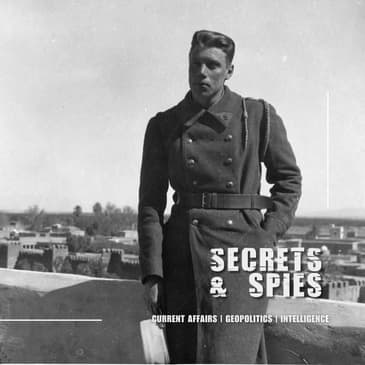
Peter J. Ortiz was the most battle-decorated member of the OSS, America’s wartime forerunner to the CIA, and one of the most decorated Marines of the Second World War. In 1944, the former French Foreign Legionnaire twice parachuted into occupied France to arm the Maquis, sabotage German lines, and feed intelligence to London ahead of D-Day. Chris speaks with former Marine and CIA historian Nicholas Reynolds and journalist Katie S. Sanders—whose grandfather, a downed airman, was among those Ortiz rescued—about their book Ortiz’s War, and the moment when Ortiz surrendered to a hundred Germans to spare a village.
Subscribe and share to stay ahead in the world of intelligence, global issues, and current affairs.Order Ortiz’s War: https://www.harpercollinsfocus.com/harper-horizon/ortizs-war/
More about Nicholas and Katie on their websites:
https://www.nicholasreynoldsauthor.com/
https://www.katiessanders.com/
Please share this episode using these links
Apple Podcasts: https://shorturl.at/LZQWF
Spotify: https://shorturl.at/qOM9J
Amazon Music: https://shorturl.at/McDTo
YouTube: https://shorturl.at/4E4N2
Take our audience survey: https://forms.gle/eFx59XntNtiKzNQa8Support Secrets and Spies
Become a “Friend of the Podcast” on Patreon for £3/$4: https://www.patreon.com/SecretsAndSpies
Buy merchandise from our shop: https://www.redbubble.com/shop/ap/60934996
Buy us a coffee: https://buymeacoffee.com/secretsandspies
Subscribe to our YouTube page: https://www.youtube.com/channel/UCDVB23lrHr3KFeXq4VU36dg
For more information about the podcast, check out our website: https://secretsandspiespodcast.com
Connect with us on social media
Bluesky: https://bsky.app/profile/secretsandspies.bsky.social
X/Twitter: https://x.com/SecretsAndSpies
Instagram: https://instagram.com/secretsandspies
Facebook: https://facebook.com/secretsandspies
Spoutible: https://spoutible.com/SecretsAndSpies
Follow Chris and Matt on Bluesky:
https://bsky.app/profile/chriscarrfilm.bsky.social
https://bsky.app/profile/mattfulton.net
Secrets and Spies is produced by Films & Podcasts LTD: https://filmsandpodcasts.co.uk/
Music by Andrew R. Bird
Photos by Marine Corps History Division, Imperial War Museums
Secrets and Spies sits at the intersection of intelligence, covert action, real-world espionage, and broader geopolitics in a way that is digestible but serious. Hosted by filmmaker Chris Carr and writer Matt Fulton, each episode examines the very topics that real intelligence officers and analysts consider on a daily basis through the lens of global events and geopolitics, featuring expert insights from former spies, authors, and journalists.
Hosted by Simplecast, an AdsWizz company. See pcm.adswizz.com for information about our collection and use of personal data for advertising.
[00:00:00] Lock your doors, close the blinds, change your passwords. This is Secrets and Spies. Secrets and Spies is a podcast that dives into the world of espionage, terrorism, geopolitics, and intrigue. This podcast is produced and hosted by Chris Carr.
[00:00:29] On today's podcast, I'm joined by authors Katie S. Sanders and Nicholas Reynolds, and we discuss their book, Ortiz's War, that looks at the life of OSS operative Peter Ortiz. Hope you enjoy this episode. Thank you for watching. Thank you for listening. Take care. The opinions expressed by guests on Secrets and Spies do not necessarily represent those of the producers and sponsors of this podcast.
[00:01:00] Jason and Nicholas, it's a pleasure to have you both on the podcast. Before we get into your book and Peter Ortiz's story, could you just tell us a little bit about yourselves and what sparked your interest in military history and intelligence operations? Life. You don't mind, I'll go first. I've been a Marine Corps officer and a CIA officer, and in retirement I love to research and write books.
[00:01:27] So my first commercial book was about Ernest Hemingway and espionage. Brilliant, brilliant. And how about yourself, Katie? Yeah, I'm a journalist with no military or CIA experience, except that I was actually, or am, the granddaughter of a former pilot in the U.S. Army Air Force during World War II who was on a mission, was shot down over France.
[00:01:53] I never met my grandfather, but I knew that maybe there was vaguely there was a story of his escape, and his escape relates to Peter Ortiz, who is how Nick and I connected. So again, journalist and interested in World War II and special ops. Thank you very much for that. Well, I suppose you've kind of part-answered this. So how did you both kind of come across this Peter Ortiz story?
[00:02:14] I came across him, so I worked as an official historian for the Marine Corps. I was what they call a field historian. And the chief historian one day in the 1990s called me in and he'd come across this Peter Ortiz that was new to him. And he said, it's a very unusual story. And he asked me to help edit a piece and publish it in a small journal I've been working on.
[00:02:40] So fast forward, Katie and I were pen pals and we were writing back and forth about OSS matters and World War II intelligence history. Now, one thing led to another, so I'll pass to you, Katie. Yeah, no, I like to always say I don't think I would have ever even known. I mean, maybe I would have heard of the Office of Strategic Services, but certainly not in the level of detail that I have come to know it.
[00:03:08] Had I not had this sort of curiosity hearing my grandfather's story of a down airman for Operation Carpetbagger, the air arm of the OSS. And again, who does he get intercepted and rescued by pre-D-Day in France, but Peter Ortiz. And so Nick, when I reached out to the CIA as a journalist, you know, looking to learn more from their historians, they said, well, there's a historian who doesn't work here technically anymore,
[00:03:32] but you should definitely talk to him because we know he too is very interested in Peter Ortiz, who I should add just for your listeners who, you know, maybe don't know the ranking of OSS personalities and, you know, veterans. Peter Ortiz was the most decorated, the most battle decorated member of the Office of Strategic Services. And, you know, sometimes we hear Julia Child or, you know, some other amazing historical figures.
[00:03:59] But for us learning about Peter Ortiz, it's like, wow, there's a lot of interesting areas to explore in his story. Well, if this is unfamiliar with him, please can you just tell us a little bit about who he was and why you think he deserves to be remembered today? Well, I'm here because of him. Nick, maybe if you want to give a little bit of the historical background, but I know I'm not alone in that. There's a town in France that I've been able to spend time in in August because they honor him every year for his mission.
[00:04:27] So, Nick, maybe you want to give us background a bit? So it's a unique story, I think. There's probably a few other operatives who have a similar story. But basically, Ortiz is a hell for leather guy who takes these enormous risks. And then at the end of the day, he opts for sacrifice. He decides to surrender to do a deal with the Germans.
[00:04:56] He will surrender himself and his team if they will spare the village. This is in 1944. It's at a point in time where the Germans are getting kind of fed up with resistance. And they're not in too good a mood because it's pretty clear they're losing the war. So it was almost a certainty that if Ortiz had continued to fight in this little village in which he found himself, that the village would be burnt and the villagers would be shot.
[00:05:22] So there's this unique, where I'm going with this is there's a unique combination of warrior and is humanitarian the right word? It's kind of old-fashioned gallantry. And that appeals to me. And that he wasn't just about fighting and winning, but also about doing the right thing. And that he had the presence of mind to do this. I mean, you can imagine the bullets are zipping over his head and he's stopping to think.
[00:05:51] He doesn't have like an hour in the library, but he takes two or three minutes out and he runs the calculus and thinks about the consequences of what he's doing. And I think that's the high point of his service in World War II. And I think it speaks volumes about him.
[00:06:15] Yeah, I think it's just interesting to think about this as, you know, Nick is an expert in OSS history and the origins of, you know, special operations in the United States and what evolves into 1947, the CIA. But here you have this, there's no blueprint for, you know, this guerrilla warfare. I mean, there's blueprints that aren't what we now think of as, you know, intelligence and special ops.
[00:06:42] And Ortiz is interesting to me because, like I said, my grandfather was a downed Allied airman who needed help. And Ortiz was pretty quick to help him. But he also was in, you know, Nazi watering holes, bars in France, in uniform sometimes doing what I would call like, you know, morale, propaganda-based missions, but also collecting intelligence that he would funnel back to, you know, OSS headquarters in London.
[00:07:06] And, you know, he was this really bold special operator who, when I think about special operations sort of mixes, you know, sabotage and espionage and, again, the guerrilla warfare and the resistance in and of itself is its own category of sort of special ops that I've been interested to see how Marines, for example, or other special operators connect their lineage to him today.
[00:07:30] We can talk more about that maybe later, but there's, you know, cyber warfare groups that, like, use him and his model as, you know, a founding father of sorts because he's so inspiring, even though for them they're really operating, you know, it's a different type of field. One thing that struck me is how much of Peter Ortiz's early life helps explain the man he became. Why is it important to understand his years in the French Foreign Legion before looking at his wartime service?
[00:07:55] So I see an arc there between the young daredevil and then the sort of the humanitarian warrior at the end. And one of his German captors called it a heroic surrender, where he surrendered in the village to save the village. And so I think it's important to anchor that man in his experience in the Foreign Legion.
[00:08:25] And also it anchors him in French history because he's legally American, but a big chunk of him is culturally and culturally French. And his heart belongs to the French Foreign Legion initially. And when he when the Germans invade France, he fights for the Legion and for the honor of France. I mean, it's really kind of a remarkable thing.
[00:08:49] You you you have Americans who go and and, you know, fly for the British and in 1940. And as much as as anything, they're fighting against the Nazis. Ortiz is fighting for France and the Legion. So this is a little slice of French history as well as American history. I would also say it speaks to sort of the cultural aspects of what made him a, you know, really viable recruit.
[00:09:13] When he showed up at Marine Corps training after enlisting in the Marines to get back into the fight post Pearl Harbor for the Americans, they were like, who is this guy who speaks not only French, but German and some Arabic and English? And who can also, you know, blend in in, you know, pretend to be a minor Vichy government official in a pub? So, again, what you see in the OSS and a lot of special ops are people who have, you know, language skills,
[00:09:42] who have cultural experience, who have just the capacity to move between worlds, which sometimes means they don't exactly fit into one. Ortiz's father, I joke when I first visited Pete Jr., his son, he said, oh, you and my grandpa worked at the same place because I had worked as a magazine editor, an assistant actually, at Conde Nast. Meanwhile, Felipe Ortiz, Peter Ortiz's father, is, you know, he's of DuPont blood and he's a Conde Nast executive who is,
[00:10:09] you know, you can look in the Library of Congress and see some of his fashion designs. He's someone who does not get near war or conflict in the way that his son is gravitationally pulled towards it, but he certainly does, you know, probably to his chagrin, raise a son who is, you know, subject to being attracted to the things that make him a special operator, who really is, you know, kind of in a league of his own. One of the things that makes Ortiz successful is that he is acculturated, right?
[00:10:38] So he doesn't just speak French, he speaks military French. And he doesn't just know France, he knows this particular corner of France. And this combination contributes to his success. So there are some other special ops guys who are dropped into the same general region. There's a team that comes in, neither of the officers speaks French. They've never been to France before, you know, and it's, it's, they're, they're not bad guys.
[00:11:04] They try their best, but compared, you can see the difference in their performance and Ortiz's performance, since he's so grounded in, in, in the region and the language and, and that kind of small war. So before we follow Ortiz into occupy France, can you just explain a little bit about what the OSS was, why the United States created it, and what made it different from a conventional military organization? How about Nick, I try and then you correct and fill in. Sure. Good? Okay.
[00:11:33] Okay. So the Office of Strategic Services is, you know, at this point early on in the war, there's a government agency called COI that it evolves from, but it is essentially wild Bill Donovan, a World War I general and, you know, decorated veteran himself, who's pretty battle hungry. You know, he's a Republican, this guy from New York, Republican lawyer, starts what is FDR's,
[00:11:58] you know, FDR later refers to the OSS as his, or as Donovan as his secret legs. It's this organization that is going to, for the first time, bring America into the world of intelligence. And in this case, you know, intelligence, special operations. And by the 1944 peak of the OSS, you have this fledgling organization that's gone from, you know,
[00:12:24] Roosevelt, Donovan, wartime startup to 13,000 Americans, civilians and military personnel. You know, again, my grandfather, this Jewish kid from Queens who never graduated high school and is a pilot, sort of seconded to fly for the OSS in the air arm, people from all walks of life. A third of them are women. Some of them have been broken out of jail to do code breaking because, you know, that's the skills they have.
[00:12:47] So it's this amalgamation of, you know, intelligence officials and, again, military and civilian personnel who are essentially volunteering to say, I will be part of this organization. So another way of looking at it is this is America's entry into this world and we really are coming late to the game.
[00:13:10] The UK started in the early 1900s, right, with MI5 and MI6. And we had nothing that was even remotely similar. And OSS comes along in part because the British counterparts are going, hey, there's nobody for us to talk to, there's nobody for us to liaise with.
[00:13:33] Can you please, please, please set up a dedicated civilian organization, not just a branch of the Army or the Navy, but one that is wholly dedicated to intelligence and intelligence operations. So that's, you know, those are the two ends. Katie describes one end. I describe the kind of the policy end, if you will, that drives OSS.
[00:13:59] I would also say if I were writing the magazine piece, I'd say OSS, the wartime forerunner to the CIA, right? So that's the quickie. You go into, you know, Langley now, where in the lobby you're met by a statue of Wild Bill Donovan and OSS officers, you know, memorial to those who lost their lives in service. It wasn't always the case in those post-World War II years, but OSS now is recognized as the forerunner to the CIA. So before we get into Ortiz's missions, could you help set the strategic scene?
[00:14:28] Why was Occupy France so important to the Allied war effort? And what role were small OSS teams expected to play in preparing for liberation? I'll give the very micro story of my grandfather, right, who's a month before D-Day. He flies on May 6th. This is just to get at what we're waiting for here, the invasion and the mood. He's flying, you know, on a mission where he's dropping not bombs but supplies to the resistance to, you know, help support, you know, the mobilization of the resistance for D-Day.
[00:14:58] And the French doctor who's in the resistance, this very brave man, Dr. Jacques Majar, who, you know, first finds him in this ditch and, you know, brings him into his home and this pregnant wife and child and saves his life, says to him, you know, to my grandfather, who, again, is this B-24 pilot who's on this mission, when is the invasion? When is the invasion? You know, because think about from his perspective, he's been living, in his case, he was in the French army and then escaped and he's secretly Jewish.
[00:15:26] I mean, this is someone who is living on borrowed time, but they all are at this point. And so I think this idea of, you know, one American or in my grandfather's case, you know, eight Americans parachuting in, it was like represented the hope that more were to come. And maybe Nick can then bring us to where we were. You know, that's Ortiz's first mission. One's pre-D-Day, one's post-D-Day in France. So the whole, you know, if you go back to 1943, what, and you're sitting in London,
[00:15:56] you know there's a French resistance, but you don't know any details about it. You have a general idea. There's a few hundred guys here. There's a few hundred guys there. And so what you want to do is get a handle on, you want to assess what there is there, and then you want to harness the forces so that when D-Day comes, you can make a difference. You can support the big blue arrow that is D-Day.
[00:16:22] The initial idea was to have more or less simultaneous landings in Normandy and in the South. As we know, ultimately there's D-Day in the North in June, and then it's August for D-Day in the South. But that's what Ortiz and the team, the initial team is British, American, and French.
[00:16:44] And the idea is to present a unified front and to, you know, get some granularity about what there is, support them and help organize them so that when the time comes, they can make this contribution. Can you give us an overview of what his sort of missions were and what his objectives were? The initial mission is organize, train, and equip. Figure out what you got. Order.
[00:17:13] Send an order to London, more or less sort of like ordering from Amazon. You're ordering from the big warehouse in the sky. Order what they need. Receive it when it comes down from the sky. And then put it in the hands of the fighters and train them in how to use it. Train them in how to work together.
[00:17:34] Create communication between the various groups so that by D-Day you have something like a unified resistance. And I would say he goes above and beyond. Like we said, you know, he's doing some side missions here. And then when it comes to Union 2, which is his second mission, this is really instead of him being a participant in it,
[00:17:57] he's leading it, and this is part of, I think we don't often talk about necessarily Operation Buick or Operation Cadillac, or these four giant aerial supply daylight missions that are post-D-Day getting arms. Even just the image of, you know, supplies parachuting into the French countryside is one that I think not, unless you've read a lot of books about the French resistance, you might not connect with.
[00:18:24] But Ortiz, it was not only him and his seven men coming down on Union 2. It was from 78 B-17s, you know, 800 plus containers of supplies parachuting down in daylight to the resistance that they were then, like Nick said, you know, tasked with figuring out how to use to help. These are two of the biggest drops of the war to the resistance in the West.
[00:18:52] So one's on July 14th, of course, Bastille Day, and the other is on August 1st, both in 1944. My favorite detail of the Bastille Day drop is that they die in the wartime. They managed to die select parachutes, red, white, and blue, you know, so there's this, like, patriotic on both ends, American and French, colors of parachutes coming down on Bastille Day. Let's take a break and be right back with more.
[00:19:35] Hey, everybody, just a quick note before we get back to the interview. We're running a survey over the summer. We'd love to hear your thoughts about the show. Please look at the link in the show notes below and fill in the survey. Thank you very much. Many listeners will be familiar with Britain's Special Operation Executive, or SOE. How closely did OSS and SOE work together, and where did their roles overlap or differ? Yeah, again, I can give some micro examples and then let Nick give the historical official answer here.
[00:20:05] But, you know, again, SOE is an inspiration to OSS in a lot of ways. The training that's happening, you know, Ortiz would end up recruiting his OSS Marines who are training, you know, people across cultures to jump into France. So you have, you know, you're in London. This is, you're looking at both organizations working closely with each other to the point where the first, we're talking about two operations Ortiz went on, Union in January of 1944,
[00:20:33] and then Union 2, which he plans and leads in, you know, August of 1944. The January of 1944 jump, people talk about the Jedbergs. This is pre-Jedbergs. This is, you know, OSS special operations or OG groups, Nick, operational groups. It's sort of this question of, can you send, for a lot of the reasons we talked about with culture, a, you know, in this case, French BCRA, you know, former French military radio
[00:21:02] operator, plus a, you know, this Ortiz guy who's OSS, plus SOE, you have HHA Thakwaite, who's representing the British, plus a kind of very interesting older French military agent together. So in that sense, you have a lot of collaboration and communication. You can find Ortiz's, one of my favorite photos of Ortiz is in his SOE file.
[00:21:31] I've never seen it anywhere else. And we don't have like the caption for it, but we can presume it's one of his identities sort of being captured on camera. So they're working together, I would say. So initially there's, you know, OSS, as I said earlier, is playing catch-up ball the whole time. It's a new organization. SOE is almost the grandfather. They've been fighting since 1940, and this is 1943, 1944.
[00:22:03] So OSS initially defers to SOE to a very large extent. And Ortiz is trained. So the poor man's been trained three or four times now, right? He's been trained by the Legion. He's been trained by the Marine Corps. And then when he lands in Britain in 1943, SOE goes, well, now you're going to have to do it the British way. Poor him. He had to jump a lot of times. A lot of airmen wish they had been trained to jump a lot of times.
[00:22:33] More jumping, more commando training, more navigation training, more communications training. So the first mission, Union 1, is really more of an SOE mission than an OSS mission. By Union 2, a few months later, OSS is confident enough to do it more or less on its own. We often think of espionage as stealing secrets, but much of Ortiz's work seems to be about sort building relationships and organizing resistance networks, enabling fighters to enabling other
[00:23:03] fighters. So what did life as an OSS officer look like in Occupy France on a day-to-day basis? Lots of cigarettes and coffee. Yeah, maybe some stimulants of sorts too. But you know what? He would go and pretend to be a pro-bushy fashion designer and do what we think of as traditional espionage. But that was sort of his after-hours work. The primary stuff he was doing, again, he had a recruiter in him.
[00:23:31] He was working a lot, this network world where, you know, you have these very vulnerable and important circuits that he's working with. He, as he begins to grasp, you know, oh, the driver of my colleague has a bunch of sisters, the Arsalan sisters who are willing to, you know, you're sort of a scout, I would say, in that sense. He stole Gestapo staff cars, a fleet in a garage that he would later use to escort my grandfather out of town.
[00:24:01] So he had some, you know, I'd say like what we could, in non-war times would be like criminal activity, you know, blowing stuff up, rail lines and doing, he was someone who, if he felt called, if he felt like it was going to make a difference, he was like not going to leave that grenade lying around. He was going to go throw it. And he might, you know, catch some, he had some wounds that are a result of that. That's true in the French Foreign Legion.
[00:24:30] This is someone who's been pretty badly wounded on several occasions. And, you know, he is working with the Maquis and he's wearing his uniform in certain situations where no one's wearing their uniform for a lot of reasons. There aren't that many uniforms there. But he really feels that bolstering morale among this, you know, these motley embryonic resistance movements is important. And he translates that from his first mission to a second.
[00:24:57] And again, in his spare time, he's rescuing at least six downed allied airmen, personally, my grandfather among them. He's got so many balls in the air. What OSS and SOE think they're paying him to do is to go around from camp to camp. There's something 50, 60 camps. Assess, train, prepare.
[00:25:19] And then the dramatic stuff is really his after hours, the missions that he more or less picks for himself. But as I say, the ones that they sent him in to do, the primary mission is to organize, train and equip the resistance fighters. I would also just add that if he had listened to his orders when he was recalled from Operation Union, he wouldn't have intercepted my grandfather.
[00:25:49] So, you know, hopefully I'd still be here to know his name. And we'd have a different story. But Ortiz was told, you know, you're recalled. We're sending a plane for you. And he said, I'll come back. You know, I understand you want to see me before D-Day. We'll get this intelligence in. But I'm going to do it on my own terms. I have people who are counting on me. I have, you know, safe houses that are about to blow where I need to deliver messages. And so, again, he defies orders and makes his own way out and, you know, helps some people along the way.
[00:26:19] The French resistance often remembered as this sort of single unified movement, but reality was much more fragmented. What sort of environment did Ortiz step into when he arrived in Occupy France? And what challenges did that create for him as an OSS officer? They don't really know who he is and what he's coming for. I mean, that's the initial conversation with the people who meet him is, why are you here?
[00:26:43] You know, we knew there were three or four people coming tonight and we deployed to meet you. But what is it that you want? And so there's, you know, there's Gaullists, there's communists, there's people in between, there's former French military. And so there's, as you say, there's just this tremendous variety of varieties, varieties to weak a word.
[00:27:11] But there are many strains to the French resistance. And that's one of the challenges. As Katie said, it really helps that Ortiz is the kind of guy who's a good recruiter. And a leader. He's, you know, this is this eclectic group. Some of them are teenagers who are sort of even, in this case, thrilled at the prospect of holding a gun for the allies, right? And maybe don't know how to hold a gun that has just dropped down from the sky from a package or a container.
[00:27:36] And so one story that really sticks with me that I think speaks to Ortiz's character is his son said that Ortiz one time beat up one of his own men, a resistant, you know, young kid who was, he was training and I said, why? And he said that the kid was having too much fun killing people. And so, again, you have someone who is sort of trying to help calibrate in a very chaotic,
[00:28:06] you know, again, eclectic situation, what behavior is productive and what is not. And one of the themes that really stood out for me was sort of trust. Ortiz seems to have succeeded because people trusted him, whether they were resistance leaders, local civilians or his own men. How important was that ability to earn trust? And do you think it ultimately is what made him such an effective operator? I think it's huge. It's more than trust. It's a warrior's bond.
[00:28:35] There's one French officer, Jean Boul, B-U-L-L-E, who becomes Ortiz's friend, might be the right word, comrade, fellow warrior. And they interact very closely. They talk about what they're going to do. They look out for each other. And I don't want to get too far ahead of the story, but they're willing to risk their lives for each other.
[00:29:03] And it's more, I mean, it's respect and confidence. My grandfather is, again, been shuffled around a bit. He's in Valence. Again, Jewish kid from Queens. Not like a great place to be having been on a secret mission and now needing help from the resistance. And Ortiz says to him, look, this safe house is about to be blown.
[00:29:26] You can come with me and we might get caught and you'll be killed twice, you know, once for what you're doing and second time for being with me. But my grandfather feels enough trust and confidence in this, you know, quasi-uniformed marine in France to say, let's go and I'll stay with you. And I know if you just look at the guy, I hope anyone who's listening and not watching you, like, Google him because I want to hear who you think should play him in a movie.
[00:29:55] He's a striking looking man who I think, you know, you get the sense he's someone who looks at you in the eye and can win you over pretty quickly and sort of knows he has that power. But we'll, you know, act to back it up. Almost that kind of movie star kind of quality almost in a way. I mean, there's nothing non-movie star about him from a physical standpoint from, you know, he's very noble and regal
[00:30:25] and, you know, that James Bond-esque, but this is real. He has a presence that a lot of really successful military officers have. You know, you, to you, on the other side, there's somebody like Rommel. And when Rommel's in the room on a battlefield in a picture, all eyes go to him. Ortiz is kind of the same thing.
[00:30:48] He's a charismatic figure and he almost doesn't have to open his mouth to start exerting his, the influence of his leadership. But he also has that, you know, what would make a celebrity successful in a lot of ways. But he also goes to Hollywood after the war and, you know, doesn't really find success per se. He's John Ford's friend and he, you know, corrects people when they're not technically following military protocol on a movie set maybe.
[00:31:13] But I would say his success is more as an operative and an agent than as the Hollywood star that I think he has a lot of attributes of too. Now, we briefly talked about this earlier, but you open with the dramatic events in your book of, at Centron, where Ortiz ultimately kind of chooses to surrender rather than risk German reprisals against civilians. More broadly, obviously, his story tells us of clandestine warfare. It could be extraordinary, costly for both the operatives and civilians who help them.
[00:31:43] So what does his experience tell us about the risks, responsibilities and kind of moral complexities of this kind of warfare? You know, it's a great scene. I think it's very, again, cinematic. It's part of why we open with it. And it shows a situation that is sort of uncharted and unprecedented. And although I would say there is precedent in the sense that Ortiz, people say, well, what do you mean he knew the town would be razed? And guess what? A few days earlier, you look at Mont Juro is a town that is razed because, you know,
[00:32:11] when allies are moving through and stepping foot in places, it immediately becomes a place where, you know, resistance or civilians are seen as having harbored the allies, right? And it can weigh in if I'm, you know, nailing that. But really, you have Ortiz in this situation where it's very clear that he feels he has an opportunity to, you know, in his eyes, do the right thing with these. These people are all looking on them, villagers, small village. There's a church.
[00:32:41] You know, people have been living under, you know, tough conditions for a long time. And they know that this is a moment where he is probably going to go through their town because that's the way out. And he knows he can get out is the thing. I think a lot of people think, oh, well, he negotiated his own surrender because he was surrounded. He thinks even though there's 100 plus Germans with machine guns to his, you know, handful of men at this time, and the team is split in half and they're sort of, you know, operating on borrowed time. But he thinks they could get out.
[00:33:11] But he also thinks that it will come at a great cost. And for him, it's too great of a cost. I think he feels that he's lived his wars. He's, you know, willing to say, I know I'll be tortured and killed. But what I think his character revealing about him is that he doesn't go ahead and order his men. In that case, it's two other OSS Marines who he's recruited kind of personally, plus Free French Officer Joseph Arcelin, who is also recruited for this mission.
[00:33:39] He says to them, I will cover for you. This can be, you know, you can get away. And then I'll go and do this surrender. And, you know, it says a lot about them too, that they look at him and they say, Major, we're Marines, what you do, we do, you know, we stay together. And they do. But it also, again, speaks to how much they respect him. And it also, when he goes and they're shooting at him, he's shouting in French, English, and German, with a white waving this thing to surrender.
[00:34:08] The officer he's surrendering to respects him. He offers him a cigarette. Ortiz, of course, says no, snubs him and takes out his own cigarette. And so this is the scene that you have that we're talking about. I don't know, Nick, where you want to fill in. To pull back a little bit and look at the, this is one of the issues about SOE in general, right? Is it worth it? Because when SOE comes to town, you better send your wife and kids out into the countryside.
[00:34:37] And after the end of the war, one of the senior SOE guys famously is asked, was it worth it? And the answer is yes, but just barely, right? So every time, and the amazing, so the official answer here, if there had been an SOE senior on the scene, the official answer would have been, of course, you've got to fight. What's this surrender business? Fight it out. We're sorry about the collateral damage, but this is war.
[00:35:05] And so, you know, it speaks to Ortiz's development and moral sensibility that he actually runs his calculus. As we said earlier, he's running it under fire. So, you know, I love the musty library. I love the old document and whatnot. And I can sit and think about these things for days. He has to run this calculus with Germans shooting at him, French villagers crying.
[00:35:34] You know, there's a dead cow that's been accidentally shot. There's an old woman who tries to save his life, and he has to push her to the ground so that he's able to... He doesn't push her. He lightly places her and carries on. Oh, well, it depends on which version you're looking at. But anyway, you know, the amazing thing is that he balances these things and brings them to mind and makes a decision. A suicidal decision.
[00:36:05] Let's take a break and be right back with more. Just before we get back into the interview, if you're enjoying this episode, please consider buying us a coffee at buymeacoffee.com forward slash secrets and spies. Thank you.
[00:36:30] The OSS disappeared after the war, but many of its ideas lived on through the CIA and modern special operation forces. So what do you think intelligence officers and military professionals can learn today from Peter Ortiz and the OSS? So there's two levels to answer that on. One is the big picture, and then there's the Ortiz-specific picture.
[00:36:52] Ortiz, after the war, spends more of his time trying to develop a film career than keeping his foot, staying with the military and promoting this idea of special operations.
[00:37:07] So, you know, what he offers, in my view, Katie, you'll have a slightly different view, and that's fine, is this, the thing we've been talking about, you know, doing the right thing under extreme pressure, being a very, very good small unit leader, leading by example,
[00:37:29] being the man who doesn't stay back, being the man who doesn't stay back, but steps forward and tries to mold a situation in the right direction. So that's the way I see OSS. OSS has, is that some people stay, you know, they start in OSS, and then they stay, especially in the U.S. Army, they stay in uniform after the war.
[00:37:55] And those are the guys, if you want, if you're looking at lineage, those are the, that's a straight line from OSS to something like Green Beret's special operations. Ortiz's case is a little different, I would say. Yeah, I bring up Francis Coolidge, who was on Ortiz's mission with him, who Ortiz recruited for his mission, Union 2, is, again, one of these seven. In, in Coolidge's case, he's actually a U.S. Air Force officer serving in the OSS.
[00:38:22] The rest of the Union 2 guys are Marines, but I say this because Coolidge does go on to serve in the CIA. And so you have, you know, again, three leaders of the CIA later who are OSS alumni. But I think in Ortiz's case, he's very much grouped in with Bill Donovan. You have Wild Bill, who is a personality, and a personality who doesn't quite jive with Truman, per se. And, you know, after the war, there's a movie, 13 Rue Madeline. It comes out in 1947.
[00:38:52] I recently learned, you know, in the process of learning about Ortiz that he's a technical advisor on it, in part because Bill Donovan brings him on. But Bill Donovan then rejects the script and, you know, hates the representation of the OSS and pulls his support. And so Ortiz is sort of left straddling these two worlds of, you know, PR campaign for OSS, but like Hollywood film.
[00:39:16] Ortiz, I would say, from a learning perspective, again, Nick is the veteran and, you know, former intelligence world professional among us. But I think Ortiz just, when you think of a bystander versus an upstander, Ortiz is the ultimate upstander. Ortiz is someone who, he can't tolerate, you know, poor treatment of the vulnerable on his watch.
[00:39:42] In fact, he's gravitationally pulled towards the vulnerable to defend in a way that I think is, you know, I don't know if it's the mandate of an intelligence organization, but it's something that I think is laudable and that we can all learn from is, as Nick and I have put it before, the antithesis of the that's not my problem crowd. And you see this, you know, he goes to Mexico later in his life.
[00:40:05] He's living there and it's like there are hurricanes and he's delivering first aid because he can to hurricane victims, not because of the photo op that comes with it. But, you know, you see that he is just, wherever he is, he's sort of looking out for where he might be able to be helpful. This is part of the arc from the early Ortiz, the legionnaire, to the man we see in 1944 and after.
[00:40:30] I incline to the view that the Legion in North Africa in the 1920s and 30s is not really a humanitarian organization. There's some pretty harsh battles and treatment of civilians that goes on there.
[00:40:47] And so you see Ortiz, you see what I like about him and what I like about this story is the development from that hard-charging young legionnaire to the reflective officer. I think it's actually a good time to slip in the funeral, Nick, because that really is what brought us together, too, is you have fast forward from what Nick was just describing in the Foreign Legion to August 1st, 1944, this jump that Ortiz has, you know, orchestrated and planned and he loses Charles Perry.
[00:41:16] So you go from having a, here's a picture on my desk of the team. This is the team, you know, after the mission, they're down a man because in this process of this, you know, exciting parachute jump into France, the parachute doesn't work so well, something goes wrong and Charles Perry, this 22-year-old Marine and their comrade and friend dies on the jump. And so along with the packages, you have this dead body. And, you know, again, these are times of war, there's costs.
[00:41:44] But to Ortiz and to the French people who are receiving the drop and the agents that have come in this union, too, they pause in the middle of war and they plan a funeral that's actually, you know, it's photographed and it's beautiful with full military honors. And there's a photo that Nick and I, you know, we're both pulled towards. Who is this leader who is, you know, taking the time to do this right at great risk in a real character moment?
[00:42:11] So I think that speaks to sort of just, again, the courage that he exudes. What do you hope listeners will take away from his story? Well, I like the, I like the, I'm the small unit leader guy. I'm like the, you know, I want a Marine Corps lieutenant to look at this and think about how he's going to lead his men and how he's going to act when he's in battle, perhaps in some place like Iraq.
[00:42:39] You know, what kind of decisions is he going to make? And perhaps he can learn a few things from Ortiz. Yeah, I think, again, it's this not my problem crowd. Opposite reaction of, you know, being aware of, you know, if your neighbor is experiencing something, you know, where you can choose to look the other way or not, Ortiz doesn't.
[00:43:06] This isn't necessarily what I hope people will glean from this, but the thing that everyone always asks when we talk about this story, Marines, special operators or not, heard of him or not, why hasn't a 21st century movie been made? So I hope, you know, for the purposes of more people knowing about his story and feeling, you know, moved by the town in France who celebrates him every year, all these things.
[00:43:29] I hope that there can be sort of a big, you know, high fidelity, you know, it doesn't have to be the Odyssey, but the next big blockbuster film with the great Ortiz, because I think we can all learn some of these lessons from him. And what date do they celebrate him in France? Because it could be fun from a tourism point of view. Yeah, so it's August 1st. And actually, Plaz, Peter Ortiz, sorry for my bad French pronunciation, is the name of the Centron Town Center.
[00:43:58] It was renamed. Ortiz never went back to Centron, but Bodnar and Ristler did, two of the Marines who surrendered there with him. I'll have just been there with the families of Joseph Arslan, one of the French resistance who surrendered with him. And then, you know, the families have all been back, the Ortiz family in the later generations. And there are photos of him. There's people who remember it firsthand. And then there's people who have passed down the memory of it.
[00:44:24] So if you're in La Seixie and the region of southeastern France where he was, August, Charles Kralt did a 1994 CBS segment when the Olympics were there, 92 or 94. And so that's also a good way to walk through it a bit. But, yeah, I'm all for the Ortiz national holiday, international holiday, August.
[00:44:49] Yeah, we read Mrs. Ortiz, whom we met after the war, attended at least one or two of these, as did his son. And then what I like to see is, you know, there's not a great number of Marines who currently serve in France, but there's enough. There's a few hundred here and there.
[00:45:09] And they, you know, over the years, we see detachments of Marines showing up at this location at this time and joining with their French counterparts. You know, so in a way, you know, Ortiz surrendered and that was, you know, we could argue whether that furthered the Union mission or not.
[00:45:32] But it certainly furthered the ideal of French American, of the French American alliance. I mean, you see these guys literally shoulder to shoulder, you know, once a year here at the location where he fought. And it's intergenerational, too. They're singing the Marine Corps hymn and one of the, I wasn't there to witness it, but I've seen video of more powerful scenes I've ever thought of.
[00:45:59] The juxtaposition of Bodnar and Ristler, who were young, you know, in their 20s when they surrendered with him, thinking that they were going to die. And here they are, you know, 40, 50 years later, you know, children of their own singing with young generations of Marines and with French civilians. The Marine Corps hymn in this corner of France where people say there were Marines in France in World War II. Yeah, fantastic. Well, thank you both for that. Where can listeners find out more about you and your wonderful book? Go to our websites.
[00:46:28] Katie understands this world way better than me. So go to Katie's website. Well, I would just say the bookstore, the library, if you're, again, hopefully we'll have a UK edition in the works. But yeah, Nick and I, the book is coming out. It'll come out August 25th from HarperCollins. And then Nick and I both have websites. But if you go to Ortiz's War, the Allies' secret weapon against the Nazis in occupied France, we'd love to hear from you. You can tag us on Instagram at at Ortiz's War book.
[00:46:58] And yeah, feel free to reach out. We love hearing from people. Absolutely. Fantastic. Well, thank you so much for joining me today. It's been wonderful chatting with you. It's a pleasure. Our pleasure. Thank you for having us. This is really nice. Well, everybody, that's it for today's episode. Thank you again for listening. If you enjoyed this podcast, please consider becoming a Patreon subscriber. Go to patreon.com forward slash secrets and spies. You'll get access to the ad-free versions of this show. Thank you for your support. Thank you for listening.
[00:47:27] Take care.
[00:48:00] Thanks for listening. This is Secrets and Spies.