
Ahmed Aboudouh — associate fellow at Chatham House's Middle East and North Africa Programme and head of the China Studies Unit at the Emirates Policy Center — joins Chris to assess the shifting architecture of power in the Middle East. He argues that China has no coherent regional strategy and that Washington's expectation of Chinese pressure on Tehran reflects a fundamental misreading of Beijing's interests and the limits of coercive statecraft. He traces how Egypt’s diplomacy reflects a country that has traded regional leadership for crisis management, explains why Arab states want a normalized Iran rather than a weakened one, and argues that the war will intensify multi-alignment rather than force a binary choice between Washington and Beijing. With the Abraham Accords effectively dead, the United States faces a damning paradox of its own making: deeper military entanglement, eroding strategic credibility.
Subscribe and share to stay ahead in the world of intelligence, global issues, and current affairs.
More about Ahmed on Chatham House: https://www.chathamhouse.org/about-us/our-people/ahmed-aboudouh
Connect with Ahmed on LinkedIn: https://www.linkedin.com/in/ahmed-aboudouh-346b1459/
Follow Ahmed on X: https://x.com/AAboudouh
Read Ahmed’s work for Chatham House
"Why Egypt is helping to end the Iran war": https://www.chathamhouse.org/2026/05/why-egypt-helping-end-iran-war
"China will benefit from the Iran war, regardless of any deal between Trump and Tehran": https://www.chathamhouse.org/2026/05/china-will-benefit-iran-war-regardless-any-deal-between-trump-and-tehran
"China is playing the long game over Iran": https://www.chathamhouse.org/2026/02/china-playing-long-game-over-iran
Support Secrets and Spies
Become a “Friend of the Podcast” on Patreon for £3/$4: https://www.patreon.com/SecretsAndSpies
Buy merchandise from our shop: https://www.redbubble.com/shop/ap/60934996
Buy us a coffee: https://buymeacoffee.com/secretsandspies
Subscribe to our YouTube page: https://www.youtube.com/channel/UCDVB23lrHr3KFeXq4VU36dg
For more information about the podcast, check out our website: https://secretsandspiespodcast.com
Connect with us on social media
Bluesky: https://bsky.app/profile/secretsandspies.bsky.social
Instagram: https://instagram.com/secretsandspies
Facebook: https://facebook.com/secretsandspies
Spoutible: https://spoutible.com/SecretsAndSpies
Follow Chris and Matt on Bluesky:
https://bsky.app/profile/chriscarrfilm.bsky.social
https://bsky.app/profile/mattfulton.net
Secrets and Spies is produced by Films & Podcasts LTD: https://filmsandpodcasts.co.uk/
Music by Andrew R. Bird
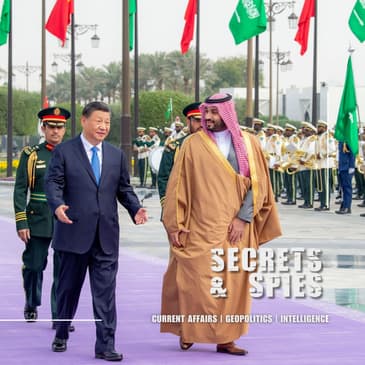
Photo by Bandar Algaloud/Saudi Royal Court, Chatham House
Secrets and Spies sits at the intersection of intelligence, covert action, real-world espionage, and broader geopolitics in a way that is digestible but serious. Hosted by filmmaker Chris Carr and writer Matt Fulton, each episode examines the very topics that real intelligence officers and analysts consider on a daily basis through the lens of global events and geopolitics, featuring expert insights from former spies, authors, and journalists.
Hosted by Simplecast, an AdsWizz company. See pcm.adswizz.com for information about our collection and use of personal data for advertising.
[00:00:00] Lock your doors, close the blinds, change your passwords. This is Secrets and Spies. Secrets and Spies is a podcast that dives into the world of espionage, terrorism, geopolitics, and intrigue. This podcast is produced and hosted by Chris Carr.
[00:00:29] Welcome to Secrets and Spies. On today's podcast, we're looking at China's relationship with Iran and its wider goals in the Middle East. I'm joined by Ahmed Aboudouh, who is a senior fellow with the Chatham House Middle East and North Africa program. If you're enjoying this podcast, please review us on Apple Podcasts, Spotify, and Amazon Music. And please consider supporting the show by subscribing to patreon.com and getting access to ad-free versions of this show.
[00:00:57] Also, you can buy us a coffee at buymeacoffee.com forward slash secrets and spies. The links are in the show notes below. Hope you enjoyed this episode. Thank you for watching. Thank you for listening. Take care. The opinions expressed by guests on Secrets and Spies do not necessarily represent those of the producers and sponsors of this podcast.
[00:01:26] Akwed, welcome to the podcast. It's wonderful to have you on. Thank you, Chris. I'm very happy to be with you. Thank you for your invitation. Thanks for joining us today. So, for the benefit of the audience, please can you just tell us a little bit about your background and the work that you do with Chatham House. I'm a Nasser Swit Fellow with Chatham House Middle East and North Africa program. I also head the China Studies Unit at EPC. That's a think tank in Abu Dhabi.
[00:01:51] And my work focuses on China's influence in the Middle East and the Global South in general. I do my PhD now at the Defence Studies Department and King's College, focusing on the same issue. And I write constantly and speak on this matter. Excellent. Thank you very much, Le.
[00:02:12] So, reading your recent work on China, Iran and Egypt, I was sort of struck by the sense that all three pieces are about a sort of larger question, which is how is power changing in the Middle East? So, before we kind of get into specifics, do you think we're witnessing the emergence of a sort of genuinely new regional order? I think so, yes. I think what happened in October 7 complemented the transformations that have been going on since the Arab Spring and accelerated them.
[00:02:41] But the war in Iran, in particular, although it is an episode that complements the certain trajectory that we are having in the Middle East since October 7, I think it will be transformative in its own right. And this is for a number of reasons. The first is, I think we are having now an ascendant Israel that has hegemonic ambitions in the Middle East, or at least it wants to be first among equals.
[00:03:11] And Iran that is more hardline and more resilient and less pragmatic and prone to sign any deals with the United States and its Western allies because it lost all confidence, obviously, after the war. We have Gulf states who are thinking about the future of their security.
[00:03:31] And I think one of the main outcomes will be to lean towards diversification of partnerships, especially in the defense sector, while keeping the United States as the main security principle or a provider of security in the future.
[00:03:48] We are also having a trend now that includes the decline or the weakening of Iran and its proxies and the rise of Israel with the support of the United States through military power.
[00:04:04] But also another block that is rising now consisting of Saudi Arabia, Turkey, Pakistan and Egypt that wants to balance both camps and wants to have its own say in the future of the regional order.
[00:04:20] And the last point is, based on what I said, I think we have a United States that is less trusted in the region and more prone to instigate instability, at least in the short term, maybe to reach stability in the long term.
[00:04:37] But it will have the worst deal any great power has in any region that is more involvement because of the rise of uncertainty and instability in the short term and less influence because of the confidence that is declining in the United States. And one of your most interesting arguments in the many pieces I've been reading recently is that many Western observers are sort of misunderstanding China's apparent restraint towards its sort of campaign in Iran. What are they getting wrong about that?
[00:05:06] I think my Western colleagues understand exactly what's going on. This is not a jab at anyone or a go at anyone. But in my view, I think there has been exaggeration, not at the analysts and researchers level necessarily, but at the policymakers level, especially in the United States, that is expecting China to heed the calls coming from Washington, D.C.
[00:05:35] And to use its leverage, especially in the economic sphere on Iran to compel it to give concessions to the United States. I think this is exaggeration for several reasons. The first is this is an existential threat to this regime in Iran. And I think the Chinese understand this.
[00:05:53] And this means that this regime will never listen to the Chinese or any other power that asks them to de-escalate at this moment where their own existence is at risk.
[00:06:40] And the third one is this coercive pressure in its classical sense in the Western thinking does not exist in China. The strategic culture in China is based on consultation and dialogue, not in coming to you and threatening you and say, do this or we are prepared to do that to you. I don't think the Chinese operate that way.
[00:07:07] And even if they were, I don't think China is in a position that allows it to do anything for the United States, quite frankly, to help the United States strategy in the Middle East or anywhere in the world. So that's why I always argue that we shouldn't expect China to step in on behalf of the United States in this world. And what does China ultimately want from its relationship with Iran? And how does Iran sort of fit into Beijing's wider Middle East strategy?
[00:07:35] Well, I think, first of all, I don't see that China has a clear strategy in the Middle East. That's because the Middle East is very far away geographically from China. It doesn't feature high on its list of priorities. Or as a decisive factor that will affect what the Chinese call the core interests, that is China security, regime stability and economic interests.
[00:08:02] But what they want from Iran is they want to continue to buy cheap oil. And this oil amounts to 13.5% of all the oil imported by China.
[00:08:14] And this goes to teapot refineries or independent refineries that their core existence in the market relies on the discount they get from Iran or Russia or previously Venezuela to be able to compete with the large NOCs or government-owned companies. They also see Iran as we see it as a regional troublemaker.
[00:08:38] And they want an insurance policy through this bilateral partnership to preserve the freedom of navigation and the flow of energy from the Strait of Hormuz and their own BRI investments in the Gulf and the security and safety of Chinese citizens that are residing in the Gulf. And in the end, I think they also see Iran as a counterweight against the United States hegemonic posture in the region.
[00:09:08] But again, this is not part of a coherent and well-defined Chinese strategy in the Middle East. China doesn't have its own vision for the regional order. It doesn't push for it. It doesn't take any risks to implement it. And as I wrote in one of my pieces, China goes with the wind. And this makes it very ironic because in the majority of objectives in the region, I think China's interests and vision converge.
[00:09:37] They don't diverge with the United States. Yeah. And it's interesting you say that China goes with the wind because a lot of American observers tend to talk about China has this sort of very big long-term strategy of all things. And you are not sort of seeing that with regards to the Middle East. I don't think so. I think I might even say that, as I said before, it's not very important for China, not at least as important as Southeast Asia or the Indo-Pacific.
[00:10:04] And also, as I said, the interests converge. And this is not allowing Iran to have a nuclear weapon. They both agree on that. They also both agree on the freedom of navigation and the safety of energy transit in the region. And they were agreeing on guaranteeing stability in the region until recently.
[00:10:28] Because I think the United States' behavior now in the region does not convince me that this is still an objective in Washington, D.C. And I'm not saying that the United States is destabilizing the region. But maybe they have a vision for short-term instability for the longer-term good. But in the end of the day, China doesn't support elevating Israel as first among equals.
[00:10:54] And it doesn't support using military force against a sovereign country that is Iran. So in the end of the day, I think we didn't see China doing anything to prevent that. We didn't see China paying the cost for guaranteeing stability in the region. And I don't think this will happen anytime soon. So you argue that China can benefit whether there's a deal with Tehran or continued confrontation. So how has the Iran conflict sort of advanced China's interests?
[00:11:21] I think the good way to answer this question is to look at what are the leverage now that Iran has in the negotiations. And I think there are two aspects that both the United States and Iran like to focus on. That is the highly enriched uranium that Iran has and the opening of the Strait of Hormuz.
[00:11:41] And I don't think the drone and missile capabilities that Iran still has or its proxies are still a priority for the Trump administration. So when we analyze these two core leverage cards that Iran has, I think you will see that both exacerbated by the first and the second Trump administration.
[00:12:06] Because had the first administration stayed in the GCBOA, Iran wouldn't have had the highly enriched uranium that the United States wants to take right now. And if the current administration didn't start the war, Iran wouldn't have moved to block the Strait of Hormuz, which was opened until the last day before the war.
[00:12:28] So what I'm trying to say here is that the Chinese know this, the Iranians know this, and the whole world know this. The other point is that I don't see the negotiations happening in a few weeks as President Trump hopes. I think the GCBOA only writing it took around two years, and I think these negotiations will also take a very long time.
[00:12:51] The longer the negotiations take, the more benefit China has, because the longer the negotiations take and the threatening, the more damage the United States image and reputation has all over the world versus China. And the more entrenched the United States is militarily and diplomatically, and when it comes to strategic resources in the Middle East, which gives China the strategic space to achieve hegemonic posture in the Indo-Pacific.
[00:13:20] In the long term, I think the Gulf states and Iran will have to learn to live together. Geography will prevail at some point. And the only power that is positioned to make this happen or to put its stamp on any agreement between these two sides in the future is China, as it did between Saudi Arabia and Iran in 2023. Question just comes to mind because it's just popped up a few times. You mentioned about how confidence in America has declined in the Middle East.
[00:13:51] What are the key points that has led to that lack of confidence, do you think? I think if you are sitting now in Riyadh or Abu Dhabi or Cairo, I think you will see both the United States and China as unreliable powers. When it comes to the United States, I think it has been the guarantor of security since after World War II.
[00:14:15] But since the Arab Spring and the signing of the GCPOA, we have seen flashpoints in the region that gave the impression that the United States cannot be relied on as a security guarantor anymore. And that it is less interested in the Middle East and wants to pivot away to other regions that it sees more important, such as the Western Hemisphere or the Indo-Pacific to contain China.
[00:14:42] So we have seen this as the narrative in the Gulf goes in letting Mubarak go and not protecting his regime and then signing the GCPOA without including Middle Eastern states. And then in the Iranian attacks on Abqaiq and Khurais Aramco oil refineries in 2019 and Houthi's attack against Abu Dhabi in 2022.
[00:15:05] And then the October 7th, it all proved that the top priority for the United States is the security of Israel, or at least this is a common narrative now in the Middle East. When it comes to China, I think China is seen as a power that can let you hear whatever you want to hear. Very nice rhetoric, but no substance.
[00:15:26] It cannot be relied on as an alternative to the United States, and it will never take risk on behalf of Middle Eastern powers to implement this instability it calls for all the time. Many analysts still frame this sort of US-China competition as a new Cold War. Does that comparison really help us understand what's happening in the Middle East, or does it obscure more than it reveals?
[00:15:46] It's misleading, to be honest, because this narrative assumes, as you said in the beginning, that the competition between the United States and China elsewhere, by default, extends to the Middle East. And this is not true. And as I said before, I think both countries' interests converge in the Middle East, at least the majority of them. And also, I think that China is free-riding on the United States security umbrella.
[00:16:14] That is guaranteeing the flow of oil to Chinese ports coming from the Middle East, and also guaranteeing the safety and security of its interests and citizens by the United States. So the United States here is paying the cost for Chinese interests to grow, and subsequently its influence to grow as well in the region. Let's take a break and be right back with more.
[00:16:53] If you were sitting in Cairo, Ryder, or Abu Dhabi today, how would you view the United States compared to China? So what does each power offer that the other's not? You've talked a little bit about some security guarantees earlier, but there are other things that they offer that are different. Well, I think, yes. I think the United States will remain, whether people like it or not, in the Middle East as the main security player in the region.
[00:17:16] And this is not because the level of trust in the United States' ability and willingness to step in to protect these countries is still high, but because they don't have any alternative at the moment.
[00:17:59] So in the end of the day, this is a perfect recipe for Middle Eastern countries to hedge, to take security from the United States partnership, but also economy, finance, and industrial development from China. China sort of seems to be gaining influence without assuming the security responsibilities that you've mentioned. So is Beijing developing a fundamentally different model of power and influence in comparison to the US? I think, yes. And this question can be discussed in other regions as well.
[00:18:28] So domestically, quickly, what the CCP wants is to see China as a country that is well-governed, economically prosperous, technologically advanced, and militarily powerful by the year 2049. And this is the centenary of the foundation of the People's Republic.
[00:18:47] When it comes to the international order, including the Middle East, I think China wants to restructure the global order to become the center of it, but without establishing hegemony in the classical sense as we think about it here.
[00:19:03] It also wants this global order to be designed in a way that diminishes gradually the United States' influence, but not only the United States, any single power that can dictate and implement rules in this global order. And it does that through different tools than the United States. The first is economic statecraft.
[00:19:23] And by that, I mean China tries to integrate itself in the most strategic supply chains for any country and subsequently increasing its strategic and political influence over this country. It also wants to implement that through establishing dominance in its immediate periphery, that is the Indo-Pacific.
[00:19:44] But also, and lastly, it wants to establish an alternative governance model through building alternative multilateral platforms to those led by the United States. And we could see that in the SCO, AIIP, and BRICS, and will continue to happen in the future until China reaches its objective. So I think it is a completely different model.
[00:20:09] And I think we should understand this if we want to analyze China and know its objectives in a very clear-eyed way. I noticed in your piece earlier, you mentioned that China has this sort of slogan that the West is declining and the East is rising. I wonder if you could just talk to us a little bit about that and how they're kind of using that to their advantage. Well, I think they keep using this phrase, especially in summits between President Xi Jinping and other leaders.
[00:20:37] And I think this means that they see the United States' behavior as accelerating, the United States' decline, as a great power. And they see that China at the time is on the side of China. And China, all it has to do is to wait and let its rivals do all the mistakes on behalf of it and just reap the gains in the future.
[00:21:06] So the essence of this narrative is that the future belongs to Eastern countries, especially China, but not the West, especially the United States. And you mentioned earlier, I don't know if we can expand on it a little bit. So Beijing is concerned that a nuclear Iran could trigger a regional war, which I think is probably a concern they share with the US. Could you talk to us a little bit about that?
[00:21:31] Yeah, I think one of the motivations that makes China opposed to Iran having a nuclear weapon is that it would trigger at least a nuclear race in the Middle East. And it would give incentives for the United States and Israel to bomb Iran or even invade it. But on the other side, the other scenario is having a nuclear weapon.
[00:21:58] And this is the scenario that concerns China big deal. Having a nuclear weapon might actually establish a level of deterrence against the United States and Israel that makes them think twice before bombing it. And we see this scenario happening, for example, in North Korea. If this happens, I think from a Chinese point of view, it might become a global model adopted by China's rivals in the Indo-Pacific. And I'm here talking especially about Japan, Australia and South Korea.
[00:22:26] They would pursue a nuclear weapon as a deterrence against China's rise in the Indo-Pacific. And subsequently also triggering another race in the Indo-Pacific in China's periphery. This is the last scenario China wants to see happening. And I think this is one of the motivations why China doesn't want Iran to have a nuclear bomb.
[00:22:47] And there's another thing that stuck out for me in the articles about how Beijing kind of sort of sees that the Iran sort of situation is almost a sort of distraction for America over the Indo-Pacific. And also it could deplete U.S. weapon stocks. And obviously there's been a lot of articles recently about this. I mean, what are your thoughts on that? I think that's right.
[00:23:09] The war, as I said before, whether the war resumes or the negotiations continue, I think it will continue to deplete and distract the United States away from the Indo-Pacific, which is the most important thing for China. In other words, it will give China more time to implement its own agenda in the region.
[00:23:29] But also when it comes to technicalities of ammunition, I think the United States expended precious ammunition in this war and in large quantities that will take years to compensate and replenish.
[00:23:44] And I think the renewed trade war between the Trump administration and China taught us that you don't do that if you understand that China controls the supply chains of critical minerals and rare minerals that are central ingredients in the manufacturing of ammunitions and military equipment.
[00:24:05] So in other words, Trump put the United States under China's mercy when it comes to replenishing its stockpiles of ammunition. So turning to Egypt, you argue that Cairo's diplomacy during the Iran crisis was driven primarily by pragmatism rather than prestige. Why was Egypt so eager to help bring the conflict to an end? Yeah, this is an interesting question.
[00:24:30] I think if you look at Egypt's diplomacy historically, it is a diplomacy that prefers regional stability and peace and mediation. And this war disrupts this agenda. I think specifically Egypt's actions during this war are motivated by four objectives I mentioned in one of my pieces. The first is it wants to prevent the Hothis from joining the war.
[00:24:57] And Egypt learned this lesson the hard way when the Hothis last year blocked the Bab el-Mandab street, which leads to the Suez Canal, which resulted in Egypt's loss of billions of dollars as revenues coming from the Suez Canal. So it wants the Hothis to stay away from this. And it also wants stability and security in the Red Sea by not allowing one single player to establish hegemony in the Horn of Africa and the Red Sea.
[00:25:25] And specifically here, I'm referring to Ethiopia, which is seen in Egypt as a regional rival. The second objective is Egypt wants to balance Israel's rise in the region, and it sees this as a direct threat. That's why we've seen Egypt adopting proactive diplomacy and joining the Quad of Pakistan, Saudi Arabia, Turkey.
[00:25:45] And the third objective is it sees that the Trump administration suffers from short attention span, and it wants it to redirect its strategic attention to other issues that Egypt sees as more important, such as implementing the ceasefire agreement in Gaza. We've seen Prime Minister Netanyahu saying that he ordered the military to expand and control 70% of the strait, which is a violation of the agreement.
[00:26:13] It also wants the United States' help to end the war in Sudan, and it wants also the United States' help to settle the dispute with Ethiopia over the GERD Dam. And the last objective is Egypt has been one of the most affected countries economically from this war.
[00:26:31] For example, in the initial phase of the war, the fuel prices jumped up to 30%, inflation increased by 215.2%, and the pound plummeted to historic lows. And Egypt wants this to stop. So the only way to stop all this is by ending the war, at least in the short term. And reading your article, I got the impression that Egypt increasingly sees itself as a manager of regional risk rather than a traditional regional leader.
[00:27:01] Is that fair? Yeah, it is fair. I think the good old days of Egypt being the leader of the region has gone a long time ago. Egypt has suffered instability through two waves of public unrest in 2011 and 2023, both resulted in removing two governments and presidents. Egypt also is suffering a chronic economic crisis that is resulting from mismanagement and also regional instability.
[00:27:29] And it relies on economic help from Gulf countries, the United States and European powers. And it also lost a big chunk of its soft power that has been dominating the region in the good old days. So Egypt has still positive tools. That is the largest military in the Arab world, the largest population in the Arab world, and its strategic location.
[00:27:55] But at the end of the day, it cannot leverage these tools because of the weaknesses I just mentioned. So the best way for Egyptian policymakers is to adopt a risk management approach that pushes for stability and de-escalation. You noted earlier that Egypt has been working alongside Saudi Arabia, Turkey and Pakistan during the Iran crisis. What does that tell us now about how the regional powers now are organizing themselves?
[00:28:22] Well, it's interesting because we have to start from the Arab Spring. And I think the Arab Spring divided the Middle East in general. A group of countries, that is the Gulf states, wanted to confront assertively Iran, especially in Yemen, by triggering the Yemen war. Turkey and Qatar wanted to promote the Islamists' agenda through the Muslim Brotherhood in the region.
[00:28:50] But then came the first Trump administration. And all these countries started to think about the United States as a power that wants to leave the region and focus on other regions. And the Middle East is not a priority. So they started hedging by bringing in China and other powers from outside, including Pakistan and India. And then came October 7. And I think October 7 changed the whole perception at the regional level.
[00:29:20] Now many countries are coming together to try to think about the future of the regional order in a way that doesn't reduce their strategic autonomy or influence and doesn't threaten their own security. I think we are seeing this transformation. As you said, they are rearranging themselves around these themes and around a common threat perception that is both Iran and Israel.
[00:29:47] So I think we are seeing now the new contours of the regional order, but they are not complete yet. And I think time will tell. And many Western observers assume Arab states would welcome a significantly weakened Iran. Because I know there are a lot of commentators during the war on terror that talk about how 1979 and the creation of the Islamic Republic of Iran sort of changed the Middle East then.
[00:30:15] So your article suggests obviously the reality is more complicated. Why is that? That's because Arab countries don't want to see weakened Iran. They want to see a normal Iran. And this is completely different. And we have to approach it from this angle to understand what's going on. So what I mean by normal Iran, I mean a less revolutionary regime that can coexist with its neighbors and not threaten their security and interests.
[00:30:42] If Iran is successful in achieving or presenting itself in this manner, I think Arab states will be very happy to integrate Iran into the regional order. At the moment, we are not there yet. But I think this war will trigger the incentives for both Iran and Arab states to try to rethink their animosity and try to reach middle ground where both sides can live together.
[00:31:09] At the same time, they see Israel as a rising threat, especially under Netanyahu. And I think this incentivizes a milder perception of Iran as a counterweight.
[00:31:25] And I think from a very pragmatic point of view, as Prince Turki Faisal, who is a prominent figure in Saudi Arabia, wrote, I think they will not allow themselves to continue this conflict against Iran or go very far in their animosity against Iran. I'm not talking about all Arab states, of course. You know, I'm talking about Saudi Arabia, Egypt, Pakistan and Turkey, as long as Israel is adopting this approach.
[00:31:53] In other words, I think Israel is the victim of its success since October 7th. There's some interesting developments going on with Saudi Arabia and the Straits of Hormuz and sort of how they're trying to sort of become a hub that bypasses it. I was wondering if you could just talk to us a bit about that. Yes, this is a very interesting dynamic that is happening here. Saudi Arabia has the biggest leverage because it's the biggest landmass in the Gulf. But I don't see only Saudi Arabia implementing that.
[00:32:23] There is a new thinking in the Middle East that is predicated on derisking maritime choke points. Whether that is the Straits of Hormuz, Bab al-Mandab or Sioux Canal through establishing overland routes. And I think Saudi Arabia just positioned perfectly to implement that very quickly. And we will see that happening in the future. In fact, we could see a competition between different projects and different initiatives.
[00:32:50] One of these initiatives is the IMIC corridor that links India, the Middle East and Europe. And upon which the Abraham Accords integration part has been built. I don't think this will happen anytime soon. Because for this to happen, normalization of Israel has to happen first to integrate Israel in these supply chains.
[00:33:14] And as we all know now, it is very difficult for countries in the region that didn't sign Abraham Accords to normalize the relationship with Israel now. And we could see that in the complete silence that President Trump's call for these countries to sign these agreements has been met. So I think we will see that happening. And I see other trends happening because of the war.
[00:33:41] One of them, and in one of your questions, you mentioned beneath the surface developments in the Middle East. One of these beneath the surface developments is a focus from external powers on North Africa. Because North Africa seems to be the more stable region compared to the Gulf and the Middle East going forward. No wars will happen in this region.
[00:34:03] Even when social stability happens, there is a great level of resilience and stability is restored again. And there is also another dynamic that is very dangerous when it comes to the strain of hormones that I think is overlooked. That is China's legal interpretation of Iran's position. And you could see that in the United Nations Security Council.
[00:34:29] China is defending Iran's interpretation because it sees that if the coastal war, if the coastal country is at war, it has the right to be equal to the international laws of the sea. That is its concerns about its sovereignty, security and interests should be taken in consideration.
[00:34:54] And I think the main objective of China here is to implement that and institutionalize it in the Indo-Pacific, South China Sea and the Strait of Taiwan. Let's take a break and be right back with more.
[00:35:21] And across all three articles, there seems to be a kind of recurring theme. Regional powers increasingly want flexibility rather than alignment. Are countries like Egypt, Saudi Arabia and the UAE trying to build a future in which they do not have to choose between Washington and Beijing? Of course, of course. We have seen this happening even before the war. And this is normal. I'm very baffled at the argument that the war will end hedging.
[00:35:48] I really don't understand where this is coming from because throughout history, not only in the Middle East, smaller and middle-sized countries look for a fallback position when uncertainty is increased and their autonomy and security is threatened. And this is classical case in the Middle East when it comes to the relations with China and the United States.
[00:36:13] And as I said before, compartmentalization is a case in point as well regarding the sectors that these countries are interested in cooperating with both great powers. So I think contrary to what I've read, the war will intensify hedging through diversification of partnerships and multi-alignment. It will not diminish it. And what do you see ahead for America's influence in the region? That's a very difficult question.
[00:36:43] But I said before that I think America will have the worst deal. That is more engagement and involvement and less influence. First. Second, I think also the answer to this question depends on what the United States wants. Both the national security and national defense strategy stated very clearly that the Middle East is not a priority anymore for the United States. But, you know, many, many, many administrations said that before.
[00:37:10] But getting out of the Middle East is a very difficult enterprise. It's not very easy. And I think the United States will try to get out, but it will fail again. The other point I'll make is that project that started in 2020 by encouraging countries to sign Abraham Accords with Israel has ended effectively, in my view.
[00:37:33] And this will increase the predicament of the United States in the region because there is no alternative to me at the moment apart from weakening Iran to strengthen Israel. There is no other. It's a very damning binary that we don't see any other alternative, at least in Washington, D.C.
[00:37:51] The United States has to recalibrate its approach, has to listen to regional powers, and has to ditch the overwhelming idea in both Israel and among hardliners in Washington, D.C. That only military force can bring the regime down in Iran and can weaken Iran. This war proved this is wrong completely.
[00:38:17] And I think unless the United States understands this is not the way forward, its influence in the region will diminish over time. The Trump administration were looking for a quick success with Iran, but have obviously miscalculated everything. Yeah, I think so. I think this naive idea that Iran is another Venezuela was completely proved to be very, very wrong. But also, I think both Israel and the United States were victims of their successes.
[00:38:44] You could see that the huge military success that the United States achieved in Venezuela emboldening President Trump personally and his administration. The same can go for Israel, its military successes against Hamas in Gaza and then in Syria and now against Hezbollah in Lebanon, made the elite in Israel think they can achieve anything by military force.
[00:39:12] Iran, I think, is completely different. And it was a very wrong approach to adopt this against Iran. And I think, yes, you are absolutely right. The United States has and still is seeking a quick resolution to the Iran war. And you could see that in the rhetoric coming from President Trump that the negotiations will happen in 60 days and everything will be fine. I don't think this will happen.
[00:39:38] And then looking ahead three to five years, what do you think the Middle East will look like if these sort of trends you describe continue? Well, I think, yes, they will continue. I think I see the United States still trying to find an understanding with Iran, whether that is through negotiations or through renewed episodes of military confrontation.
[00:40:04] I see a gulf that is more diversified and looking for certain technologies, cheaper military technologies from other sources than the United States, whether that is in Europe or Asia or anywhere else. I also see more institutionalized balancing against Israel. And I see the end of the Abraham Accords.
[00:40:27] All these dynamics will come together, I think, to form together an unstable Middle East, a high uncertainty, and a region that drags the United States more into it rather than giving it the space to pivot to other regions. To talk about the Abraham Accords, they've come up a few times. Why do you think there was an inherent weakness in them, and why do you think they ultimately failed?
[00:40:53] I think they failed because they took Israel's interests in consideration, but not the regional countries first. Second, I think the main focus was to create a high level of trade and economic integration in the region, but without sorting out all the security issues that preventing other countries from joining.
[00:41:19] And third, I think one of the main objectives, at least in Israel and the United States, is to establish an alliance that is able to confront Iran regionally. I think all these objectives were not suitable for the developments that the Middle East has witnessed since the signing of these agreements, especially isolating Iran and excluding it from the new regional order.
[00:41:47] It was very understood in the Middle East that Iran would never allow this to happen, and it would go very far to undermine this trajectory. And we saw that in October 7, and then Hezbollah's confrontation with Israel. That led to this war that we are seeing at the moment. I also think that these agreements did not, or at least the people behind them,
[00:42:12] did not take into consideration the pressure that Middle Eastern countries would have domestically if they go and sign such agreements with Israel after the atrocities against women, children, and civilians in Gaza after October 7, and after the boldness and military assertiveness that Israel showed afterwards.
[00:42:37] I think now they are dead in the water, and I don't think in any time soon we will see their revival. Generally, Western policymakers, especially Western policymakers who are concerned about the role of China in the Middle East, what could they be doing better? And this doesn't necessarily have to be exclusively the Trump administration, because they've possibly only got about two years left if they're lucky. They have to understand, they have to look at the Middle East from the perspective of its countries.
[00:43:02] They also have to understand that diplomacy is the only way forward. And they also have to understand that cooperative security and inclusive security is the only way forward, in the Gulf especially. That means including Iran in this equation. If the United States is serious about stability in the region long term,
[00:43:29] and about its ability to focus on other regions in the world, they also have to, first and foremost, and I should start by that, they have to push for peace between the Israelis and the Palestinians. They have to establish a Palestinian state, because this is the underlying issue of everything that is happening now in the Middle East. If peace existed, October 7 would have never happened.
[00:43:56] So if they start from these three objectives, I think the United States decision makers will have a much better policy and approach to the Middle East that is aligned with the priorities of its people, and will definitely, in the context of great power competition with China, elevate the United States image and prestige again. And there's been a sort of isolationist push in America internally,
[00:44:25] and if they were to successfully, should we say, pull out of the Middle East, I mean, what do you think the Middle East would look like? I mean, would it benefit from not having so much US influence, or do you think it's going to make things more difficult? What do you think might be the situation? I don't think so. I think the United States is very needed in the Middle East and for its stability, because this is a region that relied on the United States security for very long.
[00:44:54] And pulling out all of a sudden will just make it crumble, in my view. A lot of people in the Middle East would disagree, especially in Iran, but this is what I think. But this influence should be implemented and exercised in a different way. I will give you an example. The permanent military bases in the Gulf can be recalibrated in a way that replicates
[00:45:19] the United States' position or existence in Eastern Europe. That is, through bilateral agreements, through institutionalized frameworks, the United States can elevate or increase its military presence or deployments, or decrease it based on understandings with regional countries. It doesn't have to have permanent military bases, especially after proving that these military
[00:45:47] bases can be a burden, not source of protection for these countries. It also wants, it should, I think, expand its influence in a way that replicates its involvement in Southeast Asia after Vietnam War. That is offshore balancing. I mean by that the United States doesn't have to be involved in a micromanagement way.
[00:46:14] But it can balance things from a distance and intervene when it is utmost necessary for it to intervene. So there are a lot of ways that the United States can calibrate its involvement in the region. But the most important thing from a regional perspective is that people need in the region to feel that this involvement is serving their interests and taking their concerns on board.
[00:46:41] At the moment, we don't have, unfortunately, this feeling. Yeah. Ahmed, thank you so much for your time on the show today. Where can listeners find out more about you and your work? Thank you so much, Chris. That was great fun talking to you. I think my work features on the Chatham House main website, on EPC website, and on my social media pages, whether that is especially Twitter, X or LinkedIn, you will find all my works published there.
[00:47:11] Fantastic. Well, thank you again for joining me today. Thank you so much, Chris.
[00:47:42] Thanks for listening. This is Secrets and Spies.