Before Bletchley Park, there was Reginald "Blinker" Hall, the Admiralty’s mercurial intelligence chief whose codebreakers read Germany’s wireless traffic during World War I, giving Britain a front-row seat to the plot behind the 1916 Easter Rising. His target was Sir Roger Casement: a diplomat knighted for exposing colonial atrocities, turned Irish rebel, caught after a U-boat put him ashore in Kerry. Rory Carroll, The Guardian’s Ireland correspondent and acclaimed author of Killing Thatcher, joins Chris to trace the manhunt — and Casement’s "Black Diaries," the still-contested record of his private life that Hall leaked to break a clemency campaign in an early act of information warfare. A century on, Casement’s bones and his reputation remain unfinished business between Britain and Ireland.
Subscribe and share to stay ahead in the world of intelligence, global issues, and current affairs.
Order Rory’s book, A Rebel and a Traitor: A Fugitive, the Manhunt and the Birth of the IRA: https://www.amazon.com/dp/B0FS44H5RZ
Find more about Rory on his website: https://www.rorycarroll.co.uk/
Take our audience survey: https://forms.gle/eFx59XntNtiKzNQa8
Support Secrets and Spies
Become a “Friend of the Podcast” on Patreon for £3/$4: https://www.patreon.com/SecretsAndSpies
Buy merchandise from our shop: https://www.redbubble.com/shop/ap/60934996
Buy us a coffee: https://buymeacoffee.com/secretsandspies
Subscribe to our YouTube page: https://www.youtube.com/channel/UCDVB23lrHr3KFeXq4VU36dg
For more information about the podcast, check out our website: https://secretsandspiespodcast.com
Connect with us on social media
Bluesky: https://bsky.app/profile/secretsandspies.bsky.social
X/Twitter: https://x.com/SecretsAndSpies
Instagram: https://instagram.com/secretsandspies
Facebook: https://facebook.com/secretsandspies
Spoutible: https://spoutible.com/SecretsAndSpies
Follow Chris and Matt on Bluesky:
https://bsky.app/profile/chriscarrfilm.bsky.social
https://bsky.app/profile/mattfulton.net
Secrets and Spies is produced by Films & Podcasts LTD: https://filmsandpodcasts.co.uk/
Music by Andrew R. Bird
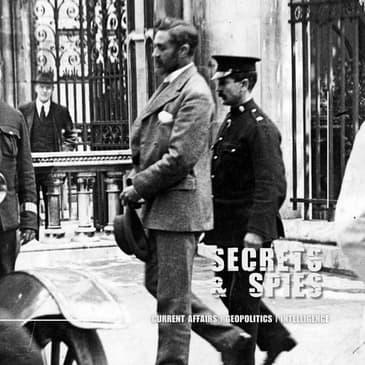
Photos by Hulton Archive, Bettmann
Secrets and Spies sits at the intersection of intelligence, covert action, real-world espionage, and broader geopolitics in a way that is digestible but serious. Hosted by filmmaker Chris Carr and writer Matt Fulton, each episode examines the very topics that real intelligence officers and analysts consider on a daily basis through the lens of global events and geopolitics, featuring expert insights from former spies, authors, and journalists.
Hosted by Simplecast, an AdsWizz company. See pcm.adswizz.com for information about our collection and use of personal data for advertising.
[00:00:00] Lock your doors, close the blinds, change your passwords. This is Secrets and Spies. Secrets and Spies is a podcast that dives into the world of espionage, terrorism, geopolitics, and intrigue.
[00:00:26] This podcast is produced and hosted by Chris Carr. On today's podcast I'm joined by journalist and author Rory Carroll and we discuss his brilliant book Rebel and a Traitor that looks at the story of Roger Casement and his role in the Irish Easter Rising. I hope you find this episode interesting. Thank you for watching. Thank you for listening. Take care. The opinions expressed by guests on Secrets and Spies do not necessarily represent those of the producers and sponsors of
[00:00:52] this podcast. Rory, welcome to the podcast. It's good to have you on. Thanks Chris for having me. Delighted to be here. Thank you. Well, for the benefit of the listeners, please can you just tell us a little bit about yourself and what drew you to the story of Roger Casement? I have been a guardian
[00:01:17] foreign correspondent for almost my entire career. I'm originally Irish but had spent most of my career overseas. I came back to Ireland a few years ago as an Ireland correspondent, which has revived my interest in Irish and British history. And so I stumbled across this aspect of Roger Casement, this Irish rebel, which was a very familiar story to Irish people. British people have largely forgotten him. But
[00:01:45] there's an aspect of the story which was new to me, very unfamiliar, which involved basically rebels and spies and the fact that there was a manhunt at the core of this story. And so I felt to me that this jumped out at me as a fabulous story. So for listeners new to this story, can you just give us a brief overview of your book, A Rebel and a Tracer and kind of what it's about?
[00:02:08] The core story here, it's a manhunt. It's a story of a protagonist who is perhaps the least likely Irish rebel ever. And the fact that he's being pursued by an antagonist, a British spy chief. And this lethal game of cat and mouse plays out against the backdrop of the Great War, the First World War,
[00:02:32] and the countdown to Ireland's rebellion in Easter 1916. And so that's the, in essence, that's the story. Yeah. And so Casement begins as a celebrated servant of the British Empire, but ends up condemned as a traitor. So what drove that transformation? He, Roger Casement is an extraordinarily complex, paradoxical character. He was born in Ireland
[00:02:59] and grew up in Antrim, in what is now Northern Ireland, as a Protestant. And he served the crown as a loyal servant of the foreign office. He was a Rovian consul and he served in Africa and also South America. And he became a humanitarian celebrity to use modern language because he did these reports
[00:03:25] exposing atrocities against indigenous tribes for which he was then knighted. He became Sir Roger Casement. And this was, made him an extraordinary adornment to the, at first to the British government. It also helped and was true that he was extraordinarily handsome. Accounts from that this time from men and women know just how, that he possessed this dark beauty. And so he, he was like this star. I mean,
[00:03:54] he was revered in the times of London, was kind of lauding him about, by being in a sense, the best of us. You know, he was this embodiment of Victorian and then Edwardian nobility. Yeah. There's certainly a few pictures of him throughout your book and he does look like a film star. I'm trying to think what actor he reminds me of who's around today, but he certainly has a look about him. I think like a young Rupert Everett in his day, he was very tall and lean, dark and he, you know,
[00:04:24] beard. So he, I mean, he, by the time of the story in which my narrative takes place, it's, you know, towards the, it's 1914 to 1916. He's a bit older and he's early, he's about to turn 50 and he's basically, he's having a nervous breakdown. So he's kind of passed his prime in a way, but it's also the most sense kind of dramatic aspect of his life and the backdrop to it.
[00:04:50] As I said, it's the great war, it's a countdown. And so, you know, that's why he, and he, in a sense, he's the gravitational pull of other story, which involves lots of other characters as well, who were kind of drawn into the orbit of Roger Casement. Yeah. Thank you for that. So can you give us a sort of bit of a guide to what the political situation in pre-World War I Ireland was?
[00:05:13] It was febrile because the British government had promised to bring home rule to Ireland. Irish nationalists wanted their own parliament. They wanted a degree of autonomy. They were not looking for independence. They were looking for just to have more, a bit more power in Dublin. The British government agreed to give that to them. And so Ireland would have stayed within the United Kingdom.
[00:05:37] However, unionists in the north of Ireland were appalled. So they, in fact, imported guns and they threatened civil war to prevent this because they did not want to be, as they would see it, subservient to a parliament in Dublin. So Ireland was on the cusp of civil war in early 1914. And that was actually the big concern for the British government was not, you know, war clouds gathering
[00:06:04] in Europe. It was actually war in Ireland. And so this was, in a sense, distracted the British government and, in some sense, emboldened the Germans as well when they were doing their own calculations to think, well, Britain is too distracted by events in Ireland to intervene in the continent should war break out there. So it was this very tense period in Ireland. Yeah. And what was Case Prince of trying to do? So he was planning to bring about Irish independence. How was he planning to do that?
[00:06:31] Initially, just before World War I, he was, at least publicly, in favour of home rule. And he was trying to raise funds and also get guns for the Irish militia. Now, this was not for independence, but merely to try to counter the fact that the unionists already had guns as well. But in fact, secretly, he was much more radicalised than he let on publicly. He now wanted full independence,
[00:06:59] which at this time, only a handful of tiny, you know, rebellious souls were pursuing that. And so he goes to the United States just before the outbreak of the war to try to raise weapons and money. And it's while he's in the United States that World War I breaks out and this changes everything. Yeah. And how does it sort of change its plans? What happened?
[00:07:24] There's an old Fenian motto that England's difficulty is Ireland's opportunity, meaning that in previous times when England was locked in conflict or distracted by great events, that was the time for Irish rebels to strike because, you know, the empire was at its, you know, perhaps weakest. And Casemont went along with this. He felt, okay, now England is locked and the British empire is
[00:07:54] locked in this gargantuan existential struggle against the German empire, a war of the likes of which the world had never seen. And so now would be the chance for Ireland to strike a blow for freedom. And so he, there's a precedent for this. Two centuries earlier, an Irish rebel called Wolf Tone had actually sailed from United States to France, revolutionary France to seek help
[00:08:22] for an Irish rebellion in the late, in the 1790s. So Casemont in a sense wanted to replicate this, but this time he would sail incognito and the, the, the, the support for the Irish rebellion would not be the French, but this time it'd be the Germans, at least so he hoped. Yeah. And how did he go about kind of getting German support for his plans? Well, first you had to get there and I mean the story, and here's already a lot of intrigue.
[00:08:49] He had to go under an assumed identity. He had to shave off his beard. He tried to cut light in his complexion with buttermilk because remember he was very well known to, to, to Britain as, you know, I kind of had formerly, by now he's really retired from the foreign office, but, you know, he had been in a sense, a celebrity. And so now he's trying to go incognito to try to, to get into Germany whilst the Royal Navy is blockading the seas. And so he had to first
[00:09:16] kind of get there. So that meant a perilous journey via Norway. And then he, then finally he makes it to Germany and there his goals, he has, you know, a few key goals. One is to try to persuade Irish men who had fought in the British army and then been captured by the Germans and were now in German POW camps to try and persuade them to abandon their allegiance to the British, to King George V and
[00:09:45] to join an Irish legion or Irish brigade that Catesman would then bring back to Ireland to, to, to fight for Irish freedom. That was one goal. The second was to get the Germans to diplomatically endorse the idea of an independent Ireland and also crucially to supply soldiers, German troops and weapons for an Irish rebellion. And how was he planning to kind of get those weapons to Ireland? Well, that was all a bit murky because it was how exactly, I mean, given that the Royal Navy was
[00:10:14] controlling the seas, I mean, the Germans themselves thought, well, this will not be easy. And they also needed to be reassured that the Irish rebels, you know, were, could be relied upon that, you know, this rebellion is going to be real. And so it took some time because it took about almost 18 months from 19, from the outbreak of war up until early 1916 for the Irish rebels, the conspirators who were
[00:10:42] based in Dublin to come up with a plan and then to share that plan with Berlin and, you know, with Roger Casement, who was in a sense, the envoy of the rebels in Germany and in the hope that the Germans would send troops and guns. And can you talk to us a little bit about sort of what Casement's sort of ideal plan was? Because he was sort of trying to basically, it was the Easter Rising plot that he was involved with. Can talk to us a little bit about that.
[00:11:09] Casement's time in Germany was very fraught for him because he basically became very isolated and he lost touch with the rebels. He did, he didn't actually really know what was happening back in Dublin. His communications were very difficult because, you know, the British were intercepting or reading all the royal, all post and mail and, you know, to try to get messages
[00:11:33] to his colleagues, his comrades in Dublin was extraordinarily difficult. And he had lost the trust of the confidence of his German hosts. And also the Irish rebels themselves were beginning to lose confidence in Casement. So he was quite an isolated figure and he didn't really know what was happening until then he suddenly told in early 1916, a rebellion is underway or it is planned for
[00:11:59] Easter. And so certainly that's kind of the scramble to see, well, you know, will the Germans supply troops? Yes or no? Will they supply weapons? And can, can they deliver those weapons to Ireland? I mean, all those questions were hanging in the air. Yeah. How active and effective were British intelligence in sort of tracking and then sort of disrupting the Easter Rising plot? They were very effective at tracking the plot, largely through the fact that they had cracked
[00:12:29] the German codes, the wireless codes. And so they were eavesdropping on German messages. And this is crucial part of the story. And this is part of the kind of the hunt aspect, because it was a precursor to Bletchley Park that had been set up. And what they were doing was that they, the British were able to, with signal stations, catch these kind of German messages that were being relayed from the German embassy and German diplomats in the United States, because the United States were
[00:12:56] still neutral at this point. And so the Germans had a diplomatic presence there. And for the Irish rebels, they had to use the German system because the Irish rebels in Dublin would then send a message, a courier to the United States, and I can written notes, which would then be handed to German diplomats, who would then code it, and then send it via wireless across the Atlantic to German signal
[00:13:22] stations in Germany. However, the British were, yeah, they were intercepting these, these messages, and then able to decode them and decipher them. And so unknown to the Germans and the Irish. So that gave the, in a sense, Reginald Blinker Hall, who was the antagonist, he was the head of admiralty intelligence. And it gave him, to some extent, a ringside seat to what the Irish were planning. Can you talk to us a little bit about Reginald Blinker Hall? Because you described him as a man
[00:13:51] of God and gunnery, but not necessarily in that order. I found that quite a fascinating description. Yeah, he's, I mean, he's a great character. I say character, I mean, he's, you know, these were real people. He was a former, he had been a battleship commander. He had a reputation for being very innovative, very forward-thinking, very modern in terms of his embrace of technology, and his use of, of, of, of the skills of his men. However, he also had a very kind of Old Testament
[00:14:21] view of right and wrong. And early in the war, he was then transferred to become the head of admiralty intelligence, which meant instead of being on a battleship, he was now in Whitehall at the apex of this very effective intelligence gathering operation that was at the admiralty intelligence is more effective than army intelligence or, you know, the embryonic MI5.
[00:14:45] And he was ruthless. He was mercurial. At times he was brilliant. And he had it in for Roger Casement because he, Reginald Hall knew what Casement was up to. And for him, you know, this was, you know, pure treason. And he really took a, had a personal, I think, animosity against Casement. And so that's, here was the game of cat and mouse with Reginald Hall as the cat,
[00:15:15] Casement is the mouse. Let's take a break and be right back with more. Just before we get back into the interview, if you're enjoying this episode, please consider buying us a coffee at buymeacoffee.com forward slash secrets and spies. Thank you.
[00:15:42] And to what extent was the failure of the Easter Rising sort of down to intelligence success versus a rebel miscalculation? And what does sort of Casement's journey, you know, from Germany via U-boat tell us about some early covert operations? It was very much rebel miscalculation is what caused the rebellion ultimately to fail. Because although Reginald Hall was aware of what was being planned, there was actually little direct
[00:16:12] intervention to try to nip it in the bud. In fact, that's one of the whole strand of narrative is the fact that Reginald Hall chose not to intervene in a sense, because, you know, as evidence, he in fact wanted the Rising to go ahead for his own political reasons. But in terms of the, how the, you know, Roger Casement and the weapons were sent, that's a whole, and writing the
[00:16:38] book, I mean, that was one of the most kind of exciting aspects, because what the Germans decided to do in the end is that they were not going to send any troops, and they were not convinced the Rising was going to work. But they did think it's, it's worth a punt that it'll probably at least cause annoyance for the, for the British, and they might have to siphon troops from the Western Front to Ireland to kind of suppress the Rising, and that would be useful to the German high command.
[00:17:03] So certainly the Germans, therefore, were decided to invest weapons. So they sent two vessels. One was a ship, a cargo shipment with 20,000 rifles and a million rounds of ammunition and plus machine guns. And this was, but the question is, well, how is this ship going to get through from Germany to Ireland when the Royal Navy, you know, had swept the German Navy from the seas? So how on earth are
[00:17:32] they going to get that ship to Ireland? And the answer was, actually, the Germans were very clever in this. They disguised this ship as a Norwegian freighter. So Norwegian flag, Norwegian name, and actually they mimicked an actual Norwegian ship, which were in the British Royal Navy logs. And actually, so the silhouette of the ship would be identical. The German sailors were told to stop clicking their heels, and they took off their uniforms, and they were given kind of these Norwegian
[00:17:59] merchantmen kind of types of uniforms. They were given pipes, so they could, and to the slouch along on the deck, and to be spitting. They had a dog on deck. They did everything they could, even though their buttons were stamped with Norwegian names, and had false documentation that was aged, you know, with kind of smoke to make it look that their papers, that if they were boarded, because they assumed that
[00:18:26] the British Navy would, in fact, intercept them, that they would bluff their way through, not fight, but bluff their way through this British blockade, and thereby then kind of sneak through and then deliver the weapons. And amazingly, it worked. Almost. They got through. They did this huge loop up towards the Arctic Circle, and then down, or over past Scotland, and then down to the west coast of Ireland. And whilst they're doing this, Roger Casement, separately, he goes in a submarine,
[00:18:55] in a U-boat, to, in a similar route around Scotland, and then down the west coast of Ireland. And the idea was the U-casement would rendezvous with this armed shipment in Tralee Bay, and that the local rebels from County Kerry would then bring them ashore, and this would all be happening on the eve of the rising, you know, literally about 24 hours before the rising. And then it would
[00:19:22] kind of kickstart the whole rebellion. That was a plan. And it's, if you're an Irish nationalist, it's agonising what you would see for them, for how it came so close to success, and then just how things unravel for them, in a sense, in Tralee Bay, where there's this extraordinary sequence of events. The book also sort of shows disagreement and doubt among the rebels themselves. How united were they
[00:19:50] sort of really, and sort of what surprised you the most about the personalities involved in the uprising? At this time in Ireland, there was virtually no desire, even among nationalists, for independence. They wanted home rule, which is a limited form of autonomy, right, of devolved government. There was the idea of like a fully independent Ireland was sort of some sort of kind of science fiction, radical, far out idea. So it's only this kind of small minority of radicals who wanted this.
[00:20:19] And so for them to kind of make this rebellion a success, they had to sort of trick the more kind of moderate nationalists who had weapons and were, you know, but were not planning a rebellion, but kind of tricked them into, in a sense, coming out for a rebellion. And so this involved lots of duplicity. So they were not just trying to conceal their plot from the British authorities that were
[00:20:43] in control of Ireland, but also from their own, to manipulate their own comrades. And so this made the whole enterprise very fraught. And it's, again, a little bit of a spoiler alert, but this is an amazing scene at the end when one of the key kind of moderate nationalist leader of a nationalist militia, he has been tricked up until the last minute into allowing his men to be deployed. And
[00:21:13] then once he realizes what's happening, he says, oh my God, there's a rising happening? No way, he didn't want that. So he gets on his bicycle and he cycles through the night, through Dublin, to go to the offices on a Saturday night, to the offices of the Sunday Independent, which is the biggest newspaper in Ireland at that time, to place an ad in the next morning's newspaper, cancelling manoeuvres, in a sense, to cancel the revolution. And this had been the most top secret
[00:21:41] rebellion. And we have an ad appearing in the national newspaper, in a sense, cancelling it. It beggars belief, but that was a degree of kind of duplicity that the, and cross wires that were happening within the plotters. Can you talk to us a little bit about the sort of circumstances of Casement's arrest? So the German U-book delivered him in Trilly Bay, and he then comes ashore with some comrades.
[00:22:08] He's exhausted, he's sick, he, you know, he had, it appears, another bout of malaria from these old tropical diseases. And he is, again, without going into too much into the details, but he is captured by the local police. And there is a chance to rescue him. I mean, the local rebels, again, this is on the eve of the rising, because the rising is supposed to happen just the, you know,
[00:22:36] the following day, or two days later. But the rebels don't rescue him, even though that actually, they could have easily stormed the police station. But they're under instructions to keep everything secret, to not rock the boats, to not alert the British authorities. So they leave Casement in the clutches, or in custody of the local police, who then pass him on to the British military
[00:23:02] authorities. And then Casement, instead of being held in Dublin, and then maybe being tried in Dublin, is then very quickly brought to London, where the Reginald Hall, the head of Admiralty Intelligence, wants Casement there. He wants to, and he interrogates him. And this is very, it's not quite a climactic scene, but a very dramatic scene, where Reginald Hall and his lieutenants in Scotland Yard
[00:23:28] interrogate Casement in Scotland Yard about the rising, which is yet to happen. It's just right, it's due to happen within a day. And so the clock is ticking down. And again, now then, this is where the narrative begins to pivot to, on once we're in Dublin, the rising begins to unfold, whilst in London, Roger Casement is now a prisoner, he's being held at the Tower of London. And he has,
[00:23:57] you know, on track to having what would be a state trial for high treason. And just, I would add that his capture, once it was, the news was disclosed to the British public, was a sensation. It actually pushed the Western Front and war news off, was no longer the lead story, because Casement was such, had been such a famous figure, and had been such a respective figure before the war, that for the
[00:24:26] British public, he was caught. I mean, and it was, and the fact, the manner in which he had been caught, it was, it jilted everything. So the, you know, the fact that then his trial was going to take place, you know, was huge news that the British cabinet was actually discussing Roger Casement's case again and again. And his trials all becomes a battle over his character as much as his actions. So how did the British governments all seek to shape public perception around him?
[00:24:54] In two ways. They, he was tried for high treason. And this trial happened a few months after the rising. So by then the rising has militarily been, been squashed. The British are back in control of, of Ireland. They think, you know, they've doused the, the flame of Irish nationalism. Although in fact, Phoenix-like there are flickers. And, you know, if you're a British
[00:25:22] policymaker, ominous flickers that actually Irish nationalism, in fact, has not been extinguished. Meantime, Casement's trial begins and they do two things. One, on a very public level, the trial is a full state trial. It's the Royal Courts of Justice. There's three judges. It's full pump. Casement is being prosecuted by the attorney general. It's, it's, it's, it's huge news. He's
[00:25:51] the first knight of the realm in centuries to be prosecuted for high treason. So, and he's given lawyers and it's a, it's a kind of a very theatrical event. And what the British government is keen to project is fairness. It's like, even when we're in the midst of the fight for our lives, the, the preparations for the Somme offensive are underway. But even in those circumstances, we will,
[00:26:18] you know, we are, uh, perform justice. And here is a trial with all of the panoply of, of, of, of justice underway. Although the outcome is foretold. I mean, Casement is found guilty of high treason, largely on the basis that he had tried to recruit these Irishmen from German camps to fight against or to fight for Ireland or Irish freedom independence. So this kind of unfolds on a public
[00:26:48] level, but parallel and simultaneous to this, there is a kind of shadow parallel operation to, to black in Casement's name. Yeah. And this is where sort of the black diaries come in, isn't it? And they obviously still remain controversial. You know, how should we understand, understand their role, uh, in, as an early example of what we might now call information warfare?
[00:27:11] Again, spoiler alert to your, your listeners, but Casement was gay. Not only was he gay, he kept a diary of his sexual encounters. Now he compartmentalized his life. No one knew that none of his friends knew that he, he was gay. And he, you know, hence his public persona had been so kind of revered because
[00:27:37] this was at a time when homosexuality was illegal, also considered a sin perversion, a mental aberration. So Casement had concealed it, but fatefully he had written down, kept these diaries quite explicit off his sexual encounters. And those diaries, some of them fell into the hands of Reginald Hall,
[00:28:01] who then had this decision to take. Does he use these diaries or not? Because they had nothing to do with Casement's treason, his political work, nothing. But for Reginald Hall, he does use them because the hunt has not concluded. Casement is captured, he's been tried, he's been sentenced to death. And yet for Reginald Hall, the hunt is still on, is still incomplete because there was a real
[00:28:30] possibility that Casement would escape the noose. His reputation before the war was such that even after he'd been convicted of high treason, he still had supporters or sympathizers in British high society. Archbishops, the likes of Arthur Conan Doyle, writers, others who felt, okay, he's committed
[00:28:54] treason, but let's not execute him. I mean, this is a noble man. He went a bit off-piste in Germany, but, you know, if we have to lock him up, let's lock him up, but let's not execute him. You know, because what he did is his role as a humanitarian and such. And the Irish Americans also at that time had the ear of the Woodrow Wilson White House. And the British were desperately courting President
[00:29:21] Wilson in the hope that he would enter the war on the British side. And so if the Irish Americans or Wilson was going to then lobby for clemency for Casement, the British would have to take it seriously. For Reginald Hall, he's horrified at the prospect that Casement might not be executed, again, because his sense of basically of wanting as justice as he would see it performed. So he leaks the diaries.
[00:29:49] Whilst just before, during, but especially then after the court case, the diaries or excerpts of the diaries are shown to opinion formers, diplomats, ambassadors, King George V himself, and eventually even to Irish Americans and others. And the idea being to squelch the clemency campaign. And it works
[00:30:16] because once this, and then once, especially once after the trial, after the conviction, the press then go public with the diaries. This then becomes news that Roger Casement, this Irish trader, is also a pervert, is, or a degenerate. And that is then the narrative. And that right there, that kills the clemency campaign. And ultimately, it kills Roger Casement.
[00:30:43] Yeah. Why, why was Reginald Hall so sort of dogged in his pursuit for the death penalty? Was he trying to deter others? Or was it more personal? What do you think that was about? I think he, his own sense of morality was offended by Casement, by Casement's political acts, but also
[00:31:03] his, his private sexual acts. I think Hall felt that he, this man simply deserves to be, deserves to die. This is at a time when millions are being slaughtered in the trenches and in the wars. And the possibility that Roger Casement might actually survive or be spared. I think it was an affront. And so I think he
[00:31:29] felt that it's, you know, justice demanded that Casement die. Let's take a break and be right back with more. Hey everybody, just a quick note before we get back to the interview. We're running a survey over the summer.
[00:31:57] We'd love to hear your thoughts about the show. Please look at the link in the show notes below and fill in the survey. Thank you very much. Now, Casement's have been seen as both a hero and a traitor. So how do you think he should be understood today? What does his story tell us about how states sort of define loyalty and betrayal? Well, that's, hence the title of the book is A Rebel and a Traitor, because there's a duality to Casement. I mean, he's such a contradictory, complex character. In some senses, he's kind of like
[00:32:27] Ireland's T.E. Lawrence, you know, in that like his life is so cinematic and his psychology was so kind of fractured in a way. And I mean, he hovered, I mean, he was, you know, from different parts of his life. You know, he was both British and Irish. He was also, every unusually, both Catholic and
[00:32:49] Protestant. He'd actually been, he had also been a servant of the crown, loyally, before turning against the crown. And so he, to this day, is an extraordinarily polarizing figure. And to the, to the point that even his, his remains, his bones remain a source of unsettled business between
[00:33:19] Britain, Ireland and Northern Ireland. Because when he was waiting for the hangman in his last meeting with his cousin, one of the few people still who remained loyal to him, and he begged her, he said, please don't let me lie in this place, in Pentonville Prison. Like, once I'm executed, please do not let me lie, lie here. Take me, my remains, back to Murlock Bay, to County Antrim,
[00:33:48] to the glens of his boyhood. And that was where he wanted to be, to be buried. Well, once he was executed, his bones were, he was, the body, the corpse was stripped naked and dumped in a, in a, in a pit in Pentonville Prison. Lime was poured on top and it was left there. That just shows right there to the extent to which the British state was, you know, really wanted casement, just, you know,
[00:34:14] purged. For the Irish, though, they, Ireland firstly affected to believe for a while, or did believe that the, the diaries were, were forgeries. The black diaries were actually a case of dirty tricks, that they were not authentic. And so therefore that enabled a casement, his ghost, to be folded into the pantheon of Irish nationalists, of the other leaders of the 1916 Rising. And so after much
[00:34:42] decades of lobbying, in 1965, the British government agreed to hand over the remains of Roger Casement, which were then disinterred from Pentonville Prison and brought to Ireland, where he was given a big state funeral in, in Ireland. But the British returned the, those bones on one condition, which was that they do not go to Northern Ireland, because by then, of course, Ireland is partitioned. And the idea that Casement still, the name of Casement,
[00:35:12] his, his, his reputation still had this kind of crackle of, of radioactivity that he, yeah. And to bring him across the border into the, into Northern Ireland was just going to cause trouble. So he had to stay in the South. And to this day, that's where, that remains the case. He still remains in Glasnevin Cemetery, where it's seen, it's considered it, it is the idea to kind of move from north to
[00:35:36] the border and fulfill his last wish to be buried in Antrim. It's still to this day considered just too, too fraught. Do you think that might change in the future? Possibly, if the Irish government made it a point to pursue this and to lobby for it. And certainly if within Northern Ireland, the, the, the, the initiative would need to come from nationalists, of course, to, to bring him
[00:36:01] north. But to, so far it's the, the troubles, the legacy of the troubles in Northern Ireland, Northern Ireland has left so much other unsettled business in terms of court cases and the history of who did what, that there are other kind of more recent cases that still, I think, need to be resolved before casement can be, can be addressed. After living this story for so long, what sort of stayed with you the most about casement as a person?
[00:36:32] He was possibly this informed speculation that he was bipolar and he would swing from states of exaltation to despair. And to keep himself kind of grounded, he, he always needed a cause. And, you know, and then you'd commit himself, he would be all in with the cause, which is what made him great in Congo and in the Amazon in terms of his bravery, his courage in exposing atrocities,
[00:37:00] which are basically what we've now considered genocide in, in those places and alerting the world to that. And later on, when the cause became Ireland, that led him, I mean, you could say the cause was, was, was just, but the, the, the, the way he chose to do it in a sense condemned him. And some would say even condemned Ireland to a fate or to, to law of unintended consequence and possibly including partition.
[00:37:29] And so he, I think it's almost apt that his last wish has not yet been fulfilled because his life is too complex to, to, to, to facilitate a pat ending, you know, like a, a neat conclusion with a bow tied onto it because he, you know, we're still wrestling with his legacy in, in, in Ireland, Northern South. Yeah. I mean, what, how is he remembered today in Ireland?
[00:37:58] By nationalists, he's remembered as a heroic figure who, of nobility and, and tragic because, you know, the fact that he was executed and it's very lonely. And I mean, unlike the other leaders of the 1916 rising who were kind of executed together and they were, you know, at least had and their families, Caseman's end was much more solitary and, and, and sad.
[00:38:24] And also there's a sense in which he's now considered by some as an LGBTQ symbol, even, even a hero, even a martyr. And yet being Caseman, everything's always, there's always a catch. The fact that some of his partners, sexual partners have been very young and we're talking about, you know, teenage, teenage teenagers, boys really, in some cases casts an awkwardness over, over his legacy as well.
[00:38:53] And there's no easy way to simply to address that. So, you know, there's this kind of aura of, of, of nobility and martyrdom around him. And yet still this kind of crackle of awkwardness about how to, you know, about how, how, how we deal with his legacy. Yeah. Where can listeners sort of find out more about you and this book or?
[00:39:15] All good bookshops would, are, are stalking a rebel and a traitor. And I would also, one final thing is that in some ways it's a sequel, or not a sequel, I should say a prequel to my previous book, Killing Thatcher, because the Caseman story shows the genesis of not just the Irish independence and the Irish state, but also the partition of Ireland. Because it is through Caseman's
[00:39:43] fellow conspirators that the, the IRA, the term first emerges in 1916 and sets in motion the partition of Ireland. And then eventually what would later on become the Troubles, which is then where the IRA plot to kill Margaret Thatcher unfolds. So for me, I, you know, there was a certain, it's quite satisfyingly in terms of narrative to be able to kind of thread that these two parts
[00:40:08] of, of British and Irish history together. And so I would anyway, I'd urge people all, all good bookshops, uh, sell the books. Rory, thank you so much for joining me on the podcast today. It's been great chatting with you about this. It's been a pleasure. Thank you, Chris. Well, everybody, that's it for today's episode. Thank you again for listening. If you enjoyed this podcast, please consider becoming a patron subscriber, go to patreon.com forward slash secrets and spies. You'll get access to the ad-free versions of this show. Thank you for your support. Thank you for listening. Take care.
[00:41:08] Thanks for listening. This is secrets and spies.